
Sizing is linked to 60–70% of fashion returns, according to the InternetRetailing Returns 2025 report. That's a useful starting point for buying tartan: the right colours won't rescue a waistband that digs in or pleats that pull open.
A good purchase starts with the garment's shape, its fibre content and how you'll wear it. Whether you're dressing for a Scottish wedding or looking for a skirt that works with everyday knitwear, those practical decisions matter more than copying a complete outfit from a photograph.
You're shopping for a wedding and find a traditional kilt, a fitted tartan dress and a lightweight checked skirt. They might share similar colours, but they won't necessarily feel, fit or move alike. Tartan describes the pattern, not a complete garment specification.
When browsing “tartan clothing ladies”, start by separating the choices into garment families. That makes it easier to compare pieces with the same purpose rather than treating every tartan item as an alternative to a kilt.
Next, decide what the outfit must do. A ceremony might involve standing outdoors, sitting through a meal and dancing afterwards. An office skirt needs to work with your usual shoes, chair and commute.
Practical rule: Choose the main garment for comfort and purpose before buying the pieces that finish the look.
Keep formal Highlandwear and fashion styling distinct. You can enjoy a tartan skirt without assembling ceremonial dress, while an event with a particular dress expectation deserves a conversation with the organiser. Your first shortlist should identify a garment, an occasion and a realistic care commitment, not just a favourite colour combination.
The earliest Scottish checked cloth wasn't an early version of a modern clan outfit. National Records of Scotland identifies the Falkirk sett, dating from approximately the 3rd century AD, as the earliest known Scottish example. Woven from different types of wool, it began as clothing rather than a fixed declaration of clan identity.
The same historical account records “Heland tartane” in a 1538 account for King James V and describes tartan production as community work involving shepherds, spinners, dyers and weavers, including women and men. These details, documented in National Records of Scotland's history of tartan, place the cloth within everyday working life as well as royal consumption.
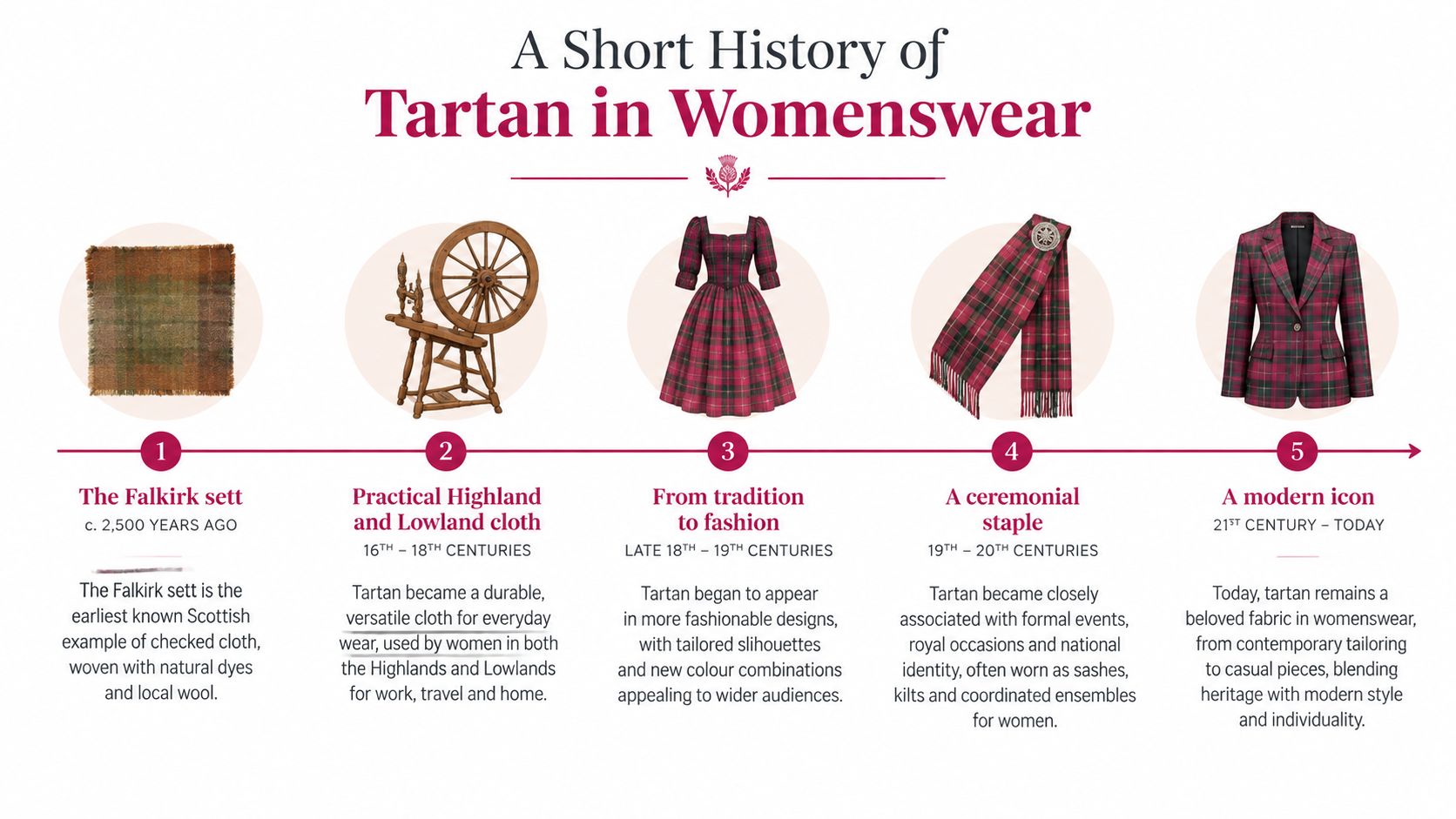
Tartan was worn across the Highlands and Lowlands. Women weren't merely spectators to its history: they helped produce the cloth and wore it themselves.
The post-Jacobite proscription of Highland dress didn't apply to women, allowing female wearers to continue using tartan while men faced legal restrictions. By the nineteenth century, women's tartan clothing had expanded into dresses, bodices, shawls and sashes influenced by European fashion, alongside looser forms of dress.
That history helps explain why a tartan dress needn't imitate a man's Highland outfit to have cultural meaning. Women's use of the cloth has its own continuity, encompassing practical clothing, fashionable tailoring and ceremonial expression.
Wearing tartan as womenswear isn't a modern departure from an exclusively male tradition.
For a first-time buyer, the useful distinction is between heritage, garment construction and dress convention. They overlap, but they aren't identical. A contemporary jacket can use historically meaningful cloth without becoming formal Highlandwear, and an elegant shawl can express a connection to Scotland without reproducing an entire historical outfit.
Start with the silhouette you enjoy wearing already. If you're comfortable in fitted trousers, trews may be a better introduction than a pleated garment. If you prefer dresses, don't assume a kilt is necessary just because the occasion is Scottish.
A kilt has a structured waistband, a front apron and pleats. When comparing fuller and lighter constructions, ask to see the back and side views: cloth quantity alone won't tell you how the finished garment sits on your body.
Trews offer a trouser silhouette. Pay attention to the rise, thigh room and how the waistband behaves when seated. Don't automatically add a sporran or belt to either garment; establish whether it belongs with the outfit you're building.
A kilted skirt borrows elements of kilt styling, while “tartan skirt” is a broader description that can include straight, flared, wrap and pleated shapes. A wool tartan skirt is worth considering if you want a standalone piece rather than a complete Highlandwear outfit.
Pleat placement deserves a close look. Ask whether the pleats are stitched down over the upper hip, where they release and whether they remain closed when you stand naturally. For a large-scale sett, request a full-length photograph rather than judging the pattern from a small swatch.
A sash adds a narrow sweep of tartan; a shawl gives broader coverage. If you're considering a fly plaid, ask how it will be secured and whether it suits the event's dress expectations.
Dresses, bodices and skirt-suits offer coordinated alternatives. Check shoulder movement and seated comfort, especially where the bodice is fitted. With jackets and waistcoats, try the intended blouse or knitwear underneath before deciding on size.
Ladies Tartan Garments at a Glance
These are shopping comparisons, not fixed dress-code rules. Warmth depends on the actual fabric and lining.
| Garment | Best For | Formality | Warmth | Movement |
|---|---|---|---|---|
| Kilt | Structured occasion outfits | Depends on accompanying pieces | Check weight and lining | Test apron and pleats seated |
| Trews | Tailored trouser outfits | Smart to ceremonial | Fabric-dependent | Check rise and thigh room |
| Tartan skirt | Everyday and adaptable dressing | Casual to occasion | Varies widely | Depends on cut and hem |
| Dress or skirt-suit | Coordinated event dressing | Smart to formal | Check sleeves and lining | Test shoulders and stride |
| Sash or shawl | Adding tartan to plain clothing | Styling-dependent | Coverage-dependent | Check fastening security |
| Jacket or waistcoat | Tailored layering | Smart to ceremonial | Layer-dependent | Check arm and chest room |
A size label is only the beginning. Body measurements and garment measurements aren't interchangeable, so ask which the supplier's chart shows before comparing it with your tape measure.
Stand naturally, keep the tape level and hold it comfortably against your body. Don't pull it tight to achieve a preferred size. If someone can help, they can check that the tape hasn't slipped at the back.
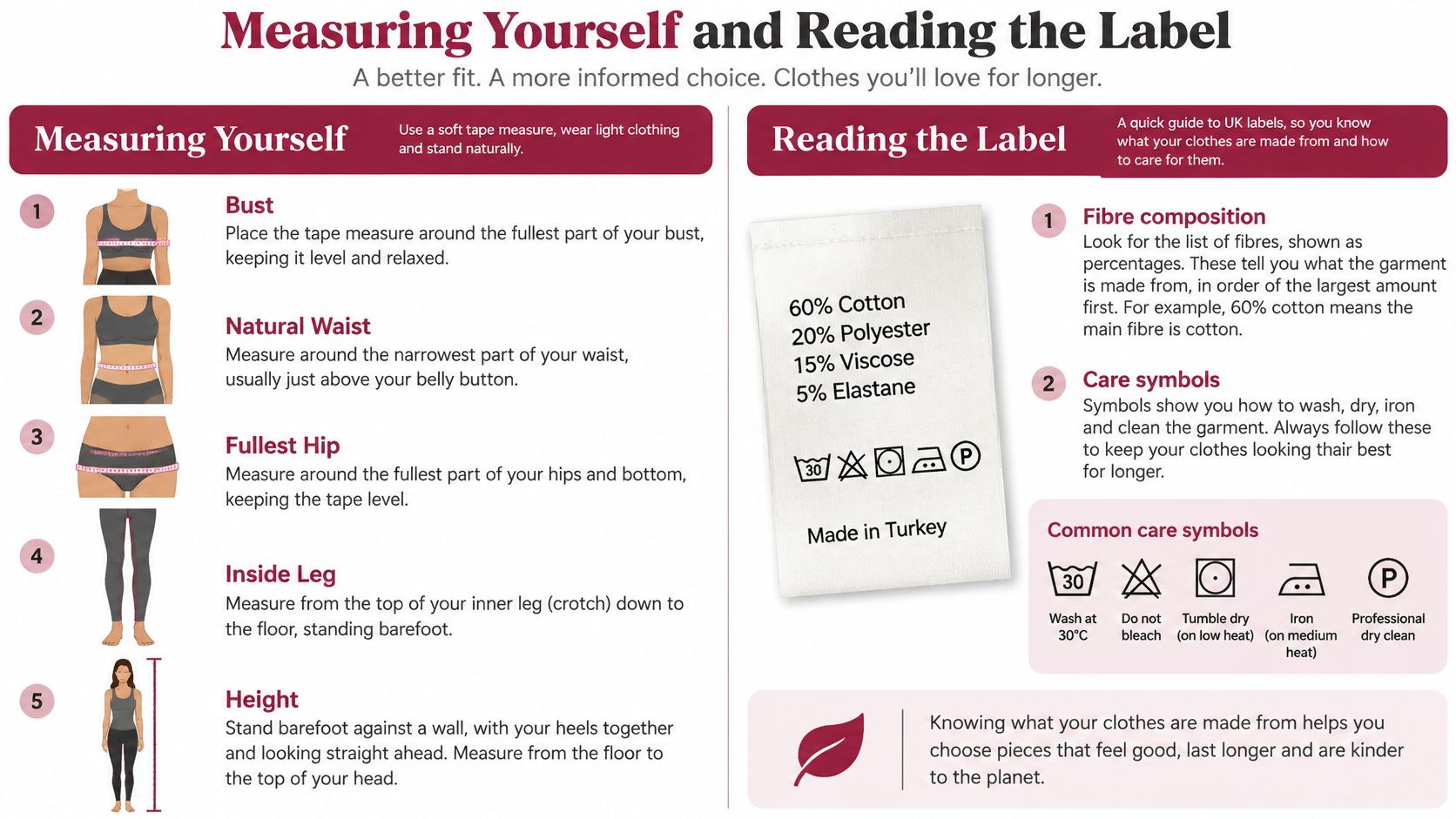
Check proportion as well as circumference. A waistband can fit while the skirt pulls across the hips, and trews can fit around the seat while feeling uncomfortable through the rise. Ask about room for a blouse, petticoat or base layer rather than adding an unexplained allowance yourself.
The UK Textile Products (Labelling and Fibre Composition) Regulations 2012 require named fibres and their percentages in descending order, with different-composition components identified separately, as explained in UKFT's textile labelling guidance. “Traditional tartan” isn't a substitute for that information.
Wool generally offers thermal buffering and moisture management; synthetic or regenerated fibres can offer advantages in cost, stability or care. However, composition doesn't automatically establish washability. Compare the actual care instructions, lining and construction too, and check for animal-derived components such as leather straps.
Before ordering, use this short workflow:
The best purchasing route depends on what you'll wear again, how closely standard sizing matches you and when the outfit is needed. Compare the complete commitment, including alterations, cleaning and accessories, rather than the garment price alone.
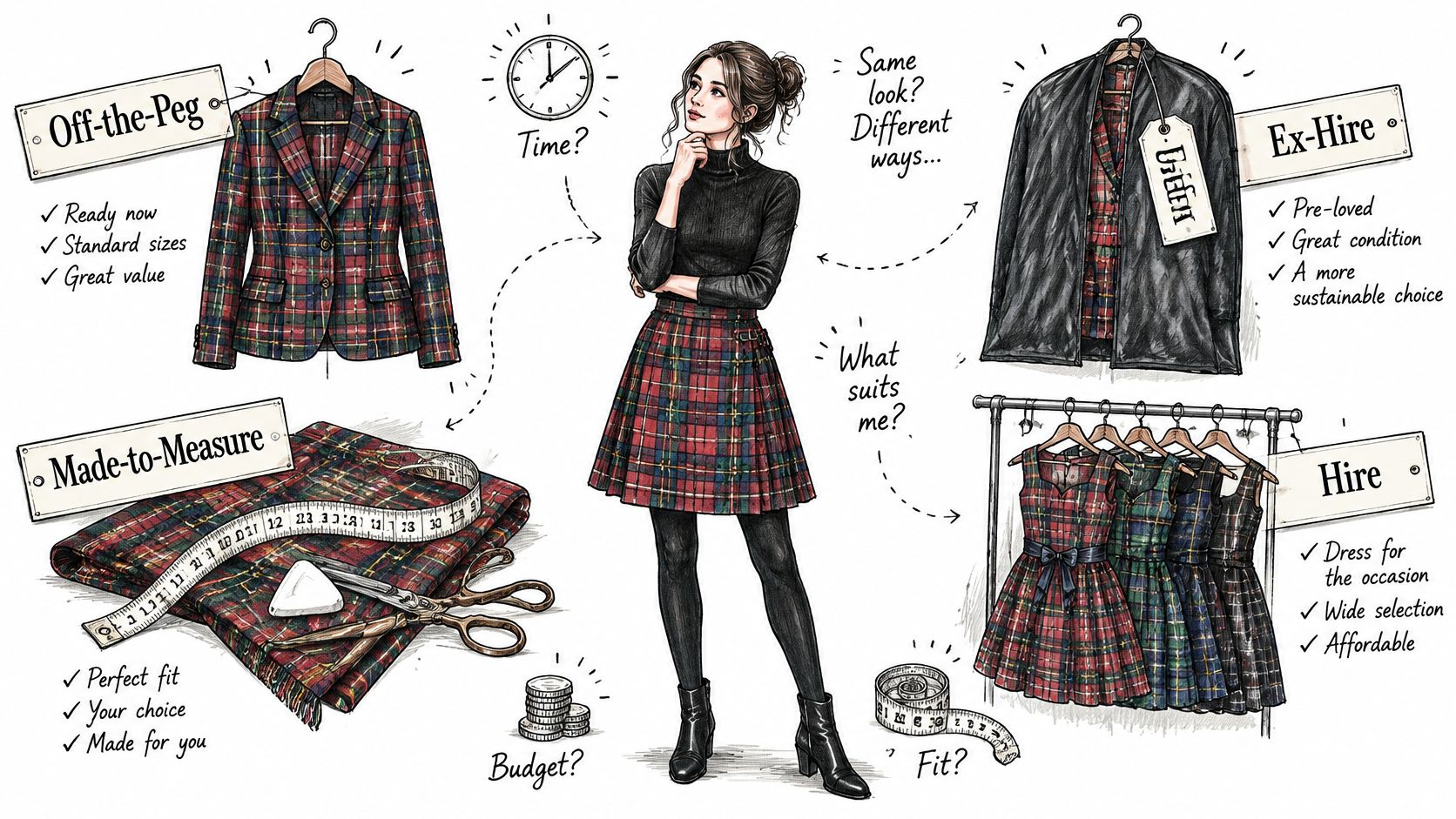
| Route | Cost question | Timing question | Fit question |
|---|---|---|---|
| Off-the-peg | Will alterations change its value? | Is your size physically in stock? | Does the whole size chart suit you? |
| Made-to-measure | Will repeat wear justify the commitment? | What is the confirmed completion date? | Which dimensions and details are adjustable? |
| Ex-hire | Does condition justify the price? | Can the actual garment be inspected? | Has it already been altered? |
| Hire | What does the package include? | When are collection and return due? | Can you try the correct size beforehand? |
Off-the-peg is a sensible starting point when the available cut already works. It's less convincing if you're planning to reconstruct the waist, reshape the hips and change the length immediately. Ask an alterations specialist to assess feasibility before buying, not afterwards.
Made-to-measure deserves consideration when standard proportions repeatedly fail you, or when a specific tartan or finished length matters. Be candid about the scope: made-to-measure doesn't necessarily include a toile, repeated fittings or unlimited changes. Get the process, measurement responsibilities and adjustment arrangements confirmed.
Ex-hire can suit a buyer who values a usable heritage outfit over untouched condition. Request photographs of the actual item, including the waistband, fastening points, hem and lining. Ask whether visible wear or previous alterations are included in the description.
Hire makes sense when you need an outfit for a single ceremony and don't expect to reuse it. Availability of women's cuts and individual pieces needs checking; don't assume every hire range includes every garment.
A purchase isn't economical simply because its initial price is low. It needs to fit, arrive in time and suit a realistic future use.
Whichever route you choose, confirm the terms for that particular order. Personalised garments, hire bookings and ready-made stock may have different cancellation, alteration and return arrangements.
Use the occasion's expectations first, then choose how prominent you want the tartan to be. A bold, high-contrast sett can become the focus of an outfit; a quieter colour combination is easier to pair with clothes you already own. Neither automatically determines formality.
For a wedding, try a tartan skirt with a plain blouse, a neatly fitted jacket and shoes you can stand in comfortably. Pick a supporting colour from the cloth rather than trying to reproduce every shade in the accessories.
If the invitation calls for formal Highlandwear, ask about the expected outfit before choosing a sash, fly plaid or brooch. Don't assume there's a universal sash-placement rule for every woman and every event. Check any role-specific or organiser-specific expectations.
For celebrations spanning different traditions, practical event information can help with clothing decisions. Premier Marquee Hire's Mehndi marquee hire tips are a useful planning resource when a Mehndi celebration forms part of the wedding schedule; ask the hosts separately about dress, footwear and the setting.
Build combinations around the level of polish you need:
If you'd rather wear plain clothing, tartan hair accessories offer a smaller accent. They're also a useful alternative when a full tartan garment would compete with an already detailed outfit.
My styling recommendation is to repeat a colour, not every traditional accessory. A blouse and shoes that work with the tartan will usually do more for a coherent outfit than adding a belt, brooch and scarf just because each is available.
Tartan doesn't have to stay in the autumn wardrobe. Recent UK fashion coverage reported a 25% rise in searches for “tartan skirt”, while the forecast cited there projected a 12% increase in tartan and check visibility in womenswear during 2026, according to Vogue's tartan skirt reporting. That's trend context, not a reason to buy cloth that feels wrong for your climate.
For spring, try a skirt with a plain shirt and a removable cardigan. For summer, ask about lighter fabric, lining and ease before ordering; a small check can create a quieter visual effect, but it doesn't make a heavy garment cooler.
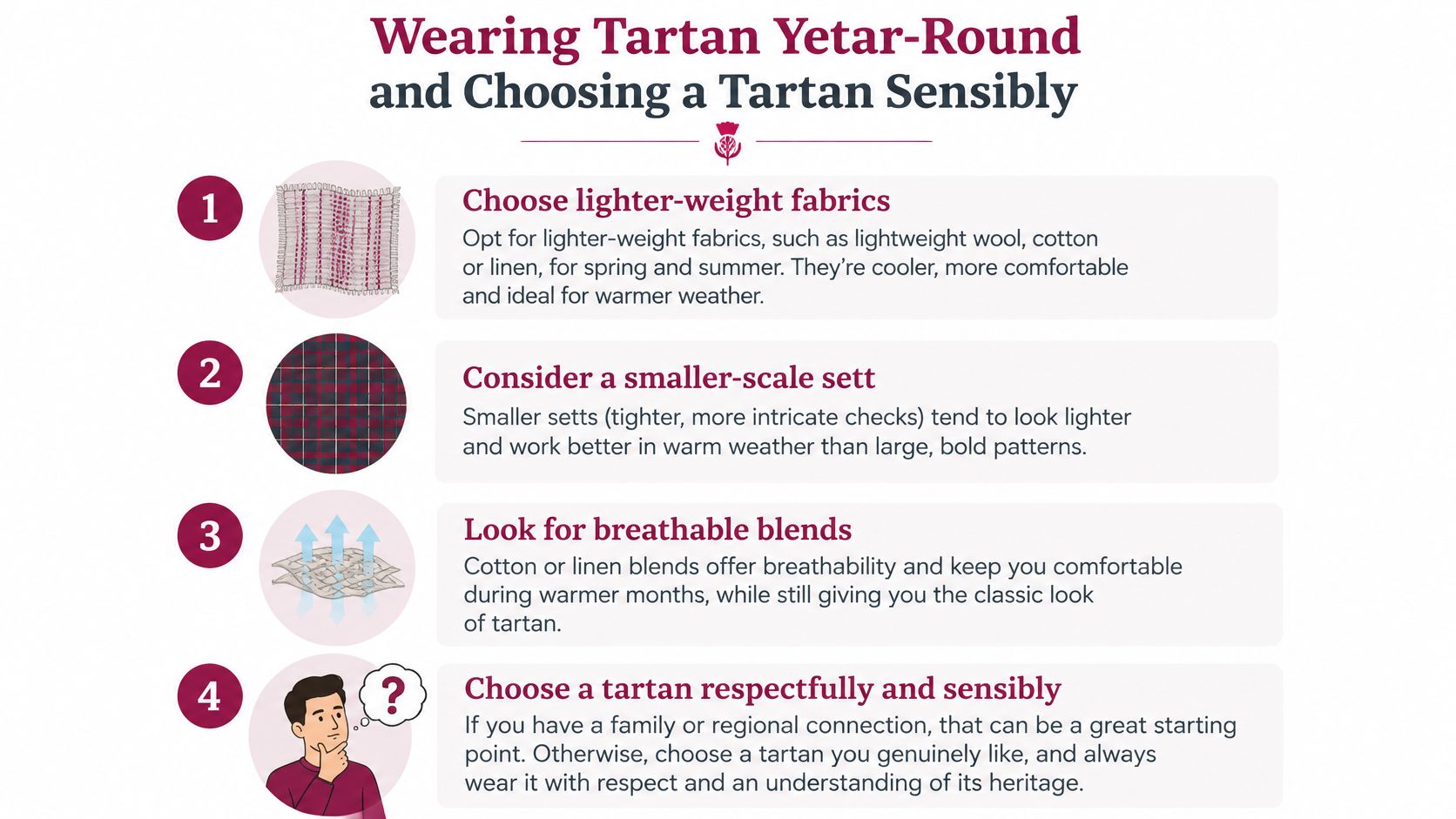
You might choose tartan because of family, place, an event or just its colours. Don't treat a surname match as the only possible starting point, but don't assume that every named design has unrestricted use either.
Use the description to establish what the association means:
For a Scottish wedding, the simplest respectful approach is to ask the couple whether they have a preferred tartan or coordinated dress plan. If not, explain what you're considering without claiming a family connection you haven't established.
Choose footwear for the actual setting. Loafers may suit an everyday skirt; ghillie brogues are an option when you're deliberately assembling Highlandwear, not a requirement for all tartan clothing.
For cooler evenings, a cashmere Scotland scarf offers an alternative to changing the main outfit. Treat it as a considered layer rather than another pattern you must coordinate into every look.
Follow the finished garment's care label, not a general rule about tartan. Don't assume all wool must receive identical treatment, or that every polyviscose garment can go into the washing machine. Linings, trims and construction can change the instructions.
Store garments clean, dry and supported, with pleats lying in their intended direction rather than crushed beneath other clothing. Before pressing, check the permitted treatment and use a specialist cleaner if you're uncertain.
Ask a tailor experienced with checked cloth to assess changes before cutting. A hem adjustment, waistband alteration or trouser-length change needs consideration of the visible pattern, not just the amount being removed.
Use this final check before committing:
Should I hire or buy? Hire is worth considering for an isolated event. Buy when you can identify repeat uses and the fit works beyond the first occasion.
Can I use the adult sizing approach for children? Use the child-specific garment chart and the supplier's instructions. Ask about safe length, fastening comfort and when to recheck measurements before the event.
What's the difference between a kilt and a kilted skirt? Compare construction rather than relying on the name. Ask about the apron, pleats, waistband, fastening and lining, because those details determine what you're buying.
Kilts4Less offers off-the-peg and made-to-measure Highlandwear, accessories, ex-hire options and hire services for weddings and ceremonies. Visit Kilts4Less with your measurements, event date and preferred tartan to discuss available garments and choose a practical route to the right outfit.

Kilts4Less is Scotland’s best bespoke, handmade kilt and highlandwear company since 1983.
Specialists in made-to-order handmade kilts, kilt jackets, sporrans & also Scottish, Irish / American Tartan Hybrids. Don’t settle for cheap alternatives – Buy Online at Kilts4Less – sale is now on!
Easy 30 days returns
30 days money back guarantee
100% Secure Checkout
PayPal / MasterCard / Visa