
You've found a waistcoat for a wedding, checked your jacket label and picked what looks like the matching size. Then you try it on: the chest sits neatly, but the buttons pull across your stomach. Going up a size solves that problem and leaves the shoulders looking loose.
That's the key sizing decision. This waistcoat sizing guide starts with chest and waist together, then helps you decide whether a standard garment, an ex-hire find or made-to-measure is the sensible route.
The reference bands and waist pairings below come from FashionCapital's metric sizing guide: Small is approximately 92–96 cm chest, Medium 100–104 cm, Large 108–112 cm and XL 116–120 cm, with a 100 cm chest paired with an 83 cm natural waist and an 86 cm trouser waist measured 4 cm lower.
| Size | Chest (cm) | Natural waist (cm) | Trouser waist, 4 cm lower (cm) |
|---|---|---|---|
| Small | 92–96 | Not published; check retailer's body chart | Not published; check retailer's body chart |
| Medium | 100–104 | 83, paired with 100 cm chest | 86, paired with 100 cm chest |
| Large | 108–112 | Not published; check retailer's body chart | Not published; check retailer's body chart |
| XL | 116–120 | Not published; check retailer's body chart | Not published; check retailer's body chart |
Read a row as a starting point for the body the garment is intended to fit, not the circumference of the finished waistcoat. The waist pairing shown within Medium belongs to the stated chest reference, not automatically to everyone within that band.
Don't fill the missing waist cells by guessing. A neat progression would look useful, but it could steer someone with a fuller stomach into a garment that won't fasten.
The British sizing approach identifies the intended wearer's body dimensions rather than making Small, Medium and Large universal across shops. A Large jacket therefore doesn't guarantee that a Large waistcoat will fit, even when both labels sound equivalent.
Chest and waist also vary independently. Men with the same chest measurement can need different cuts through the middle, particularly when a fitted waistcoat has little scope for adjustment.
For comparison when shopping across clothing brands, the California Cowboy size guide is a useful brand-specific reference. Keep each retailer's sizing instructions with its own garments rather than transferring a label from another wardrobe item.
Starting rule: Find your chest band, then confirm that the retailer's waist allowance accommodates you. Neither measurement cancels out the other.
Look for wording that distinguishes body measurements from finished garment measurements. If the page only says chest, establish which it means before comparing it with your tape reading.
Also check whether the chart belongs to that particular waistcoat or to a broad clothing range. A close-cut formal waistcoat and a relaxed casual style aren't interchangeable fitting propositions.
If your reading sits at a boundary, repeat the measurement before deciding. Don't round down because you prefer the smaller label, and don't assume a back strap will create extra room.
Record chest, natural waist and back length in centimetres over the shirt and base layer you'll wear. Use a flexible dressmaker's tape, a mirror and, preferably, someone who can check the tape across your back.
The BSI body-measurement standard provides the anthropometric basis for clothing measurements. Keep these body readings separate from any measurements taken from a waistcoat laid flat.
Use this visual as a placement reminder while you measure.
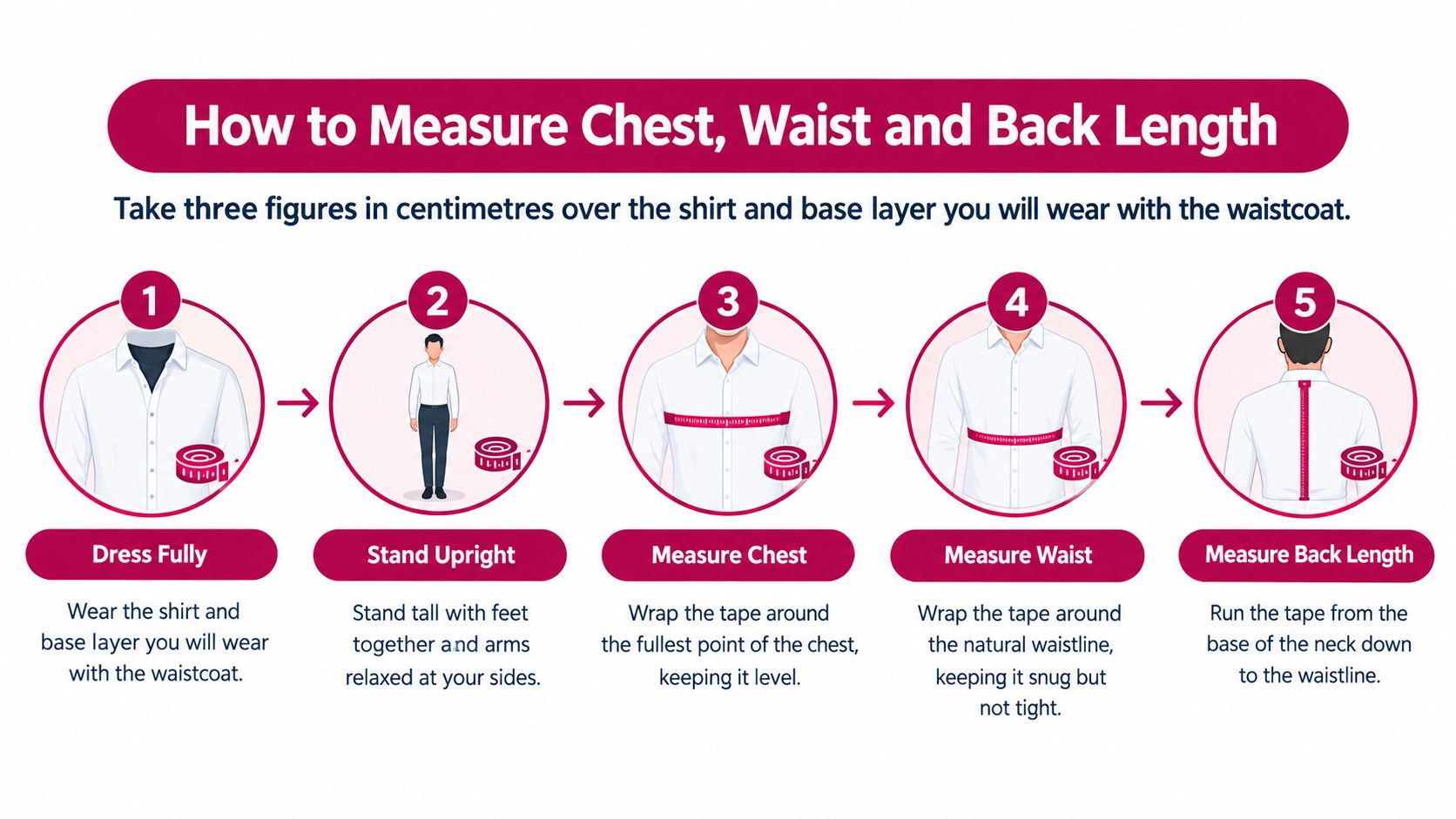
Put on the intended shirt. Include any base layer you'll wear in practice. Leave the jacket off, since its padding and bulk would distort the reading.
Stand naturally. Keep your feet together, arms relaxed and weight balanced. Don't adopt a chest-out photograph pose or pull your abdomen in.
Measure the chest. Pass the tape under the armpits and around the fullest part of the chest. Check that it stays horizontal across the back, then read it after a normal breath rather than a deep inhalation.
Find the natural waist. Place the tape around the narrowest part of the torso, comfortably close without compressing the body. Don't substitute the waistband size printed inside your trousers.
Measure the back length. Start at the prominent bone at the base of the neck and measure down to the intended hem. Wear your trousers or kilt at the intended height so the endpoint reflects the outfit.
Repeat and record. Remove and reposition the tape, then measure again. If the readings disagree, check placement and posture until you have a consistent result; use the larger consistent reading rather than the smallest result you can obtain.
Keep the original metric readings even if the retailer asks for inches. Convert afterwards, label the units clearly and avoid rounding early.
A diagonal tape can add apparent circumference without measuring the correct level. Twisting to read the tape can also change your posture, which is why a helper is particularly useful for back length.
The waist reading deserves care because a garment can sit comfortably across the chest yet strain at the fastening. If your stomach projects beyond the natural waist, record that fuller circumference separately and explain where you took it.
For Highlandwear, establish the kilt's position before judging waistcoat length. Our guide to measuring yourself for a kilt helps with that setup; we also provide how-to video tutorials covering kilt measurement, putting on a kilt, tying ghillie brogues and wearing a sporran.
Finish the try-on with these pass checks:
Use the chest to establish a starting size, then let waist closure decide whether that size is viable. Chest fit matters for the upper body, but you shouldn't accept tight buttons just because the chest label matches.
Matching your jacket size only works when the waistcoat's proportions also suit you. Its cut, front shaping and adjustment range may differ from the jacket you already own.
Say your chest falls comfortably within a retailer's size band, but your natural waist belongs in the next band up. Try the chest size only if the finished dimensions suggest enough room through the middle; otherwise, start with the larger size and assess the shoulders carefully.
The aim isn't to prioritise the larger label automatically. It's to accommodate the measurement that prevents comfortable wear without creating a different structural problem.
| Measurement pattern | Size to try first | Check at the try-on | If it fails |
|---|---|---|---|
| Chest and waist in the same band | That band | Button closure and armhole clearance | Re-measure, then check the chart boundary |
| Waist in a larger band than chest | Chest band, if finished waist dimensions allow | Button strain and available adjustment | Made-to-measure, or the next size up if buttons pull |
| Chest in a larger band than waist | Chest band | Gaping at the waist and back strap position | Have a tailor assess taking in the side seams |
| Chest or waist between bands | Larger band | Shoulder position and armhole pull | Made-to-measure for a more precise fit |
| Prominent stomach or sloping shoulders | Made-to-measure consultation | Hem balance, armholes and front closure | Request a pattern adjustment before cutting |
The Charles Tyrwhitt sizing guide gives an example of a size 42 waistcoat intended for a 42-inch body chest, with a 45-inch finished chest. That difference is wearing ease, not an instruction to choose a smaller body-size label.
Compare the product's finished dimensions with your shirt-layer measurements. Don't apply a universal ease allowance: lining, fabric and cut affect how usable that space feels.
A back adjuster takes excess fabric in. It doesn't add fabric to a waistcoat that's already tight.
At the fitting, look for diagonal lines radiating from the buttons. Then raise your arms naturally and reach forwards; some movement is normal, but the waistcoat shouldn't drag sharply upwards or bind.
Finally, inspect the adjuster rather than assuming it can solve any looseness. Heavy bunching at the back means you're asking it to do more than tidy the fit.
Our guide to wearing a waistcoat helps you judge its position within the complete outfit. If accommodating the stomach leaves the upper body loose, or shoulder slope prevents the front hanging level, consider made-to-measure before paying for extensive alterations.
Off-the-peg is a practical starting point for standard proportions. Ex-hire can suit a restricted budget or an occasional event, while made-to-measure is more useful when your shape repeatedly defeats standard cuts.
Compare the routes by what can actually be adjusted, not just by the label attached to them.
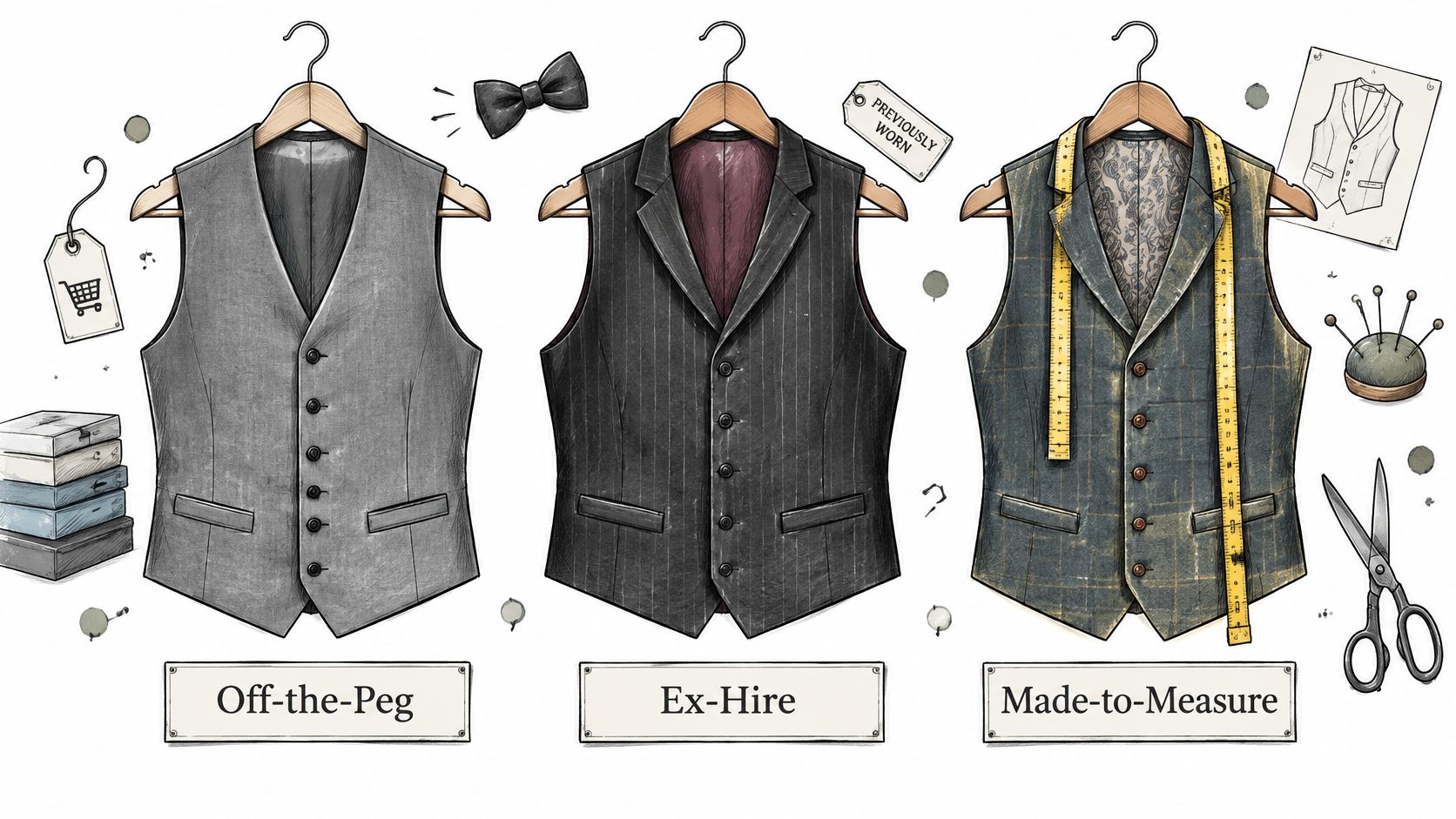
| Route | What you match | How fit is adjusted | Best for |
|---|---|---|---|
| Off-the-peg | Chest and waist against the labelled body-size chart | Fixed cut, with an adjustable back where fitted | Standard builds without a large mismatch between chest and waist bands |
| Ex-hire | The individual garment's finished measurements against your body figures | Limited by construction and available stock; sizes differ by item | Budget buys and occasional events |
| Made-to-measure | Submitted body measurements, shirt layer and posture notes | The cut is adapted to your figures before making | Awkward proportions, a prominent stomach or sloping shoulders |
For standard garments, match your body to the chart, then examine finished measurements where available. The BSI guide to clothing measurements and intervals supports body-based size designation and flexible intervals; identical ease between brands isn't guaranteed.
When browsing off-the-peg jackets and waistcoats, judge the complete combination rather than assuming both pieces will need the same adjustment. A tidy waist alteration may be worthwhile, but extensive changes can undermine the reason for buying ready-made.
With ex-hire, assess the actual item. Ask about previous alterations, available seam allowance and condition around buttonholes, seams and lining before relying on future adjustment.
For made-to-measure, submit body figures rather than copying a favourite garment's dimensions. Include height, intended shirt layer and posture details, especially sloping shoulders or a tendency for the front hem to rise.
Use the fitting guidance alongside a visual demonstration.
A group order needs a record for each wearer, not a list of jacket labels. Include:
We offer a personal service to guide customers through their kilt buying journey. Use that conversation to coordinate the waistcoat with the rest of the outfit rather than making isolated sizing decisions.
For standard proportions and an occasional event, off-the-peg is usually straightforward. Choose ex-hire when budget matters and the individual garment passes the fitting checks; choose made-to-measure when a standard cut cannot accommodate both your upper body and middle.
A child tries on a waistcoat for a wedding and it looks immaculate while standing. By collection, the front is snug, and sitting down makes the buttons pull. The original measurement wasn't necessarily wrong; the wearer has changed.
A teenager between sizes presents a different trade-off. Buying the smallest neat fit leaves little room for growth, but buying oversized shoulders produces a garment that never sits properly.
A slightly roomy waistcoat with an adjustable back can be the more forgiving choice for a growing wearer. The shoulders and armholes must still sit correctly; extra body room shouldn't mean the whole garment hangs down.
The Little Mistress waistcoat fit guidance notes that cut, fabric and lining affect fit and advises measuring naturally without pulling the tape tight. Although it concerns womenswear, that measurement principle is useful when checking a changing body rather than relying on an old label.
For adults, don't assume a previous waistcoat remains a reliable template. A changed waist can alter how the front hangs even when the chest still feels familiar.
Fit the person who'll wear the waistcoat on the day, not the measurements saved with an earlier order.
Measure when ordering and again shortly before collection, using the same shirt layer. For a wedding party, agree who'll collect updated readings so changes don't get lost in separate messages.
Then have each wearer sit, lean forwards and move with the planned jacket on. Check comfort as well as appearance, without asking them to hold their stomach in.
Watch for:
Use measurements taken at ordering, not numbers recorded for an earlier waistcoat. If the wearer changes afterwards, update the fitting decision rather than forcing the original size to work.
Choose a buying route only when you know what needs adjusting. A standard waistcoat with a manageable waist alteration is a different purchase from one that needs its shoulders, front balance and length rebuilt.
Keep a written measurement record beside the product page. It's easier to spot a unit error or an unresolved waist conflict there than after checkout.
Use this checklist before making the final choice.
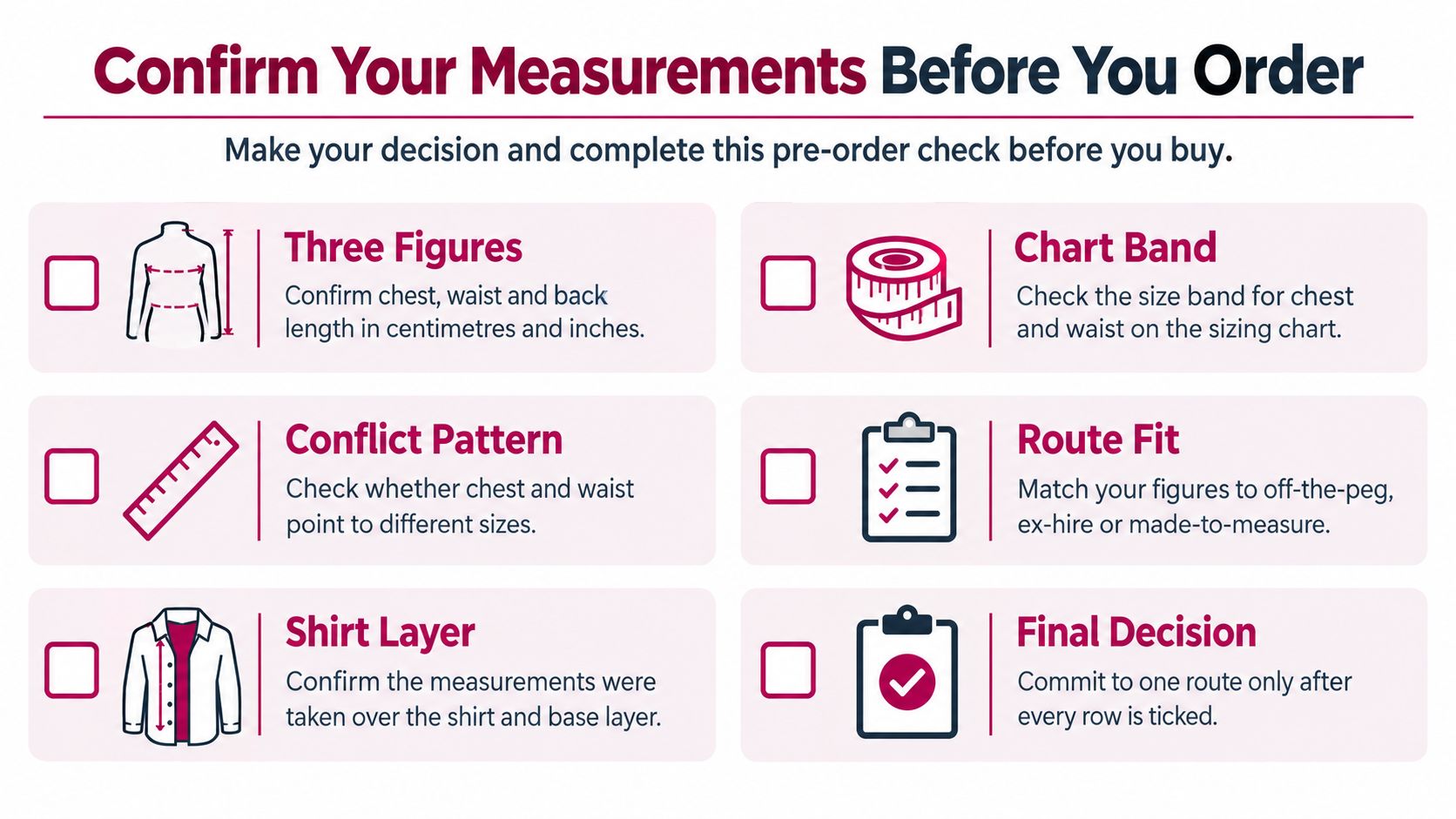
For graduation ceremonies, check dress requirements separately from garment fit. The academic regalia color guide from Grad Store is a useful reference for coordinating regalia colour and fabric choices.
Our UK delivery charge for the Jackets and Waistcoats category is £8.00; the EU and worldwide charge is £40.00. Check the returns policy and the conditions applicable to your chosen garment before treating a return as a fallback, particularly for made-to-measure work.
Use our personal service to review uncertain measurements before ordering, especially for a group. If chest and waist sit in different bands, don't order on chest alone; arrange a check with our personal service first.
Kilts4Less offers jackets and waistcoats alongside kilts, sporrans and shirts, with personal guidance to help coordinate your Highlandwear. Visit Kilts4Less with your chest, waist and back-length measurements to discuss a suitable route before placing your order.

Kilts4Less is Scotland’s best bespoke, handmade kilt and highlandwear company since 1983.
Specialists in made-to-order handmade kilts, kilt jackets, sporrans & also Scottish, Irish / American Tartan Hybrids. Don’t settle for cheap alternatives – Buy Online at Kilts4Less – sale is now on!
Easy 30 days returns
30 days money back guarantee
100% Secure Checkout
PayPal / MasterCard / Visa