
You've found a tartan pleated skirt for a wedding, an office day or a child's outfit, and the colour looks right. Then you look closer: is it a kilt, a kilt-style skirt or a checked skirt with folds? Before you order, turn your attention from the photograph to the waistband, the point where the pleats open and the care label. Those details will decide whether you enjoy wearing it.
A short tartan skirt isn't automatically a shortened kilt. The cloth may look familiar, but a fashion skirt and a garment intended for Highland dress can have different construction, proportions and purposes. There's nothing wrong with either, provided you buy the one that suits your occasion.
For a wedding guest, that might mean a structured kilt-style skirt. For someone who wants tartan with a jumper and boots, a lighter fashion cut may be the better purchase. Authenticity isn't a substitute for suitability.
Tartan's cultural meaning comes from a long, changing history. Its roots include medieval Gaelic display culture; after the 1707 Act of Union, it became associated with anti-Union and pro-Jacobite sentiment. Following Culloden in 1746, restrictions on wearing tartan formed part of the suppression of Highland culture, although loyal Highland military regiments could continue wearing it.
The revival included Sir Walter Scott's Edinburgh tartan pageant for George IV in 1822. The creation of the Scottish Register of Tartans in 2009 added an institutional framework for recording patterns. These milestones are described in National Museums Scotland's account of tartan.
That history helps explain why the same cloth can serve as everyday clothing, ceremonial dress and an expression of Scottish identity. Those roles overlap, but they aren't interchangeable.
Start with what you need the garment to do, rather than whether the label uses the word traditional.
A fashion skirt isn't an inferior kilt. It's a different garment, and sometimes it's exactly the right one.
Ask to see the back as well as the front. That's where the pleating gives you a clearer picture of what you're buying.
Turn the garment round on the hanger. Look at the folds, the repeated stripes and the point where the stitching stops. A front photograph can hide much of the construction that determines how a tartan pleated skirt moves.
Earlier Highland kilts were often pleated by hand and secured with a belt. Surviving examples from approximately 1790 to 1830 show garments sewn to shape and fastened with ribbons and buttons; evenly sewn pleats were emerging by around 1820, according to National Museums Scotland's Georgian kilt collection.
A MacGregor tartan kilt in that collection was pleated to sett. The maker deliberately recreated the tartan pattern across the back pleats instead of letting the stripes fall wherever the folds happened to land.
The comparison below gives you a starting point for examining the back of a garment.
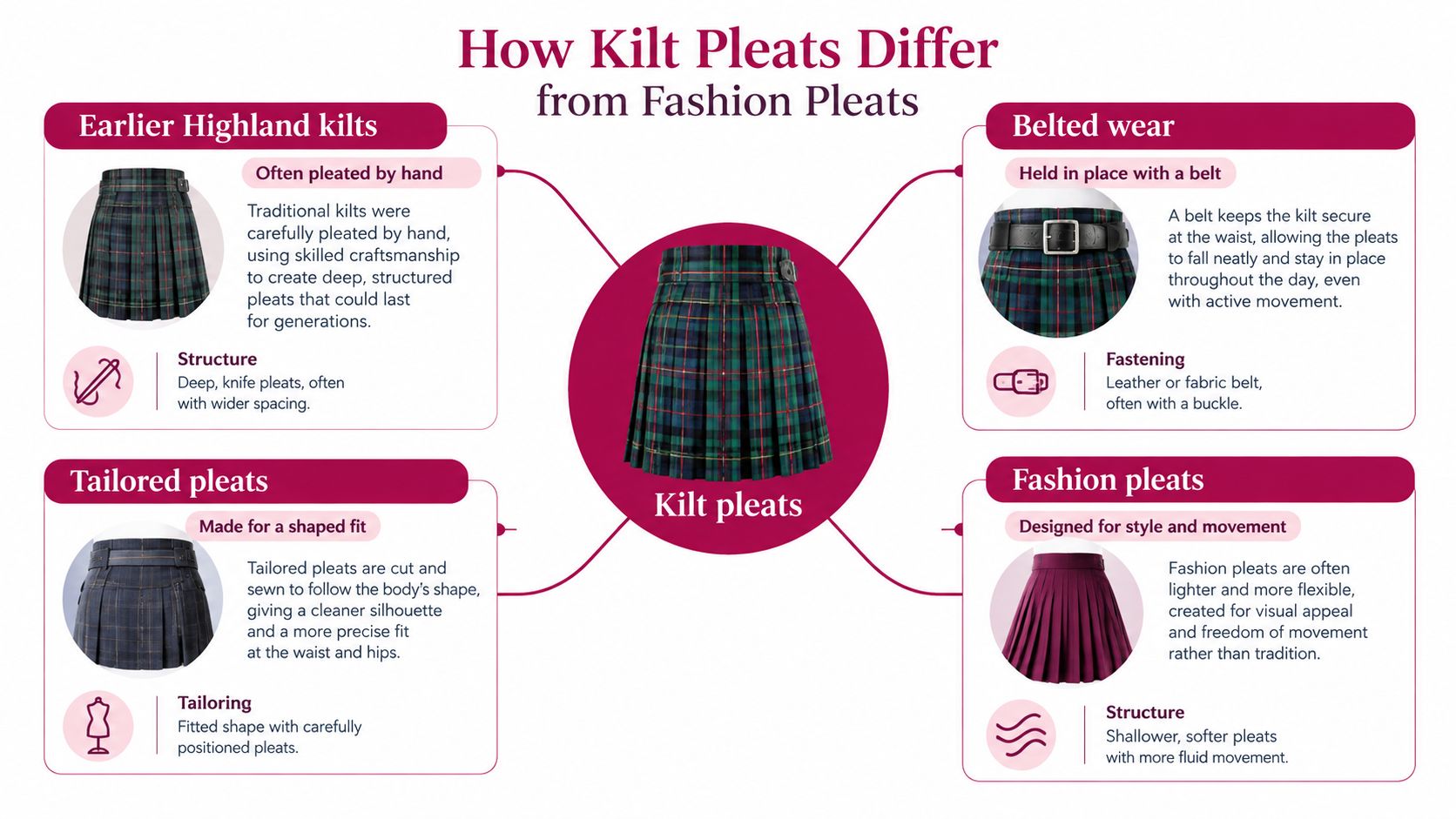
A sett is the measured sequence and width of the tartan's stripes, normally arranged symmetrically around a central pivot, as explained in National Records of Scotland's guide to tartan. Think of it as the pattern's repeating unit, not just its colour combination.
Knife pleats fold in the same direction. Their spacing determines which parts of that repeating pattern remain visible and which disappear inside the folds. If the maker hasn't planned the alignment, stripes can appear interrupted at seams or across the pleated area.
A traditional kilt-style skirt may combine an overlapping apron front with deeper pleats behind. A fashion skirt may use shallower folds, lighter cloth or pleats arranged all round. Neither description guarantees quality, so examine the actual garment rather than relying on its name.
Ask the seller these questions:
Stitched-down pleats constrain the folds rather than relying on pressing alone, which is useful for frequent sitting and schoolwear. But stitched down doesn't mean stitched shut from waist to hem. The lower pleats still need room to open.
Pattern continuity and controlled movement matter more than the check alone.
A skirt can fasten comfortably at the waist and still be the wrong fit. If the pleats pull open across the hips while you're standing, or the hem obstructs your stride, choosing a different size may not solve the underlying cut.
UK clothing sizes don't follow a single universal standard, so use the garment's measurements rather than treating your usual size as a guarantee. This discussion of UK fashion sizing explains why labels alone can be an unreliable starting point.
Take measurements over the underwear or light clothing you expect to wear underneath. Keep the tape level and comfortably close, not pulled tight.
For a traditional garment, use the retailer's kilt measuring guidance rather than transferring measurements from a low-rise fashion skirt.
A fixed waistband gives a defined fit but little tolerance for measurement error. Elastic can accommodate changes more readily, while a tie waist offers adjustment without guaranteeing that the hips or pleats will fit. For an office day or wedding meal, test the waistband sitting down as well as standing.
| Feature | Kilt-style | Fashion tartan pleated skirt |
|---|---|---|
| Waist | Often a defined, structured fit with adjustable fastening | May be fixed, elasticated or tied |
| Typical length role | Chosen in relation to traditional proportions and occasion | Chosen for the wearer's preferred hem and daily use |
| Pleat behaviour | Deeper folds behind an apron can provide controlled swing | Shallower or all-round pleats can give a lighter silhouette |
| Best use | Highlandwear-inspired or ceremonial dressing | Office, casual, school or trend-led outfits |
Pleat release is where the stitched upper section ends and the folds become free to open. If that point sits awkwardly against your fullest hip, the skirt may spread where you want it to lie smoothly.
Knife pleats introduce visual volume, and a large tartan repeat can make that volume more noticeable. Neither is a reason to avoid them. Compare the front, side and seated view rather than judging yourself against a product photograph.
There's no universally flattering midi. Choose the hem and pleat release together, then check your stride.
Petite, regular and tall labels are useful starting points, not verdicts. For children and wee man's outfits, check the child's actual proportions, fastening and walking clearance rather than assuming a scaled-down adult cut will work.
Dress for the occasion you're attending, not for every possible Scottish occasion at once. A fashion skirt doesn't need a full set of Highland accessories, and a formal kilt outfit deserves more thought than adding a jacket.
These outfits illustrate how differently a pleated tartan garment can be worn.
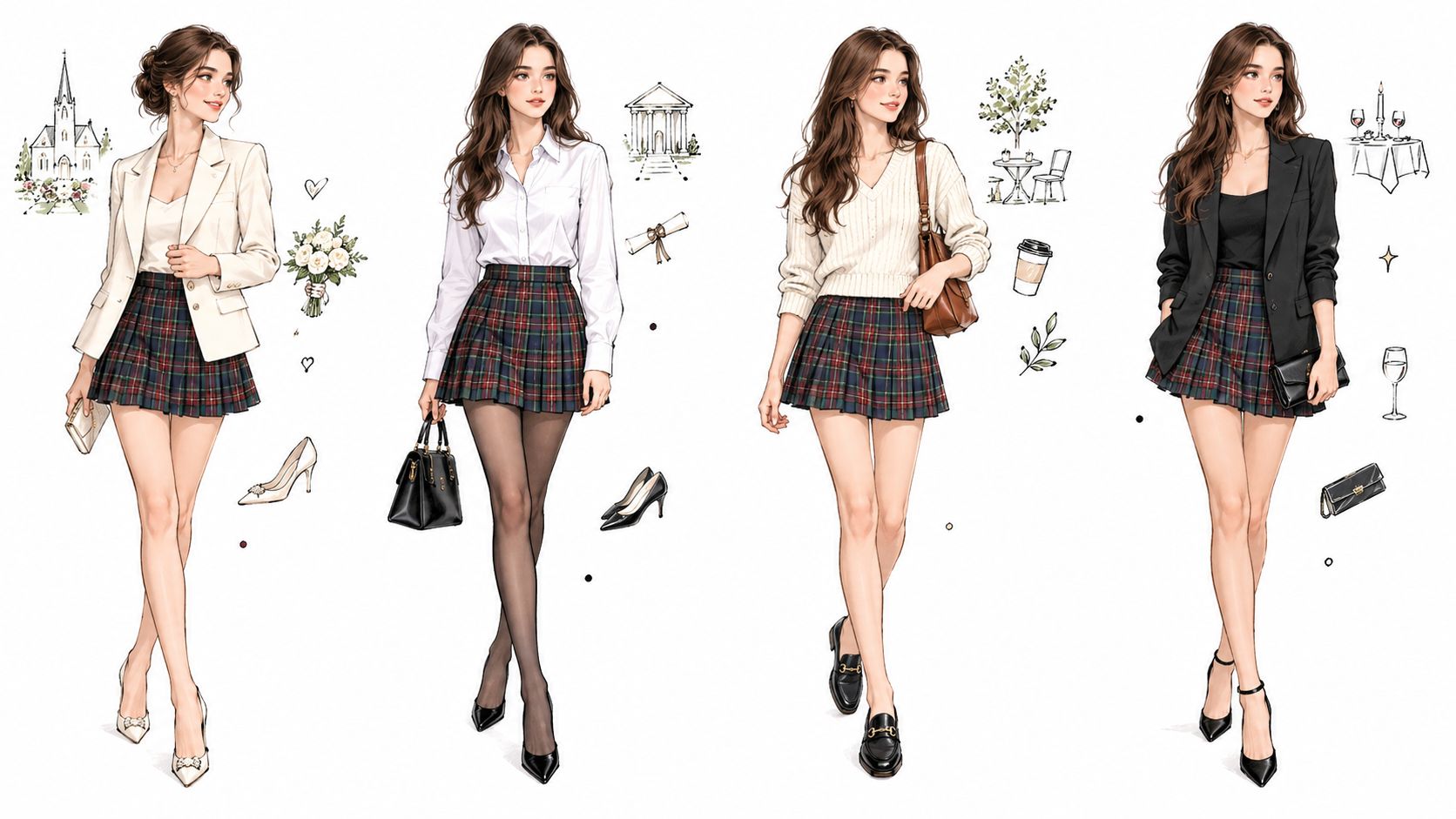
For a wedding, decide whether you're wearing full Highland dress or a skirt styled for a formal occasion. With a full kilt outfit, coordinate the jacket or waistcoat, hose, flashes, ghillie brogues and kilt pin, then choose a dress, semi-dress or day sporran appropriate to the outfit. A kilt-style skirt doesn't automatically require every one of those pieces.
Try the completed outfit sitting and walking. A sporran hanging awkwardly low can interfere with movement, and accessories shouldn't pin the apron or pleats into an uncomfortable position.
For the office, I'd favour a lighter skirt with a plain shirt or knit. A smaller sett can be easier to balance with a fitted top, while a knee-clearing or midi hem should be tested against your commute and chair. Watch where a cross-body bag rests: its strap or bag can obscure the pattern and bunch the cloth.
Before wearing unfamiliar Highland accessories, use a dressing demonstration to check the arrangement.
For football or rugby, choose the outfit around travel, standing and the weather forecast. A practical shorter skirt with a team layer may suit you better than ceremonial dress. Don't tighten a separate belt across the pleated area to hold everything in place.
For a child's outfit, keep the accessories proportionate and let the child walk, sit and bend before declaring the fit finished.
The best styling decision is often leaving something off. Comfortable, deliberate dressing looks better than an overloaded outfit.
The care label tells you something the fitting-room mirror can't: what owning the skirt will involve. Choose cloth for the frequency of wear, the setting and the cleaning routine you're prepared to follow.
UK schoolwear examples include 65% polyester and 35% viscose, while another listed specification uses 80% polyester and 20% viscose at 250 g/m². Polyester contributes abrasion resistance, crease recovery and lower moisture absorption; viscose adds softness and drape but needs more care around wet abrasion and dimensional change. These specifications and practical comparisons are reflected in the tartan schoolwear fabric and care information, which includes care guidance such as 40°C washing, inside-out washing, line drying and cool ironing.
That fabric weight can give a school or formal skirt useful structure without being equivalent to heavy kilt-weight wool. For prolonged indoor wear, that may be welcome; for outdoor warmth and a traditional natural-fibre drape, heavier wool may be preferable.
Use this checklist alongside, not instead of, the garment's own instructions.
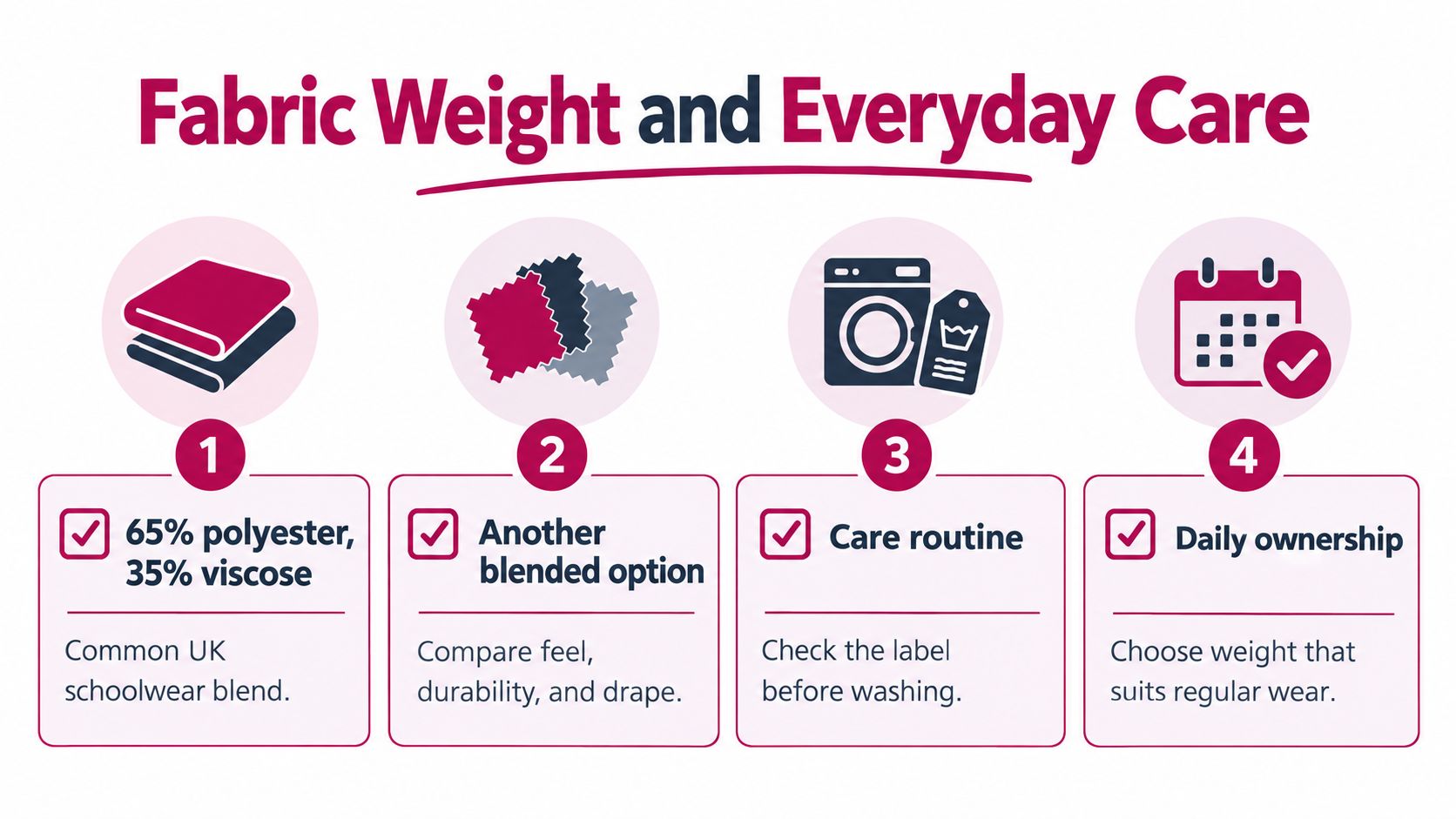
A washable polyester-viscose skirt is a sensible candidate for school, youth outfits and frequent use. Wool may suit someone who values warmth and traditional drape and is willing to air, spot-clean or arrange professional care as directed.
Neither fibre choice removes the need for careful handling.
Ownership rule: Buy the skirt whose care routine you'll follow, not the one whose ideal maintenance you'll keep postponing.
Environmental cost also includes how long you keep wearing it. UK clothing consumption contributes more than 5% of the country's annual carbon and water footprints; repair generally keeps a garment in use for at least another year, and extending clothing life can reduce its carbon, water and waste footprint by up to 20%, depending on the circumstances, according to Less Waste's wear, care and repair guidance.
A washable blend isn't automatically the lower-impact choice, nor is wool automatically better. Repeated wear, appropriate cleaning and repair are more useful purchasing tests than the cheapest ticket price.
Choose your buying route before choosing accessories. Someone dressing for repeated formal occasions has different needs from a wedding guest who wants an outfit for a single event. Likewise, an everyday tartan skirt shouldn't become a bespoke kilt purchase just because both use pleats.
The specialist storefront below is a starting point for comparing garment categories, not a reason to choose the most elaborate option.
Bespoke makes sense when you need a particular tartan, a carefully measured fit and a garment intended for continued use. Confirm the cloth, finished measurements, construction and delivery arrangements before committing. If you dislike wearing pleats, made-to-measure tartan trews may answer the brief better than a skirt you'll tolerate rather than enjoy.
Ready-made is worth considering when an available size fits and you want to assess a complete garment. Check the measurements and composition separately: off-the-peg describes the purchasing route, not whether the cloth is wool or polyviscose.
| Buying route | A sensible reason to choose it | What to establish before ordering |
|---|---|---|
| Bespoke | Particular fit and tartan requirements | Measurement method, specification and terms |
| Ready-made | An available garment meets your needs | Actual dimensions, stock and care |
| Ex-hire | You're comfortable buying a previously worn garment | Condition, fit and any alterations |
| Hire | You need formal clothing temporarily | Collection, return arrangements and included pieces |
Ex-hire can be a practical budget route, but judge the individual garment. Hire is useful when you want the formal outfit without taking on long-term storage and care.
If you want a coordinated daytime outfit rather than Highland dress, compare fashion garments on their own terms. Casual Chic Luxe's elegant two-piece skirt suit offers a useful fashion comparison: consider whether you want a matching set rather than a traditional kilt outfit, then assess its fit and product details independently.
You can also browse a dedicated ladies' tartan clothing selection to separate skirt options from full Highlandwear.
Before paying, ask about dispatch timing, international delivery where relevant, and the return conditions for your particular purchase. Don't assume bespoke, ready-made, ex-hire and hire transactions have interchangeable terms. A clear answer matters more than a reassuring slogan.
The right route is the one that meets your fit, occasion and ownership needs without adding work you don't want.
Write down the occasion, who'll wear the tartan pleated skirt and whether it's intended for occasional or repeated use. Add the date you need it in your hands, including time to try it with the rest of the outfit.
Keep that note beside you while shopping. It's easy to start with a practical requirement and finish comparing attractive tartans in garments that don't meet it.
Check these items against the product description or ask the retailer for anything missing.
For a formal event where fit must be exact, investigate made-to-measure or a properly fitted hire outfit. For school, youth, supporter or everyday use, start with suitable ready-made garments and check their care labels before purchase.
Send the retailer your measurements and explain the intended use in plain language. Saying that you'll be sitting through a ceremony, travelling to a match or buying for a growing child gives them more useful information than asking whether a skirt is flattering.
Ask them to identify the closest suitable route and explain any compromise. If a waistband fits but the proposed length doesn't, settle that before ordering rather than hoping the garment will look different at home.
When it arrives, keep the packaging and labels intact while you assess it under the seller's return conditions. Try it with the intended top and footwear, check the seated fit and compare the result with your written measurements. If something doesn't match, contact the retailer promptly rather than altering it first.
Your next action is straightforward: take your measurements and occasion note to a specialist, then ask for the garment or hire option that meets them.
Kilts4Less offers made-to-measure, off-the-peg, ex-hire and hire Highlandwear, with children's options and accessories for completing an outfit. Visit Kilts4Less with your waist, hip and preferred hem measurements to compare a traditional kilt route with the tartan skirt options that suit your occasion.

Kilts4Less is Scotland’s best bespoke, handmade kilt and highlandwear company since 1983.
Specialists in made-to-order handmade kilts, kilt jackets, sporrans & also Scottish, Irish / American Tartan Hybrids. Don’t settle for cheap alternatives – Buy Online at Kilts4Less – sale is now on!
Easy 30 days returns
30 days money back guarantee
100% Secure Checkout
PayPal / MasterCard / Visa