
You're in front of a scarf rail, or scrolling a product page, and every label sounds confident. Scottish, cashmere, made in Scotland, heritage, maybe even all four at once. The problem is simple, and expensive: a pretty scarf isn't the same thing as a verified cashmere scarf, and a Scottish story doesn't automatically tell you what fibre you're buying.
A scotland scarf cashmere purchase should be treated like a decision, not a mood. I've seen buyers pay for softness, provenance, and prestige all at once, then discover they've bought a blend, a marketing line, or a scarf that's too delicate for real wear. The fix is to check the fibre, the making, the style, and the care before you hand over money.
Practical rule: if the seller can't tell you what the scarf is made from, where it was made, and how it's meant to be worn, keep walking.
You're standing at a market stall in Edinburgh, or maybe staring at three tabs on your laptop. One scarf says Scottish, one says cashmere, one says both, and none of them tells you the whole truth. That's where you get caught.
A wedding buyer usually wants something refined and formal. A gift buyer wants something that feels special without being awkward to wear. A winter buyer wants warmth, drape, and something that won't look tired after two outings. Those are three different jobs, and the same scarf won't always do them well.
First, ask whether Scottish refers to the design, the mill, or the fibre. Second, ask whether the scarf is cashmere or a blend built to sound premium. Third, ask whether the price is paying for fibre quality, finishing, or just branding. Fourth, ask whether the scarf suits the way it'll be worn.
A scarf can be elegant and still be the wrong buy. A soft scarf can still be a poor investment if it pills quickly, feels too light for real weather, or needs care the owner will never bother with. If you buy with those questions in mind, the choice gets much easier.
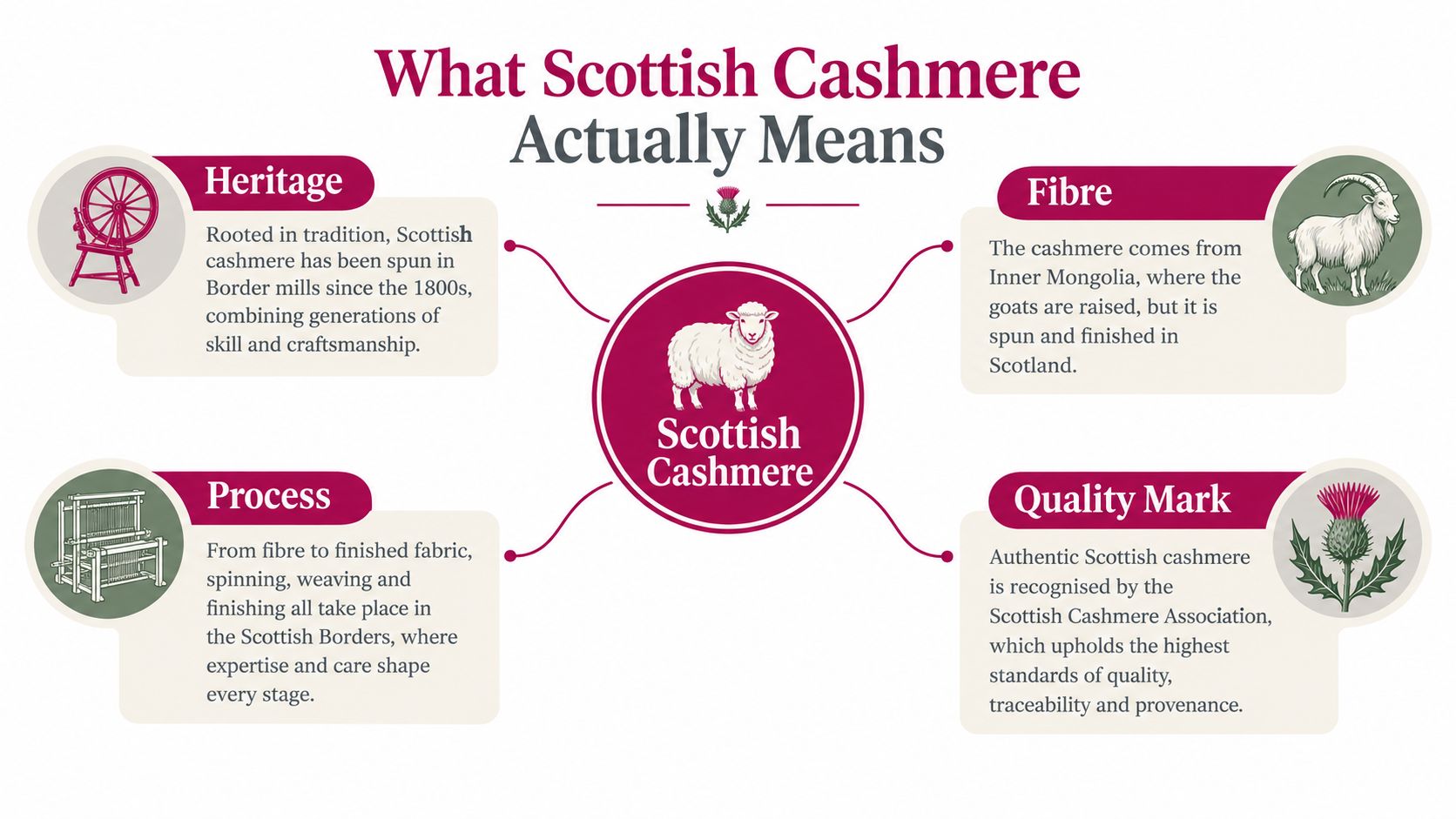
Scottish cashmere is a manufacturing tradition, not a claim that cashmere goats are roaming the Borders. The centre of that tradition is the Scottish Borders, especially Hawick, Galashiels, Peebles, Innerleithen, and Selkirk, where knitting, spinning, and finishing built a serious textile base over generations. By 1845, more than 2,000 of Scotland's 2,605 knitting frames, about 77%, were in the Borders, with Hawick alone holding about half of them (Scottish Enterprise evaluation and historical industry data).
That matters because the region already had the machinery and skill to make fine-gauge knitwear before cashmere became part of the story in the mid-1850s. The industry later worked with imported cashmere from China and Mongolia, while Scottish makers added value through spinning, knitting, and finishing. The heritage is in the work, not in a romantic idea of local fibre supply.
A scarf marked made in Scotland tells you where production happened. It does not tell you that the fibre was sourced in Scotland, because that is not what the tradition claims. A scarf described as Scottish-inspired is a style statement, not a production claim.
The modern Cashmere Made in Scotland promotion began in 1997 to reposition the sector towards higher-value markets. That promotion was about the value of Scottish making, not a guarantee that every scarf is pure cashmere or that every heritage-style scarf came from a Border mill. The Scottish Enterprise evaluation makes that distinction plain.
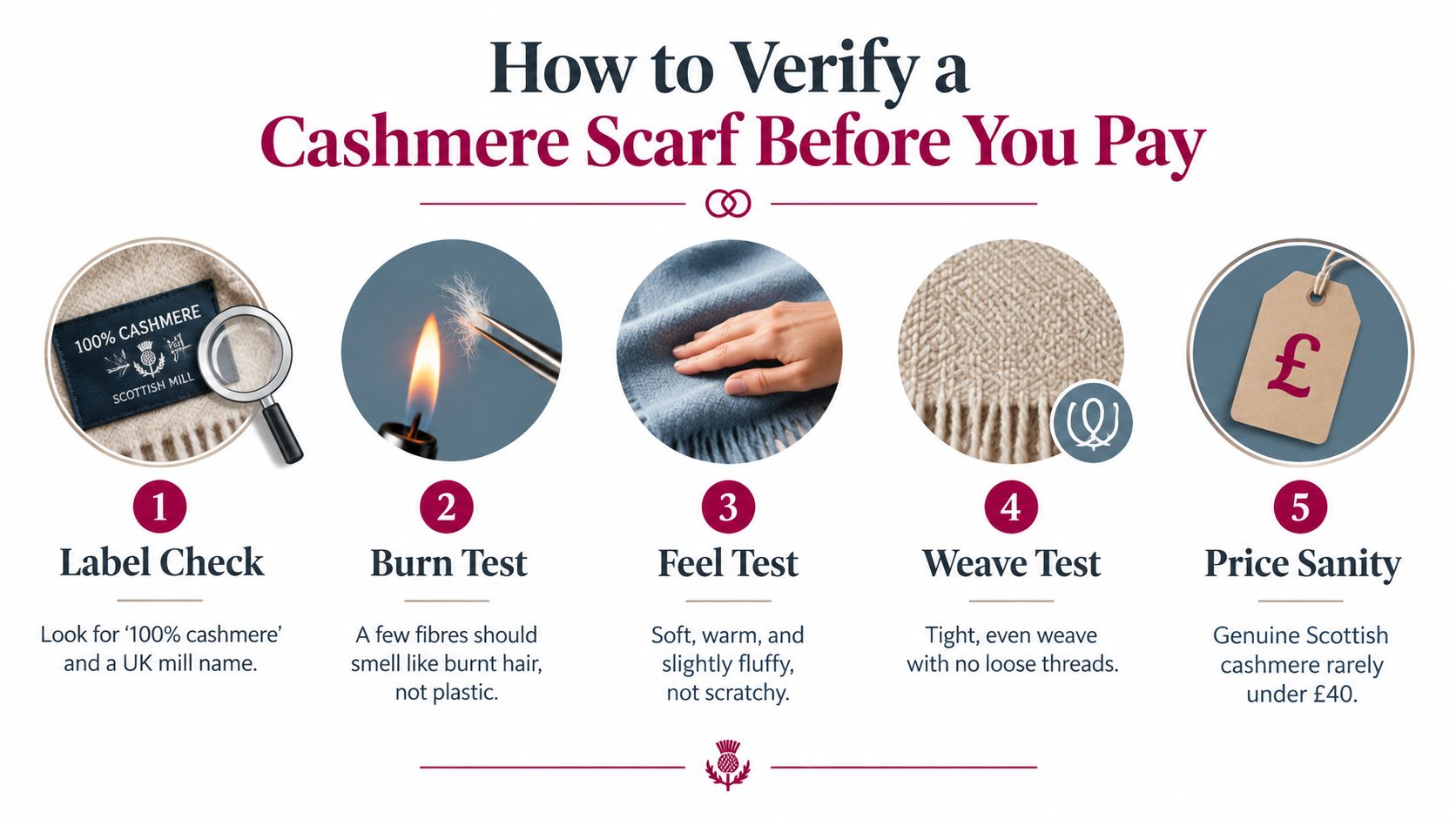
Treat cashmere as a specification, not a feeling. UK textile labelling requires fibre percentages to be declared, and labels must be durable, legible, visible, and accessible (UK textile labelling guidance). If the composition is vague, the scarf is not ready for premium money.
Laboratories separate cashmere from wool by fibre diameter, scale frequency, and cuticle-scale height. Wool cuticle edges are typically at least 0.6 microns high, while cashmere edges are up to 0.4 microns (SGS and UK microscopy-based composition guidance). A scarf can feel luxurious and still fail the label test.
UK guidance allows a composition tolerance of about ±3% of total fibre weight in testing. That means you should compare the declared composition with an independent blend-analysis report before paying a premium. If the numbers do not line up, walk away.
If you are matching accessories to a scarf, use the same discipline with cashmere hand warmers. The fibre story should be written plainly, not left to assumption.
Buyer's habit: never pay premium money for a premium-looking label unless the composition is written down and matches the claim.
Cashmere gets the praise, but wool does a lot of the hard work. If a scarf will be worn often, stuffed into a coat, caught in drizzle, and cleaned more than a couple of times a season, a good wool or wool blend is often the smarter buy. If it's for formal wear, gifting, or moments when handle matters more than hard wear, cashmere earns its place.
UK-focused technical guidance commonly places premium cashmere around 14 to 15.5 microns, standard commercial cashmere around 15.5 to 16.5 microns, and coarser grades around 16.5 to 18 microns (UK technical guidance on cashmere fibre ranges). Finer fibres feel softer next to the skin, while longer fibres help with cohesion and reduce surface shedding. But a scarf's real performance still depends on yarn count, ply, knitting density, finishing, and abrasion exposure.
| Factor | Fine Cashmere | Wool or Wool Blend |
|---|---|---|
| Next-to-skin feel | Softer, smoother, more luxurious | Usually firmer, sometimes warmer-looking rather than softer |
| Daily wear | Better for low-friction, occasional use | Better for frequent commuting and rougher handling |
| Care | More delicate, needs more discipline | Easier to live with in everyday conditions |
| Formal occasions | Excellent for weddings, gifts, dress outfits | Good when texture and practicality matter more |
| Value judgement | Worth paying for if the wearer will treasure it | Better if wear frequency is high |
A wedding kilt outfit wants refinement. A winter commute wants resilience. A country walk wants something the weather won't bully into shape after one season. That's the divide.
If I were choosing for an event, I'd pick cashmere for a partner's gift, a formal Highlandwear look, or a scarf that needs to sit neatly against a jacket. If I were choosing for repeated city use, I'd lean wool or a strong blend every time. Care difficulty is the deciding factor, not bragging rights.
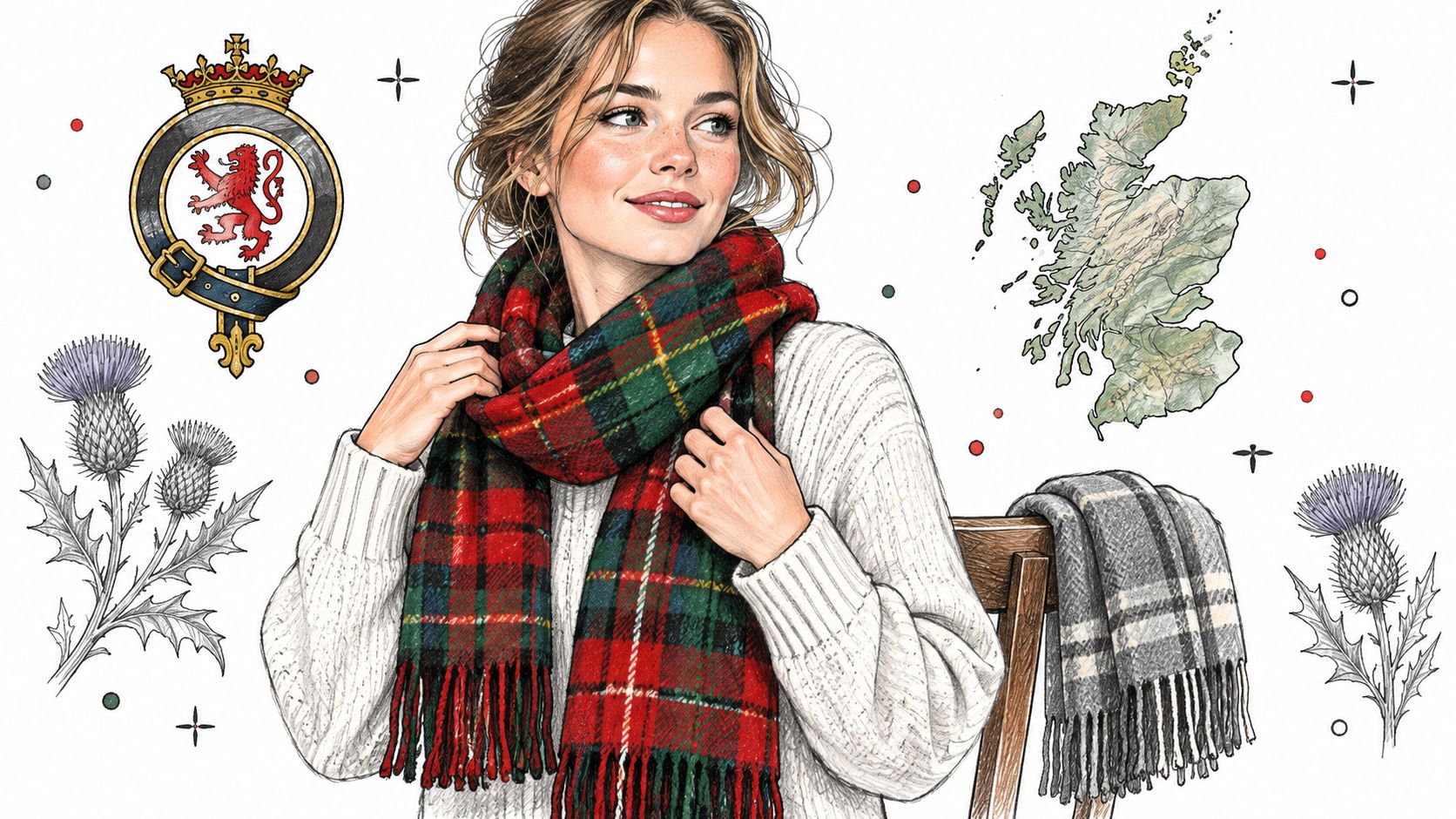
A tartan scarf works best when the colours suit the wearer, not when the buyer chases the loudest pattern on the rail. If the scarf is going with a kilt or jacket, the colours need to sit comfortably beside the rest of the outfit. If it's a standalone gift, the safest move is to choose a palette the recipient already wears.
A simple rule keeps you out of trouble. First, match the dominant colour to the wearer's coat, jacket, or usual wardrobe. Then echo one accent colour from the tartan in a tie, waistcoat, gloves, or pocket square.
For a formal look, muted tartans tend to behave better than bright ones. For a gift, a modern or neutral tartan usually gives the recipient more ways to wear it. For heritage wear, choose the sett with intention, not as decoration.
If you're matching accessories, tartan scarf mens is a useful starting point for seeing how pattern and proportion affect the finished look. The point isn't to overstyle the scarf, it's to let the tartan do its job without fighting the rest of the outfit.
Not every buyer needs a clan connection. Some people want a tartan because they like the colours, the balance, or the feeling of Scottish dress. That's fine. A good scarf should look deliberate, not inherited by accident.
The best scarf gift fits the wearer's life, not the giver's taste. That sounds obvious until you see someone buy a pale, delicate cashmere scarf for a man who wears dark tweed every day, or a loud tartan for someone who wants quiet luxury.
A partner going to a wedding needs polish first. Go for a scarf that frames the outfit, not one that competes with it. A parent or older relative usually values something classic, wearable, and easy to recognise as Scottish without being flashy. A groomsman or close friend often needs coordination, so colour discipline matters more than personality.
If you want more styling inspiration for giftable accessories, the luxe infinity scarf ideas article is a useful reminder that scarves work best when shape and drape suit the person, not the shop display. That principle holds for Highlandwear too.
A premium scarf is worth it when the recipient will wear it often enough to appreciate the handling. It's not worth stretching for a scarf that will sit in a drawer because it feels too precious. In that case, a well-made wool alternative is the better gift.
For a coordinated outfit, use the scarf to support the rest of the look. For a heritage-minded relative, keep the pattern readable and the colour depth rich. For someone who hates fuss, avoid anything that demands special treatment or constant adjustment.
the right tartan pocket square can do some of the same visual work in a more compact way, especially when you want a matching touch without another full accessory. That's often the cleaner choice for groomsmen and formal gifts.
A cheap scarf is cheap for a reason. You are usually paying for a blend, thin yarn, light finishing, or all three. A serious scarf costs more because fibre quality, ply, and finishing all take money, and you feel that difference the first time you wear it.
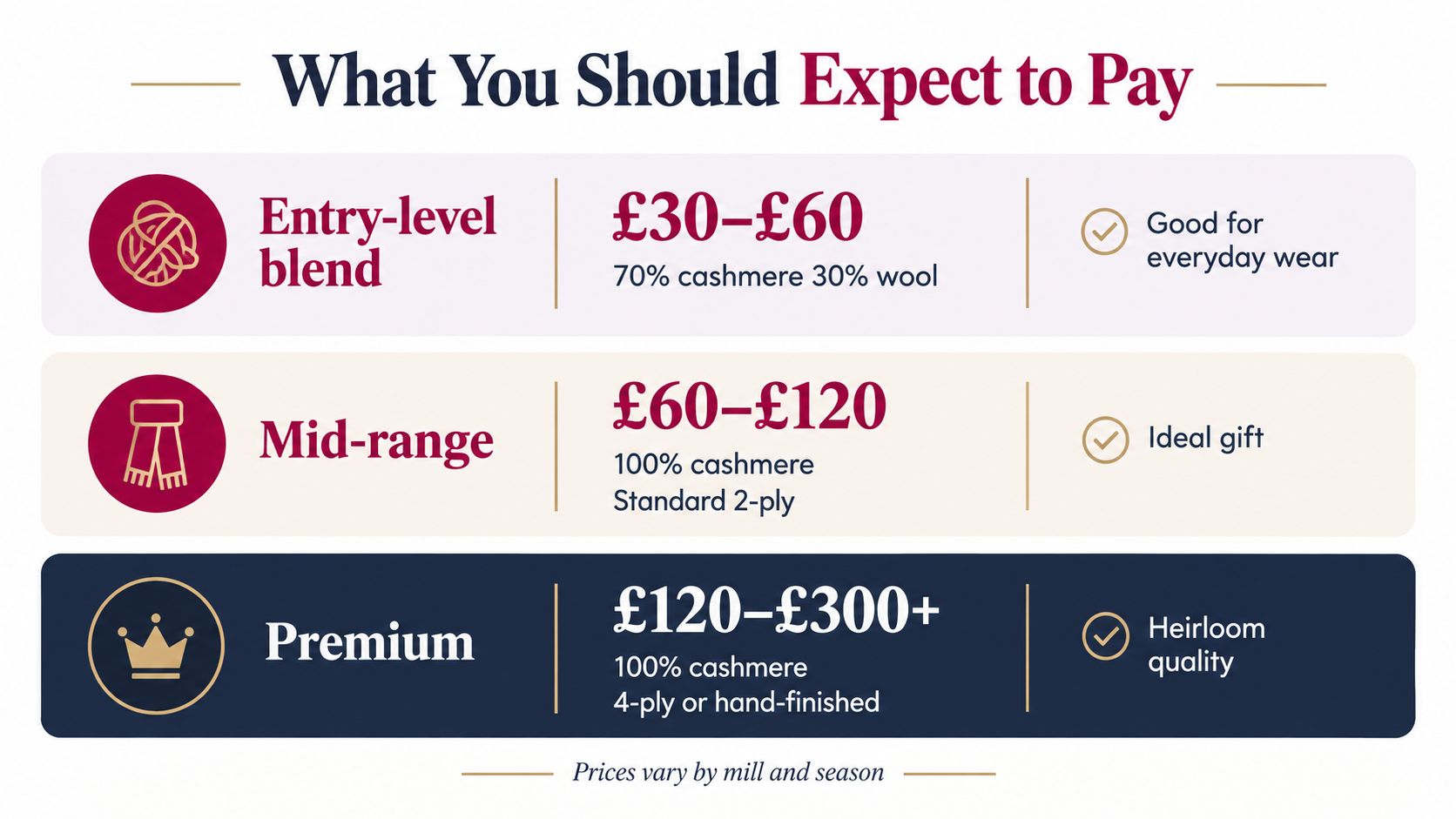
Price only makes sense beside the specification. The Scottish Enterprise evaluation shows that Scottish cashmere is a small-scale, higher-value product, not a mass-market one. Cumulative Scottish production between 1991 and 2000 was estimated at around 7 tonnes, less than 1% of global production. That is why a well-made Scottish cashmere scarf carries a proper price.
| Tier | What it usually pays for | My take |
|---|---|---|
| Entry-level blend | Lower cashmere content, simpler finishing | Fine for casual wear, but read the label carefully |
| Mid-range pure cashmere | Better fibre, cleaner construction, more consistent handle | The sweet spot for most gift buyers |
| Premium Scottish-made cashmere | Higher-grade finishing, stronger provenance, better build | Worth it if you want a long-term piece |
Do not buy on heritage words alone. Vague composition, “Scottish-inspired” wording with no mill information, and origin claims that do not match the actual country of manufacture all deserve scepticism. If the seller cannot explain the specification, the price is theatre. Buy the scarf that states what it is, shows where it was made, and feels substantial without feeling heavy. That is the piece that earns its keep in UK weather and still looks right after repeat wear.
John Lewis care guidance is blunt, and it's right to be. Dry cashmere flat, reshape it while damp, and never tumble-dry it, because heat can felt and damage the fibres (John Lewis care guidance). That's the routine that protects your money.
Don't wash it after every outing. Shake it out, air it flat, and keep it away from perfume, deodorant, bag straps, and rough coat seams. Those are the things that shorten a scarf's life fastest.
For storage, fold it rather than hanging it, and keep it in a breathable cotton bag with cedar nearby if you want extra moth deterrence. If you get pilling, deal with it gently instead of dragging the surface. If you stain it badly, use professional cleaning rather than improvising with heat or aggressive rubbing.
The point is simple. A cashmere scarf is only expensive if you wreck it early. Treat it well, and it becomes the kind of accessory you stop replacing.
If you want a scarf that earns its keep, start with the fibre, not the label. Kilts4Less offers Highlandwear accessories, tartan pieces, and practical buying options for people who want the look without guesswork. Visit Kilts4Less if you want to compare proper Scottish styling with the kind of product details that help you buy well.

Kilts4Less is Scotland’s best bespoke, handmade kilt and highlandwear company since 1983.
Specialists in made-to-order handmade kilts, kilt jackets, sporrans & also Scottish, Irish / American Tartan Hybrids. Don’t settle for cheap alternatives – Buy Online at Kilts4Less – sale is now on!
Easy 30 days returns
30 days money back guarantee
100% Secure Checkout
PayPal / MasterCard / Visa