
The pìob mhòr is Gaelic for “great pipe”, the Great Highland bagpipe of Scotland. Many people searching for “piob mhor of Scotland” want to understand the music it plays, not only the instrument itself.
At a Scottish wedding, a piper steps outside the entrance and begins a tune. Conversation stops, heads turn, and the sound seems to arrive from every direction at once. That reaction comes from an instrument with a deep Highland Gaelic identity, a distinctive mechanical design, and a repertoire far broader than the familiar ceremonial march.
The phrase pìob mhòr names the instrument, not a band, organisation, or single style of performance. It refers to the Great Highland bagpipe associated with Scotland's Highland tradition. The National Library of Scotland's history of the bagpipe traces bagpipes in Scotland to at least the medieval period and records a royal piper in the Exchequer Rolls in 1362.
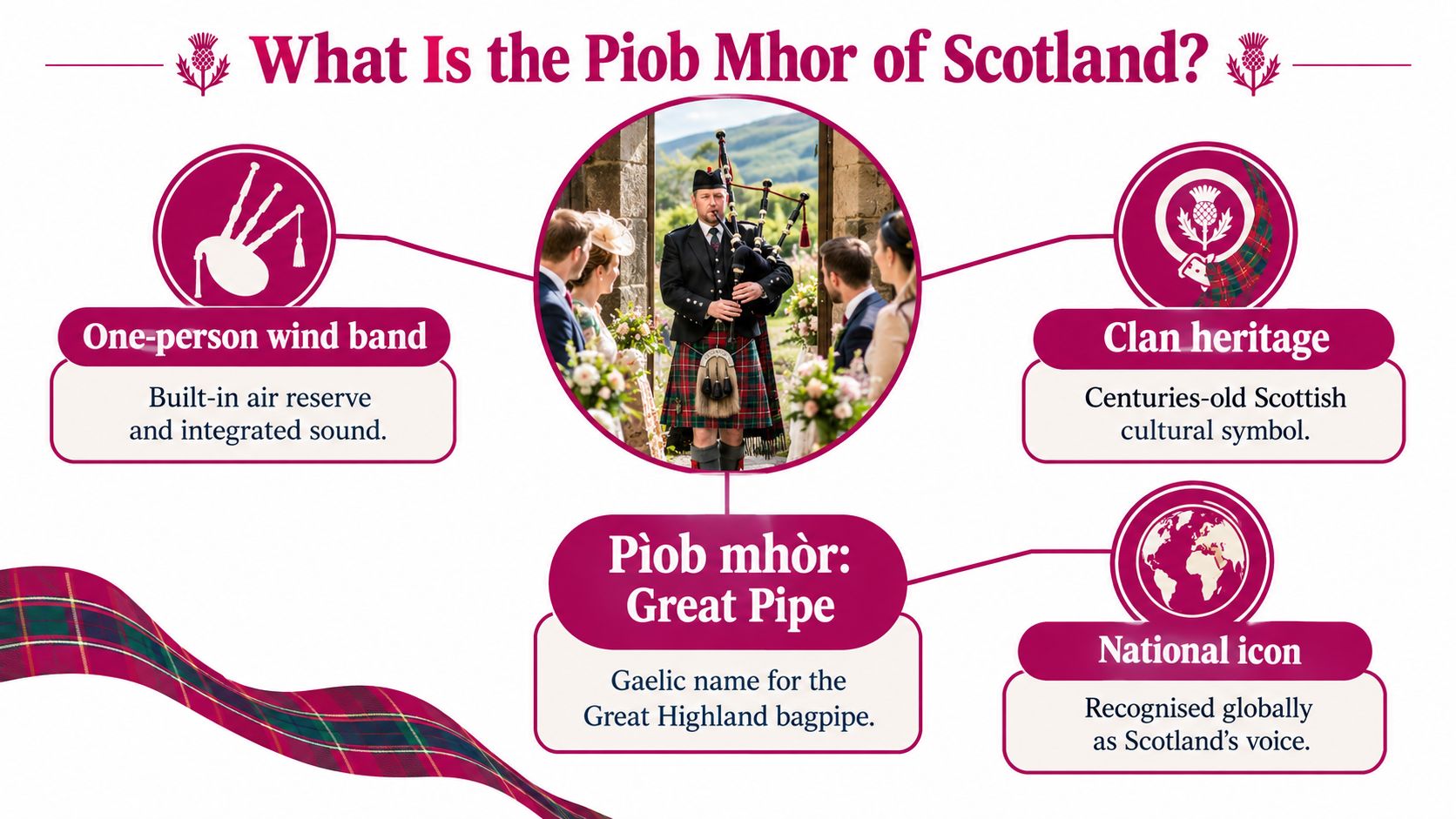
The useful distinction is simple. The pìob mhòr is the physical instrument, while piobaireachd, also called pibroch, is its classical repertoire. Once that difference is clear, the whole subject becomes easier to follow. You can understand how the bagpipe works, see why clans employed hereditary pipers, recognise the structure of classical piping, and choose the right musical setting for a wedding, funeral, Highland games, or formal ceremony.
For further reading on Scottish dress and tradition, explore the Highlandwear and Scottish culture articles.
A piper steps forward at a wedding, the room stills, and the first note seems to open the air itself. In moments like that, people often say they are hearing the “piob mhor of Scotland.” What they usually mean is the pìob mhòr, the Great Highland bagpipe. The phrase names the instrument.
The name is the best place to start. Pìob is Gaelic for pipe, and mhòr is the lenited form of mòr, meaning great. So pìob mhòr means “great pipe”. It points to the size, status, and role of the instrument in Highland tradition, not to one tune type, one band, or one ceremony.
That distinction clears up a common confusion. The pìob mhòr is the object you can hold and hear. Piobaireachd, often called pibroch, is a body of music written for it. A simple way to hear the difference is this. The instrument is the voice, while the repertoire decides whether that voice greets guests, honours the dead, or fills a games field with ceremony.
The instrument itself has a recognisable structure. Air goes in through the blowpipe and is stored in the bag. The chanter carries the melody under the piper's fingers. The drones hold a continuous note behind it, like a sound horizon that stays in place while the tune moves across it. That is why the bagpipe can sound both fixed and flowing at once.
Readers often mix up instrument and music because the same bagpipe can speak in very different ways. A bright processional at a wedding and a slow classical lament may come from the same pìob mhòr, yet they belong to different musical settings and carry different social meanings. Highland dress customs and ceremonial etiquette shape that setting too, especially at weddings, funerals, and public gatherings. For more on that wider context, see these Highlandwear and Scottish culture articles.
So the pìob mhòr is more than a familiar symbol on postcards or parade grounds. It is a Highland instrument with a specific name, a specific sound world, and a long ceremonial life. Once that is clear, it becomes much easier to tell when you are learning about the bagpipe itself and when you are hearing about the classical music written for it.
A useful way to understand the pìob mhòr is to think of it as a one-person wind band with a built-in air reserve. The piper does not blow directly into a tube and pause whenever a breath runs out. Instead, the player fills and compresses a bag, which regulates the airflow while the hands shape the melody.
The Historic Environment Scotland description of the Great Highland bagpipe identifies four functional subsystems and links the instrument's sound to hillsides, battlefields, and parades.
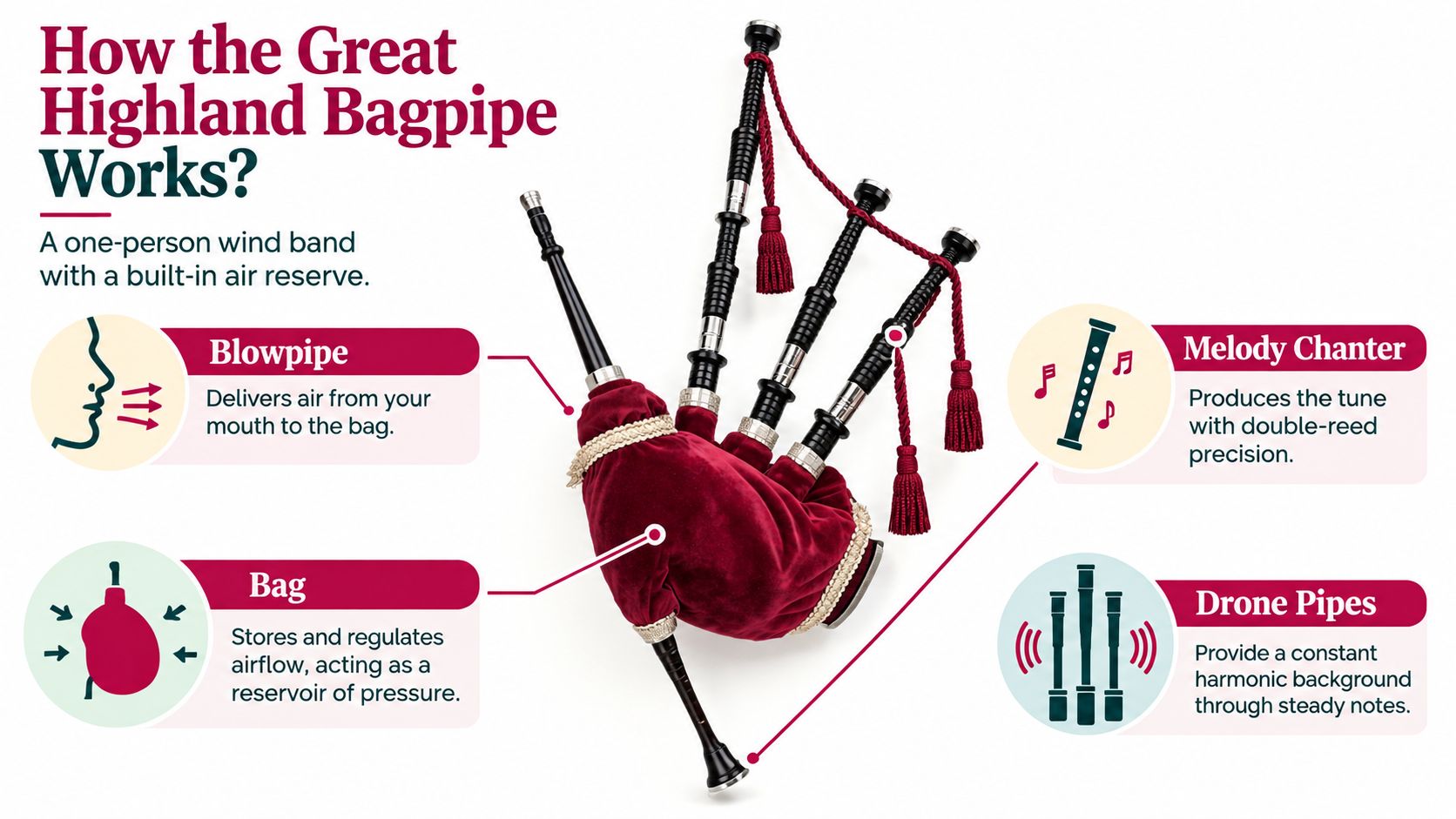
The bag is the essential middle stage. Breath enters the reservoir, then the piper presses the bag with the arm to keep the reeds supplied. That pressure allows the chanter and drones to continue sounding while the piper takes another breath.
The central idea: the bag turns individual breaths into a continuous musical line.
The drones are best understood as a sound horizon. They don't carry the tune in the way the chanter does, but they establish a steady sonic backdrop beneath it. The melody moves across that horizon, while the uninterrupted drones make the instrument feel larger than a single performer.
This arrangement also explains the pìob mhòr's outdoor strength. Its design developed for sound that could travel across open ground, not for delicate playing in a quiet drawing room. Hillsides, battlefields, parades, processions, and large gatherings all reward a sustained tone with a strong harmonic base.
That projection has practical consequences today. At an outdoor entrance or in a large hall, a piper may need less amplification than a speaker delivering announcements or recorded music. In a small indoor room, however, the same sustained volume and low-frequency drone energy can dominate the space, so placement and timing deserve attention.
A performance reveals the design clearly if you listen in layers. Hear the tune first, then notice the constant drone beneath it, and finally listen for the way the piper maintains continuity between musical phrases. The pìob mhòr isn't loud by accident. Its sound follows directly from the way its four subsystems work together.
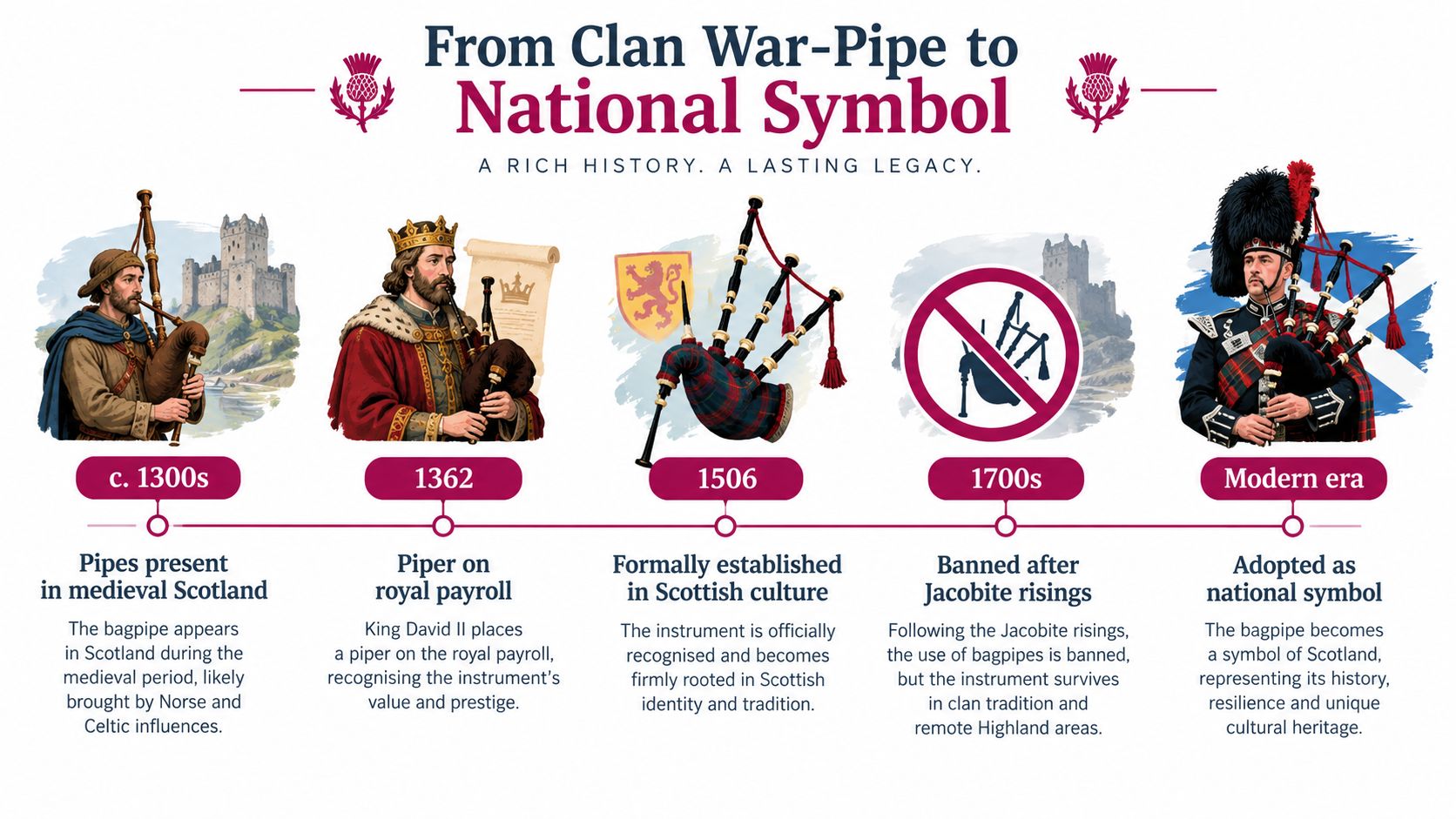
By 1506, the pìob mhòr had taken shape in the Highland imagination as the great war-pipe. That matters because it gives this history a clearer centre. Rather than treating the instrument as a timeless symbol that appeared fully formed of its own accord, it helps to see it entering public life through use, duty, and sound.
The reason is practical as much as cultural. On open ground, the instrument's penetrating chanter and steady drones could carry where quieter music would disappear. In that setting, the piper did more than provide accompaniment. He could signal movement, heighten resolve, and represent the authority of a chief before a word was spoken.
As the instrument became more closely tied to Highland society, hereditary piping families helped define its public role. Their position was not limited to performance skill alone. They preserved repertory, style, and ceremonial knowledge across generations, making the piper a guardian of memory as well as a musician.
That is one reason the pìob mhòr should not be confused with its classical music. The instrument belongs to many settings. Its later piobaireachd tradition belongs to one important part of that world, but clan service was broader than recital music. A piper might accompany formal gatherings, mark mourning, or lend weight to acts of welcome and honour.
Funerals show this especially clearly. The sustained tone can feel almost architectural, filling outdoor space the way stone walls define a courtyard. At moments of grief, that long line of sound gives shape to communal remembrance.
After the Jacobite period and the weakening of the clan system, the piper's place in society changed. The martial function receded, but the public one remained. What survived was not a museum relic. It was a living ceremonial language.
That shift helps explain why the pìob mhòr now appears so naturally beside Highland dress at weddings, funerals, civic events, and Highland games. In each setting, the etiquette differs, yet the underlying message is related. The piper announces arrival, frames procession, marks respect, or gives a gathering a distinctly Highland tone.
So the journey from war-pipe to national symbol was not a sudden reinvention. It was a gradual transfer of meaning from battlefield and clan household to parade ground, memorial space, and formal celebration, a history reflected in A timeline infographic titled From Clan War-Pipe to National Symbol showing the history of Scottish bagpipes.
The most important listening distinction is between the pìob mhòr and piobaireachd. The first is the instrument. The second is a classical repertoire played on that instrument, often rendered in English as pibroch.
The Dictionary of the Scots Language entry on pibroch distinguishes this repertoire as ceòl mòr, or “great music”. Its structure begins with an urlar, the central theme or ground, followed by successive variations. The urlar works like a theme statement in a formal musical argument. The later variations revisit and reshape that idea rather than repeating a tune in a straightforward way.
That structure helps explain why pibroch can sound unfamiliar to someone who knows only marches, reels, or wedding tunes. A march often establishes a clear pulse for movement. A reel invites dance. Piobaireachd unfolds more patiently, asking the listener to notice changes in ornament, rhythm, and musical intensity around the original theme.
| Term | Meaning | Where You'll Hear It |
|---|---|---|
| Pìob mhòr | The Great Highland bagpipe, the instrument itself | Weddings, ceremonies, parades, competitions, and concerts |
| Piobaireachd or pibroch | The classical repertoire of the Highland pipes | Formal recitals, competitions, commemorative performances, and specialist concerts |
| Ceòl mòr | “Great music”, the structured classical tradition | Extended performances built around a theme and variations |
| Url ar | The ground or central theme of a pibroch | At the opening of a classical piping composition |
| Variations | Successive developments of the central theme | The later sections of a pibroch |
| Ceòl beag | “Little music”, lighter piping repertoire | Marches, reels, dance tunes, and many social events |
| Canntaireachd | Gaelic “singing”, a vocal method for expressing piping music | Historical teaching and transmission of piobaireachd |
The spelling urlar is sometimes visually difficult for newcomers, but its function is straightforward. Listen for the theme statement first, then hear how the piper returns to its musical shape through increasingly elaborate passages.
Hereditary piping families transmitted piobaireachd across generations. Canntaireachd, meaning Gaelic “singing”, provided a specialist way to vocalise the repertoire. Before a listener treats pibroch as merely slow bagpipe music, it helps to recognise this vocal and familial teaching tradition. The music carries an organised grammar, not just a mood.
That doesn't make lighter repertoire less important. Ceòl beag is central to the social life of piping, particularly at dances, celebrations, processions, and weddings. The better question isn't whether one style is more “authentic”. It's what the occasion asks the instrument to express.
Museum objects make the pìob mhòr's history tangible. They show that Highland piping depends on skilled making, carefully chosen materials, and the preservation of individual components, not just on modern performance and ceremonial clothing.
National Museums Scotland records Highland bagpipes associated with late-19th-century Scottish manufacture in Perthshire. Surviving examples use materials including ebony, cocus wood, lignum vitae, ivory, silver, and textile covers, as documented by National Museums Scotland's collection story.
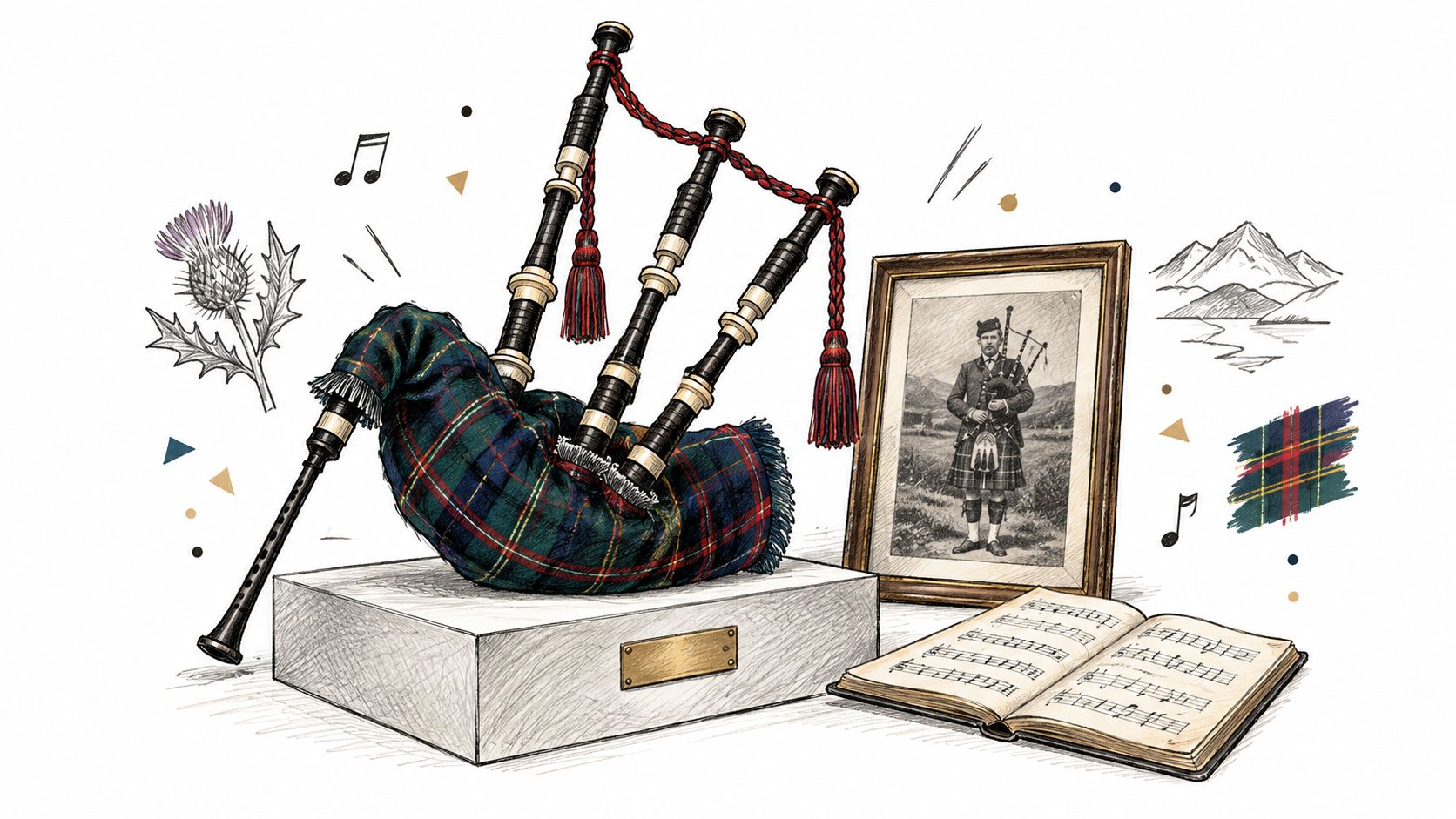
One object gives this material history a human focus. The chanter associated with Iain MacKay, Am Pìobaire Dall, who lived approximately 1656–1754, is made from lignum vitae. Its finger holes generate the melody, making it the part of the instrument through which the piper's hands shape the musical line.
The museum regards it as one of the oldest known Highland bagpipe chanters. Its story also demonstrates how piping knowledge travelled through families. The chanter was preserved through eight generations of the MacKay family before being transferred to Canada in 1805, according to the museum's account.
That is evidence of more than physical survival. A chanter carries the possibility of repertoire, technique, and memory. When a family keeps an instrument across generations, it preserves an object that belongs to a living practice rather than a decorative past.
The artefacts support a practical conclusion. The pìob mhòr should be treated as a precision cultural instrument, not merely as a costume accessory brought out for photographs.
For a wedding or formal event, organisers should provide:
The result is better for everyone. Respecting the instrument's construction also respects the craft and family traditions that made its music possible.
A piper works best when the event gives the sound a clear purpose. At a wedding, that might mean welcoming guests, announcing the couple's arrival, accompanying a procession, or marking the transition from ceremony to reception. At a funeral, a lament or measured performance can create a formal space for remembrance without requiring words.
The setting should determine the arrangement. Outdoor entrances and large halls suit the pìob mhòr naturally because the sound can expand into the surrounding space. An intimate indoor moment needs more care. Sustained volume and low-frequency drone energy can overwhelm conversation, readings, or a small room if the piper stands too close to the guests.
Practical rule: Give the piper a defined position, a clear start cue, and enough distance for the sound to settle before the main moment begins.
A formal entrance usually benefits from a tune with a strong sense of procession. A funeral calls for restraint and dignity. A Highland games event may welcome marches, reels, massed bands, and a more public atmosphere. A ceilidh or reception can move towards lighter social repertoire, where the rhythm supports dancing and conversation.
The distinction between pibroch and ceòl beag helps here. A pibroch can suit a solemn or commemorative setting because its theme and variations reward concentrated listening. A march or reel may be more appropriate when people are moving, greeting one another, or preparing to dance.
Highlandwear should respond to the same setting. Full formal dress pairs naturally with a ceremonial piper, a procession, or a solemn occasion. A lighter outfit can make more sense for an informal gathering or ceilidh. The aim isn't to create a rigid uniform. It's to let clothing, music, and behaviour communicate the same level of occasion.
For practical guidance on combining jackets, waistcoats, shirts, and accessories, consult this guide to wearing a waistcoat with Highland dress.
Guests often want to remember the moment as well as hear it. If friends and family are sharing images after the ceremony, a private space to collect guest photos can preserve different viewpoints of the piper's arrival, the procession, and the reactions around it.
A few decisions make the performance feel intentional:
The strongest event performances don't treat the pìob mhòr as a surprise sound effect. They give it a role within the ceremony.
A wedding procession begins. The drones arrive first, steady and wide, like a sound horizon settling over the room. Then the melody steps out above them. In that moment, the pìob mhòr is doing more than making a loud entrance. It is marking place, occasion, and memory.
That is why it still matters. The instrument and the music are related, but they are not the same thing. The pìob mhòr is the Great Highland bagpipe itself. Piobaireachd, or ceòl mòr, is its classical repertoire. People often blur those ideas together, yet the distinction helps you hear what is happening. The drones hold the ground. The urlar works like a theme statement. The variations return to it, test it, and reshape it without losing its identity.
That musical logic is part of a living tradition, not a shelf display. The same instrument can lead a bride, accompany mourning, stand at a Highland games field, or sound across a civic ceremony. Each setting changes how listeners receive it. At a funeral, the sustained tone can feel like collective breath. At a wedding, it gives formality warmth rather than stiffness. At games, it becomes public and competitive, but still ceremonial.
The social setting matters as much as the notes. Highland dress, timing, and etiquette help the performance feel coherent, especially when music and clothing are meant to speak the same cultural language. If you're preparing for an occasion of that kind, kilt hire for ceremonies and formal occasions can help match the formality of the event.
Listen closely and the old confusion begins to clear. The pìob mhòr is the instrument. Ceòl mòr is one of the highest forms of music written for it. Together, they remain a living communal practice.

Kilts4Less is Scotland’s best bespoke, handmade kilt and highlandwear company since 1983.
Specialists in made-to-order handmade kilts, kilt jackets, sporrans & also Scottish, Irish / American Tartan Hybrids. Don’t settle for cheap alternatives – Buy Online at Kilts4Less – sale is now on!
Easy 30 days returns
30 days money back guarantee
100% Secure Checkout
PayPal / MasterCard / Visa