
You've got a wedding invitation, a kilt ready to wear and a jacket that looks a little plain over a shirt. A tweed waistcoat seems like the missing piece, but the listings raise questions: is the cloth genuine, will it sit properly above the kilt, and does buying one make sense for a single ceremony?
At a Scottish wedding or ceilidh, a full business suit may feel out of place beside Highlandwear, while a shirt and jacket alone may not give you the outfit you want. A men's Harris Tweed waistcoat offers another approach: a close-fitting layer that brings texture to the centre of the outfit without asking you to replace everything else.
Think of a guest wearing a tartan kilt, a plain shirt and a restrained kilt jacket. Adding a carefully chosen waistcoat can make that combination feel more considered, particularly when the jacket comes off during the reception. The important choice isn't whether the tweed looks attractive, but whether the garment works with the clothes already selected.
Lay out the kilt, shirt and jacket before choosing a waistcoat colour. If you're still deciding on the outer layer, compare the shape and colour of suitable men's plaid and kilt jackets rather than buying the waistcoat in isolation.
For a first purchase, separate the decision into distinct questions:
These questions prevent an attractive fabric photograph from becoming the whole buying decision. A handsome front panel won't solve an uncomfortable fit, and an excellent fit won't turn an uncertified lookalike into Harris Tweed.
For an autumn wedding, you might want a textured formal layer that remains presentable without the jacket. For a ceremony followed by an energetic ceilidh, you might favour a less substantial garment and pay particular attention to freedom of movement.
There's no need to choose every accessory at once. Establish the cloth, cut and relationship with the jacket first, then decide how much additional pattern the outfit needs.
The useful outcome is confidence: knowing what to ask the seller, what to check during a fitting and whether this is a garment you'll wear again. That's a better starting point than choosing whichever listing looks most traditionally Scottish.
Harris Tweed is a protected cloth identity, not a fashion adjective. A brown herringbone waistcoat doesn't become Harris Tweed because its colour or pattern resembles island weaving.
The Harris Tweed Act 1993 established the Harris Tweed Authority and restricted the name to qualifying cloth: pure virgin wool, dyed and spun in the Outer Hebrides, handwoven by islanders in their homes, and finished in the Outer Hebrides; the protection builds on the Harris Tweed Association, formed in 1909, and the Orb trademark, registered in 1910, as recorded in the legislation protecting Harris Tweed and its certification mark.
The illustration gives a visual reference for the cloth and its identifying tag.
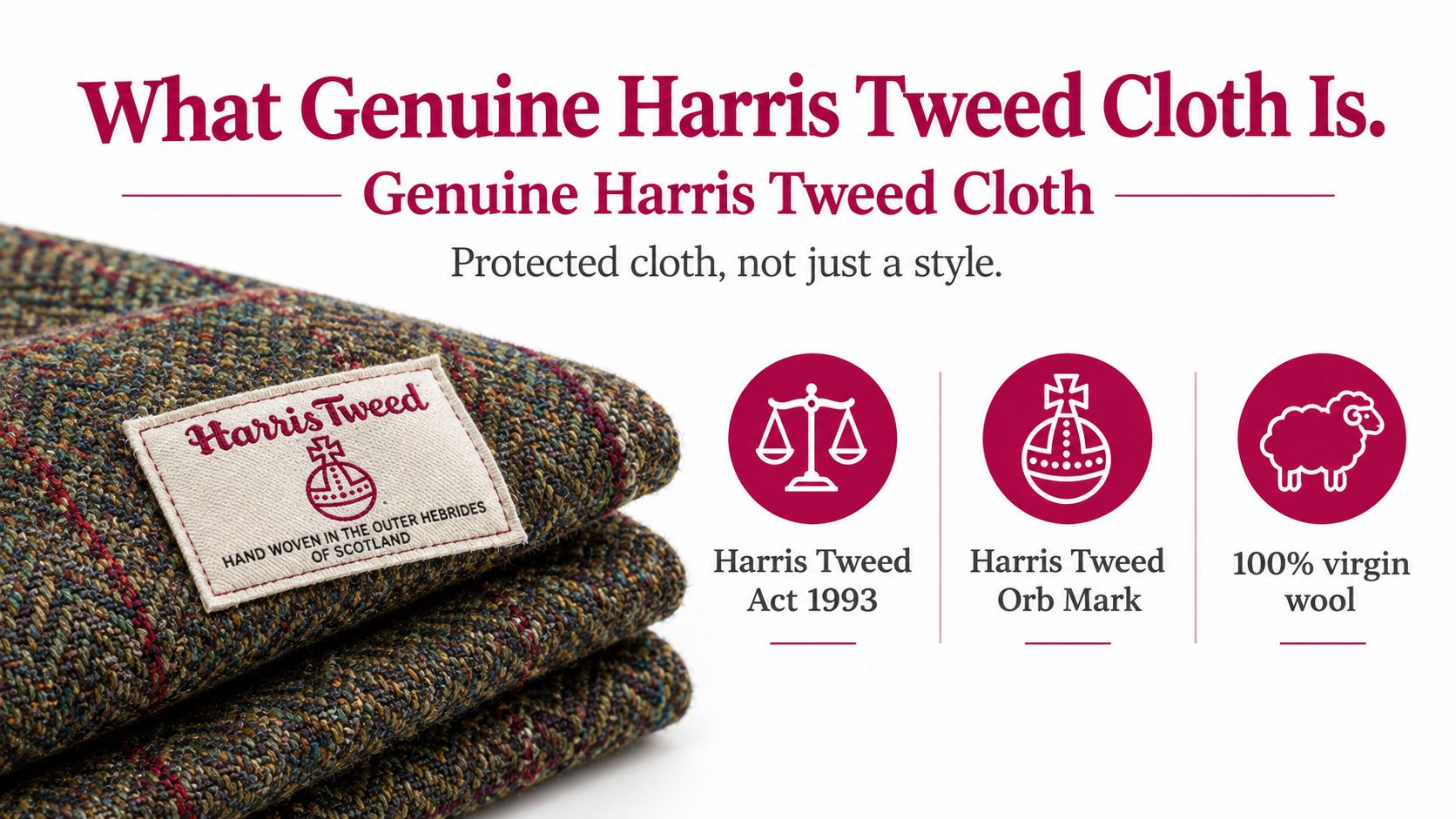
A passport establishes a particular identity. In a similar way, the Orb certification mark identifies material that meets the protected Harris Tweed requirements.
Each part of the definition matters. The wool specification concerns the material, the island requirements establish where production happens, and home handweaving specifies how the cloth is made. A manufacturer can't substitute a similar-looking fabric and retain the same identity merely because the finished waistcoat has a convincing country appearance.
It also helps to distinguish cloth production from garment making. The protected production requirements concern the tweed itself. They shouldn't be read as a promise that every subsequent cutting, lining and sewing operation takes place in an island weaver's home.
Practical rule: Treat the Orb as evidence about the cloth, then assess the finished waistcoat separately.
The mark isn't a personal fitting service or a dress-code recommendation. It doesn't tell you whether a particular neckline suits your shirt, whether the armholes clear comfortably beneath your jacket, or whether the back length works with your kilt.
Nor should you assume that every component of a certified-cloth waistcoat is tweed. A lining, back panel, fastening or adjustment strap needs its own product description.
This distinction keeps the buying process straightforward. Establish that the outer cloth has the right identity, then ask how the maker has turned it into a garment. Terms such as Harris-style or island tweed may describe an appearance, but they don't replace certification.
Choosing this cloth also means buying from a surviving Scottish island craft. Its history isn't a simple story of uninterrupted growth, and that matters when you're trying to coordinate garments for a wedding party.
In the 1960s, about 2,000 weavers produced roughly 7.6 million yards, while output had fallen to just over 492,000 yards by 2009; the subsequent recovery took production from about 450,000 metres in 2009 to more than 1 million metres by 2012, according to the BBC's reporting on the Harris Tweed revival.
This visual connects the island production process with the finished garment.
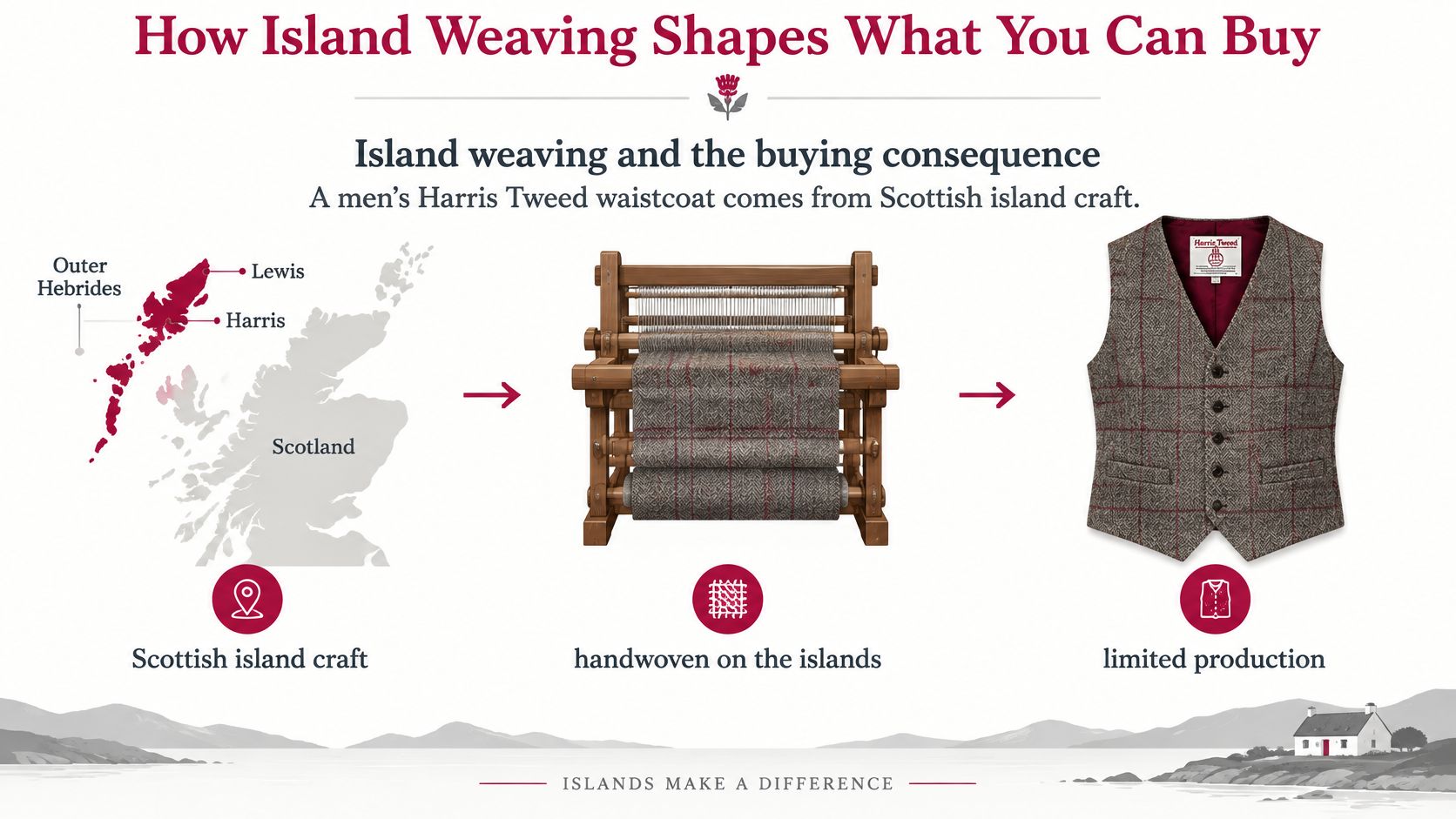
The figures show substantial contraction followed by renewed demand. They don't establish that every colour is rare, that every order faces a delay, or that a waistcoat's price can be calculated from industry yardage.
Notice the units, too. The historical figures use both yards and metres, so they shouldn't be treated as directly interchangeable totals.
For a buyer, the sensible conclusion is narrower: ask about the actual cloth available for your order. A retailer may have a finished waistcoat ready to dispatch, while a maker working to your measurements may need to confirm fabric before beginning.
Suppose you want matching waistcoats for the groom and wedding party. Don't assume that finding a suitable sample means the maker can immediately supply every required garment.
Ask practical questions:
A look at island weaving provides useful context for those conversations.
You don't need to become a textile historian to buy well. You do need to distinguish a stock garment from a future cloth order, especially when several people must be dressed for the same date.
A speckled wool front can look convincing in a product photograph. That isn't enough to establish authenticity, because appearance and certification answer different questions.
Genuine Harris Tweed must be 100 per cent pure new wool, dyed and spun in the Outer Hebrides, handwoven by islanders at home and finished there, with the Orb mark identifying qualifying cloth, as set out in the Harris Tweed Authority's label and brand-use rules.
Use the garment's identifying details, rather than its colour alone, as your starting point.
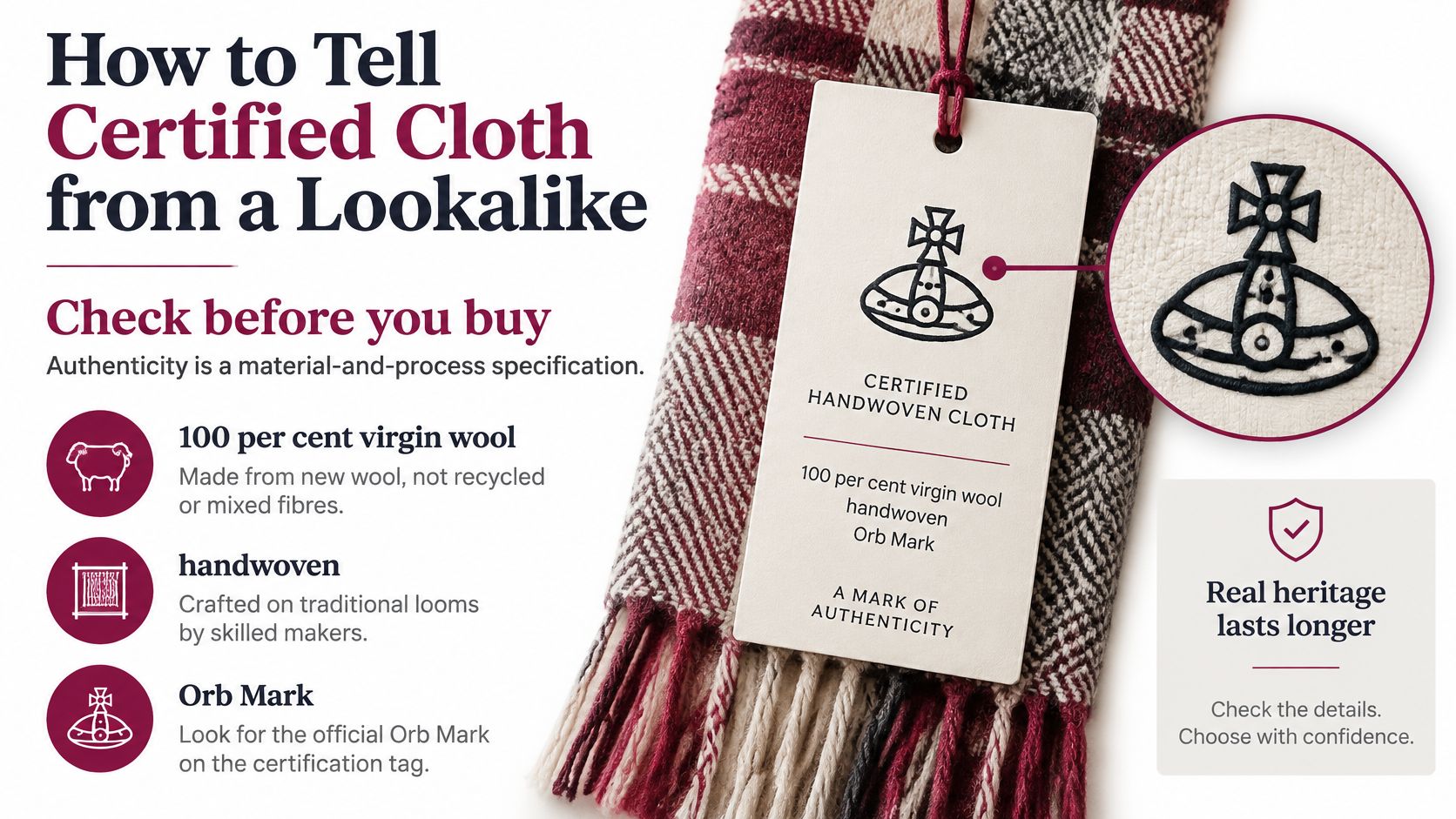
A listing may contain several textile terms without explaining which applies to the waistcoat in front of you. Scottish tweed, wool tweed and Harris-style aren't interchangeable with the protected name.
Similar-looking cloth may use blended wool, recycled fibre, machine weaving or production outside the islands. Those materials can be legitimate choices in their own right, but they shouldn't be bought under a mistaken assumption about provenance.
Before ordering, make these checks:
A convincing pattern is a design detail. Certification is evidence of cloth identity.
For UK autumn and winter formalwear, pure wool and a dense woven structure make Harris Tweed a sensible material to consider for insulation. That doesn't make every waistcoat equally warm, nor does it mean a lightweight synthetic garment offers the same wearing experience.
The actual result depends on cloth weight, lining, fit and shirt layers. A waistcoat with a tweed back is also a different proposition from one whose back is made from a lighter lining fabric.
Ask about those details if you'll spend time outdoors before the ceremony or move between a cold arrival area and a warm reception room. Don't buy on a promise of warmth without understanding the garment's construction.
For a wedding purchase, the defensible quality check is therefore certification plus clear fibre disclosure. You should know both what the outer cloth is and what you'll be wearing against the rest of your outfit.
A waistcoat has less room to hide a poor fit than a jacket. Its front sits close to the torso, so pulling buttons, an uneven hem or excess fabric at the sides remain visible.
UK men's size designation under BS 6185 uses the intended wearer's body dimensions rather than the finished garment measurements, with chest measurements commonly expressed in centimetres and standard outerwear intervals of about 4 cm, as explained in FashionCapital's metric sizing guidance.
Body chest means your chest measurement. Finished chest means the circumference of the waistcoat itself, which must allow the intended fit over a shirt.
Confusing the two can lead you to choose the wrong size even when you've used a tape measure carefully. The supplier should also explain waist measurement, back length and how much adjustment the strap provides.
Measure horizontally around the fullest part of your chest, then measure your natural waist. Wear the sort of shirt you expect to use for the occasion, keep the tape level and compare both measurements with the supplier's chart rather than relying on your usual jacket label.
| Measure | Where to take it | What good fit looks like |
|---|---|---|
| Body chest | Around the fullest part of the chest | The front closes comfortably without pulling |
| Natural waist | Around the natural waist | The lower buttons fasten without strain |
| Finished chest | From the garment or supplier's specification | Enough room for the shirt and intended close fit |
| Back length | Along the back, using the maker's stated reference points | The garment sits at the intended waistband level |
| Front coverage | Check while wearing the intended kilt or trousers | The hem meets the waistband without an unwanted shirt gap |
| Adjustment allowance | Confirm the strap or buckle range with the supplier | Fine adjustment remains available without gathering the back excessively |
Pure wool has limited stretch, so don't expect a tight waistcoat to behave like stretch casualwear. Excessive tension can distort the front panels, strain the buttons and spoil the way the cloth hangs.
The back buckle should refine a suitable base size. It shouldn't be used to pull a substantially oversized garment into shape.
For hire or off-the-peg purchases, establish chest and waist compatibility first, then check length and armhole clearance. Sit down, move your arms and try the jacket over the waistcoat rather than judging the fit from a standing mirror view alone.
For made-to-measure, record chest, waist, shoulder width and front length, together with your preferred waistband coverage. Tell the maker whether you'll wear it with a kilt, trews or trousers, and follow their measuring instructions.
Use the guidance on how to wear a waistcoat alongside the supplier's chart. Styling advice helps with presentation, but it doesn't replace the measurements for the garment you're ordering.
A green-brown waistcoat, a tartan kilt and a patterned jacket may each look attractive separately. Put them together and you may find that none has enough visual space.
My recommendation for a first Highlandwear outfit is to give the waistcoat a clear supporting role. Choose colours in relation to the kilt and jacket, rather than trying to make every piece the main feature.
For a daytime wedding, consider a Harris Tweed waistcoat with a tweed kilt jacket, tartan kilt, plain shirt and restrained tie. If the waistcoat has a pronounced check, try a quieter jacket before adding more patterned accessories.
For a ceremony with a smarter dress expectation, ask the organiser or outfitter whether your proposed tweed combination suits the dress code. A bow tie alone doesn't resolve a mismatch between a relaxed cloth combination and the requested level of formality.
Trews offer another route if you prefer a trouser-based Highlandwear outfit. With a conventional suit jacket, a tweed waistcoat can add texture, but it should complement the jacket rather than be treated as its replacement.
Keep accessories deliberate. Suitable brogues and a restrained tie may be enough; consider a belt only where it works with the complete outfit and doesn't crowd the waistcoat hem. If you add a tartan pocket square, compare it with the kilt and tweed together, rather than selecting another pattern in isolation.
| Route | When to consider it | What to establish before committing |
|---|---|---|
| Made-to-measure | Your chest, waist and length need individual attention | Measuring method, cloth availability and completion timing |
| Off-the-peg | The supplier's standard proportions suit you | Actual size chart and alteration options |
| Ex-hire purchase | Budget and reuse matter more than having a new garment | Condition, measurements and any previous alterations |
| Short-term hire | You need an outfit for a particular event | Available sizes, collection arrangements and return requirements |
For a concrete Scottish retail and hire option, the publisher offers tweed and general kilt jackets, tartan waistcoats, ex-hire jackets and complete outfit packages, alongside full-outfit, kilt and jacket hire. Its made-to-order and off-the-peg routes give buyers different ways to assemble Highlandwear without assuming every garment must be commissioned.
For overseas orders, confirm shipping arrangements and leave room for a proper fitting. Check purchase returns conditions separately from hire terms, and don't assume that a made-to-measure item follows the same process as stock clothing.
Read the waistcoat's care label before treating the cloth. The outer tweed is only part of the garment, and the lining, back panel, buttons and internal construction may require different handling.
As a cautious routine, let the waistcoat rest between wears, brush away loose surface dust gently and air it after an event. Don't assume that washing instructions for a polyviscose kilt apply to a wool waistcoat just because both belong to the same Highlandwear outfit.
Avoid packing the waistcoat tightly beneath heavy items. If it gets wet during outdoor photographs, let it dry naturally with support rather than trying to force it dry with direct heat.
For stains or a thorough clean, follow the maker's instructions and tell the cleaner about any contrasting back or lining material. If the label is unclear, ask the retailer before attempting a home treatment.
Before returning hire clothing: Follow the hire provider's instructions rather than trying to remove a mark with an improvised wash.
Check the garment after wearing it, particularly around the buttons and adjustment strap. Address a loose fastening before the next event rather than tightening the buckle further to compensate for an unrelated problem.
A successful purchase joins three things: verified cloth, suitable proportions and a realistic plan for use. None is a substitute for the others.
Before committing, keep a short record:
Review the available tweed jackets, waistcoats and outfit options with those notes beside you. Compare the purchase and hire routes before choosing, and check the applicable returns terms rather than treating them as an alternative to measuring.
The right waistcoat should feel like part of your outfit, not a piece you must keep adjusting throughout the ceremony. Choose it with the jacket and waistband in mind, then give it the care its full construction requires.
Kilts4Less offers tweed kilt jackets, matching waistcoat options and wider Highlandwear purchase and hire routes for weddings and ceremonies. Visit Kilts4Less with your chest and waist measurements to discuss certified cloth, outfit coordination and whether buying or hiring suits your event.

Kilts4Less is Scotland’s best bespoke, handmade kilt and highlandwear company since 1983.
Specialists in made-to-order handmade kilts, kilt jackets, sporrans & also Scottish, Irish / American Tartan Hybrids. Don’t settle for cheap alternatives – Buy Online at Kilts4Less – sale is now on!
Easy 30 days returns
30 days money back guarantee
100% Secure Checkout
PayPal / MasterCard / Visa