
You've arranged your ladies tartan sash in the mirror, and the diagonal looks balanced. Then you reach for your bag, turn for a photograph or sit down, and the fabric shifts towards your neck. A successful fit needs more than a neat standing pose: it needs the right convention, a suitable fastening and enough freedom for the day you're attending.
At a wedding, a sash might look settled before the ceremony but pull at the neckline when the wearer gathers her skirt for photographs. Treat that as a fitting problem to solve beforehand, not something to correct by tightening the brooch on the day. Rehearse the movements that will matter, wearing the complete outfit.
Start with the invitation and your role. A family wedding, a clan gathering and a dance may call for different decisions. Shoulder conventions aren't universally fixed: The Field's discussion of sash etiquette highlights variations in guidance and the distinction between tradition and legally binding rules.
Establish whether you're following formal convention, family preference or modern styling. If the occasion has a ceremonial organiser or an established family custom, ask about it before choosing the arrangement. That's more dependable than copying a photograph whose wearer's role you don't know.
Have these details ready:
Try the sash on your body, not just across a dress laid flat. A jacket lapel changes the available shoulder space, while a waistcoat can alter where the lower drape sits. An asymmetric neckline may also look quite different once tartan crosses it.
Practical rule: Prepare for the busiest part of the event, not just the photograph at the beginning.
Leave time to change the arrangement. A comfortable rehearsal is far preferable to discovering an awkward overlap after you've left home.
Choose the intended arrangement before choosing the sash. The fabric needs to support the shape you want, whether that's a restrained diagonal, a fuller shoulder drape or a bow. A product photograph can suggest a finish, but it can't establish whether that finish suits your circumstances.
The modern sash isn't a direct equivalent of the men's kilt. Its background lies in the arisaid, or earasaid, a larger Highland women's garment used for wrapping and coverage; the narrower ceremonial sash developed from that draped tradition. This account of Scottish and Celtic traditional dress describes that relationship and tartan's later adoption into fashionable women's clothing.
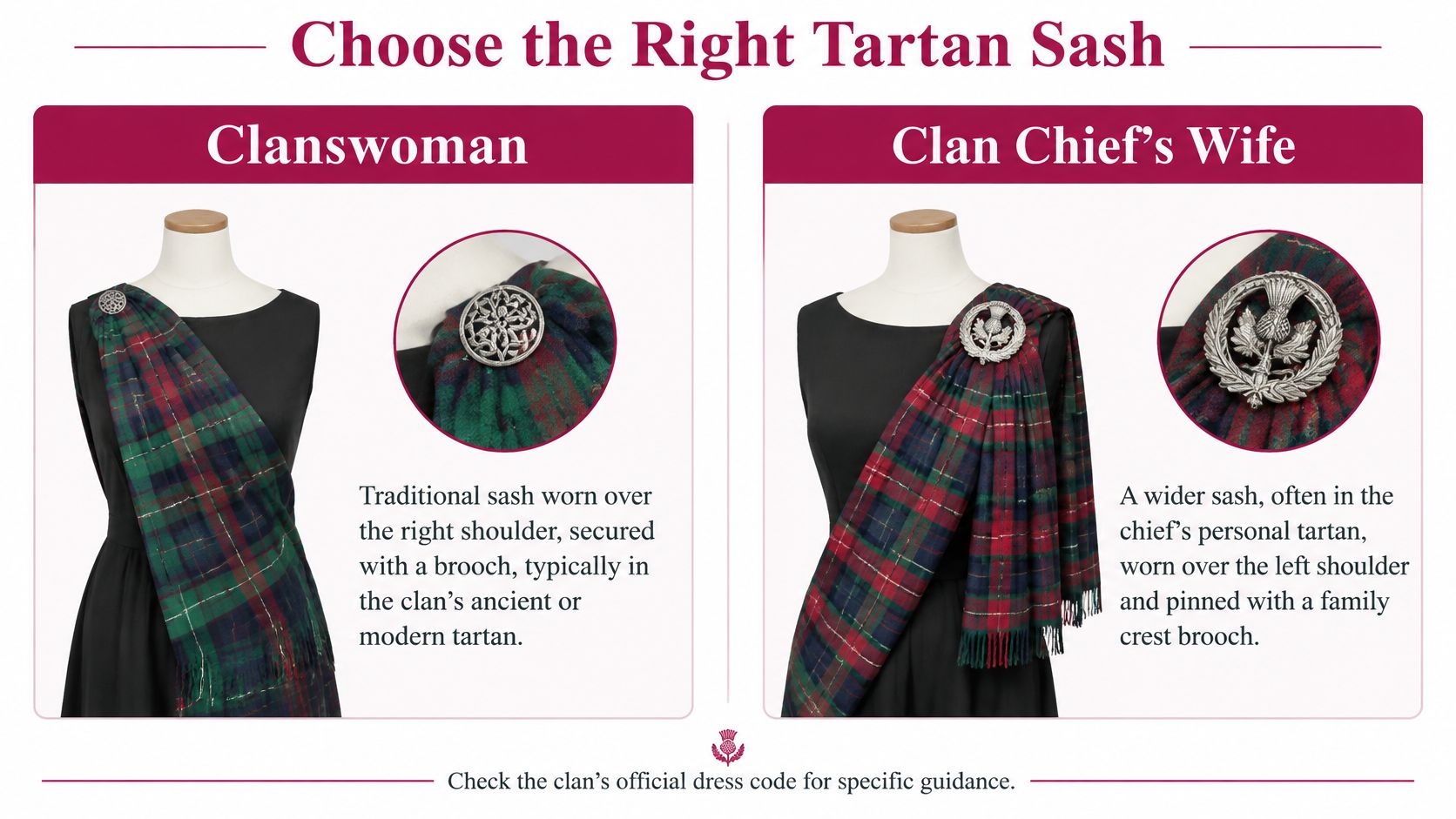
A clanswoman's diagonal arrangement calls for a different distribution of cloth from the fuller style associated with a clan chief's wife. Wearing birth-family tartan after marrying outside the clan introduces another consideration: enough usable length for the traditional hip bow. The role-specific distinctions are addressed below, but they should inform the purchase rather than become an afterthought.
The comparison below illustrates the main shoulder distinction. Confirm the wearer's role with the relevant family or clan rather than treating decorative details as requirements.
Use these purchasing priorities:
Browse ladies' tartan clothing alongside your dress or separates so you're considering the whole outfit.
For an academic ceremony, distinguish Highland dress from academic accessories. Gradshop's guide to graduation sashes for grads is a separate resource for graduation planning, not a substitute for Scottish sash etiquette.
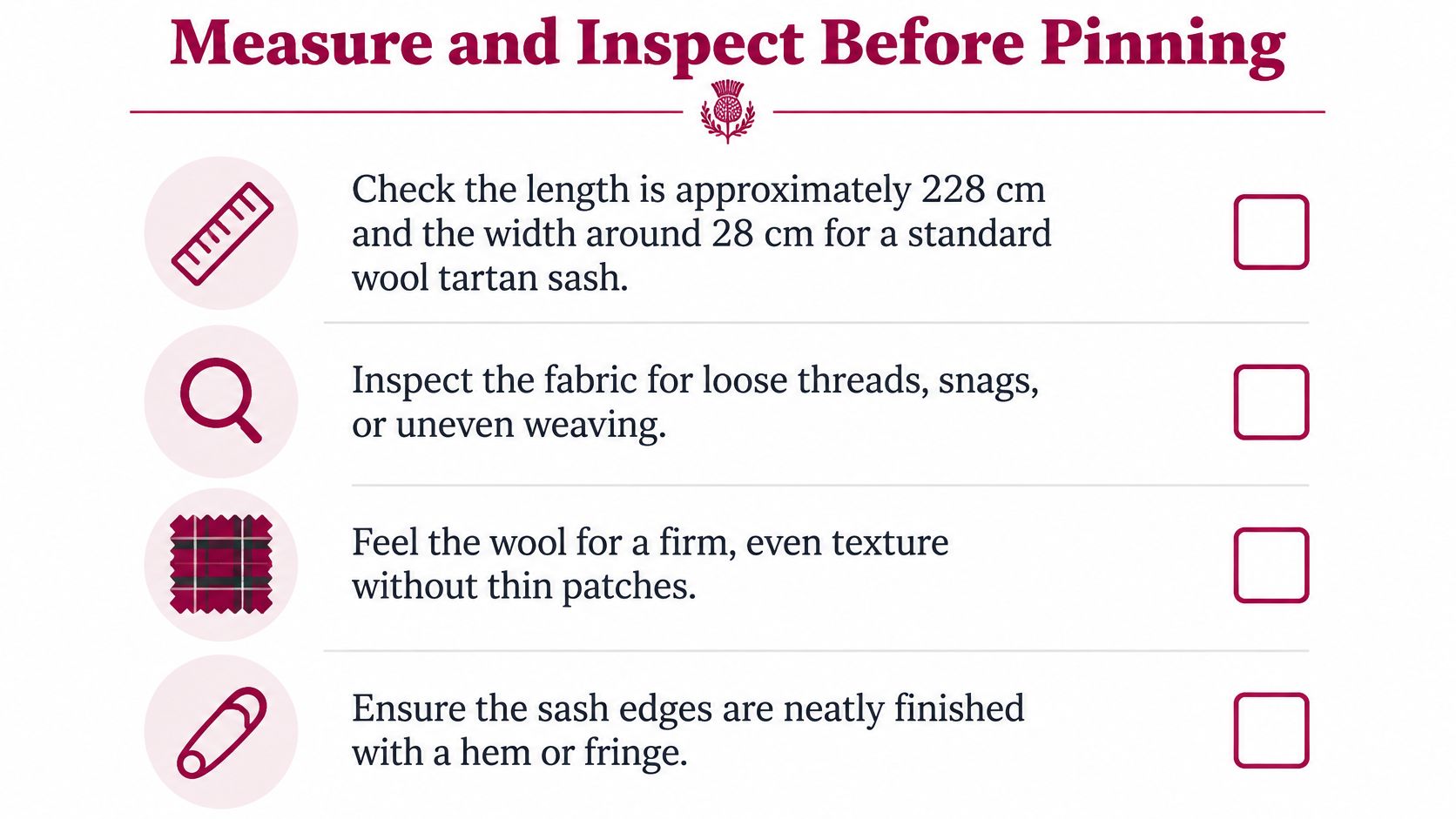
A useful retail benchmark for a wool tartan sash is approximately 28 × 228 cm, as described in ScotlandShop's wool tartan sash guidance. Treat that as a starting point, not a statutory specification or a guarantee of fit. Compare the finished garment with the seller's stated measurements.
Lay the sash out without stretching it. Measure its finished width and length, inspect both selvedges, and look across the surface for fraying, skipped threads or distortion. Follow the tartan's colour sequence and sett alignment along the full length rather than checking only the visible shoulder section.
Use this checklist as a prompt, while checking the edge finish against the actual product specification.
Place the fabric loosely over the right shoulder for the initial fitting. Establish whether there's enough length for your chosen finish before folding, gathering or fastening anything. Don't judge a hip-bow arrangement from the length of the diagonal alone.
Let the cloth settle against the outfit. If you have to pull it firmly to bring the intended fastening points together, reconsider the placement or sash length. Pinning shouldn't be used to compensate for insufficient fabric.
Mark the preferred position with a removable fitting reference that won't damage the garment, then assess it while wearing the outfit. A brooch position copied from a photograph may land on an unsuitable part of your neckline.
Keep a brief fit record:
Before committing to the fastening, look from the front, side and back. Correct measurements still need a wearer-specific fitting.
Begin with the sash loose against your clothing. Identify the upper and lower ends, check the direction of the tartan and smooth out any accidental twist before forming the diagonal. Keep the intended brooch area accessible.
The photograph shows how a shoulder fastening can form part of the finished presentation.
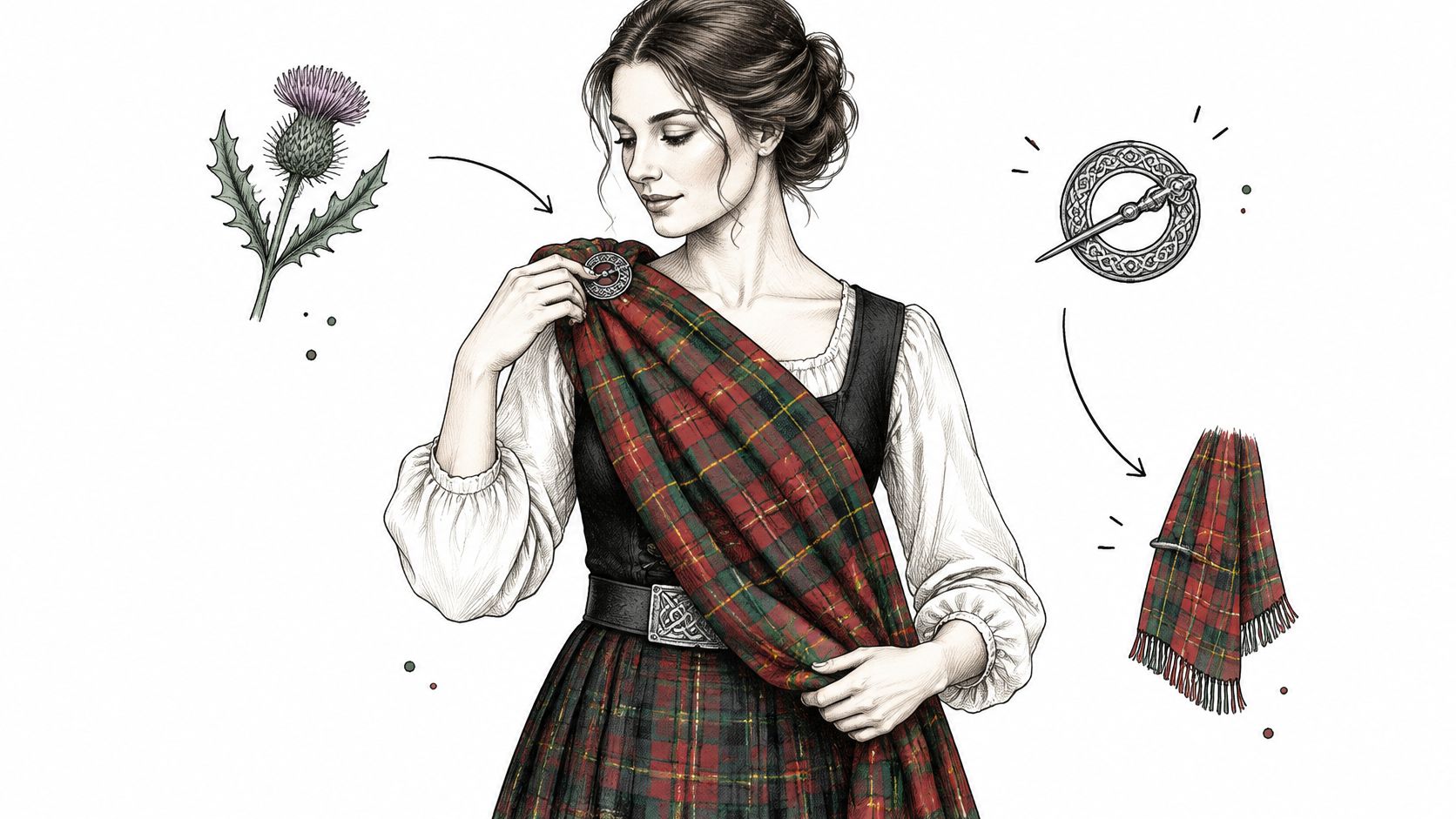
For the main right-shoulder routine, distribute the cloth diagonally towards the opposite hip. Lay it across the body rather than pulling it across. Smooth the width with your hands so the fabric sits deliberately instead of gathering into a narrow cord.
Move your arm forward before fastening. Notice whether the upper section travels towards your neck or the lower section lifts sharply. Adjust the amount of fabric at the shoulder until that movement feels natural.
Bring the brooch into position only once the drape is settled. Check that its pin closes securely and its point is enclosed. If the fastening requires you to pierce delicate dress fabric, stop and assess the support beneath it before proceeding.
Tidy the lower portion without winding it around the body. A flat diagonal, a hip bow and a back-secured finish need different amounts of loose fabric; don't force them into the same outline.
For a wedding outfit with a structured shoulder, trial the fastening where the dress can support it without distorting the neckline. With a softly draped evening dress, position and support need more care: a decorative brooch shouldn't be expected to hold everything by weight alone.
For a seated ceremony, sit down before making the final adjustment. Check whether the lower fabric bunches at the waist or becomes caught beneath you, then stand without pulling on the sash.
Use the video alongside a hands-on rehearsal rather than judging the fit from a still image.
A secure finish should stay arranged because the drape and fastening work together, not because the wearer keeps an arm motionless.
Don't transfer fastening instructions between different garments. The guide to where to place a kilt pin addresses a separate Highlandwear item, not the method for securing a sash to a dress.
Likewise, if your event includes academic dress, use the separate guidance to drape your academic hood correctly from Stoles.com®. Fit each ceremonial garment for its own purpose, then check how the layers interact.
There isn't a single shoulder rule that resolves every occasion. The documented conventions for ladies in evening dress distinguish arrangements by ceremonial or family position, rather than treating left and right as interchangeable fashion choices.
| Arrangement | Traditional association | Fitting consideration |
|---|---|---|
| Right-shoulder diagonal | Standard clanswoman's style, secured at the shoulder | Keep the diagonal balanced across the bodice |
| Fuller left-shoulder style | Chieftainesses, wives of clan chiefs and wives of colonels of Scottish regiments | Allow space for the fuller shoulder drape |
| Right shoulder with left-hip bow | A woman married outside her clan who continues wearing her original clan tartan | Trial the bow's bulk and position |
| Back-secured arrangement | Country dancing or occasions requiring a clear dress front | Check the fall behind the right arm |
Formal convention matters most when your role forms part of the ceremony. Confirm the appropriate arrangement with the organiser rather than choosing the fuller left-shoulder style because it balances a neckline.
Family preference may guide a wedding or private gathering. Ask what the family intends, particularly when relatives are coordinating tartans. That conversation is more useful than attempting to settle conflicting online advice on the morning.
Modern styling leaves room to accommodate the actual wearer. If a prescribed-looking arrangement interferes with a mobility aid or necessary arm movement, discuss a practical adaptation instead of accepting discomfort.
The visual below offers a comparison of shapes. Use the table above for their traditional associations: a simple hanging drape isn't the documented back-secured dance arrangement, and the hip bow has a specific family context rather than being merely decorative.
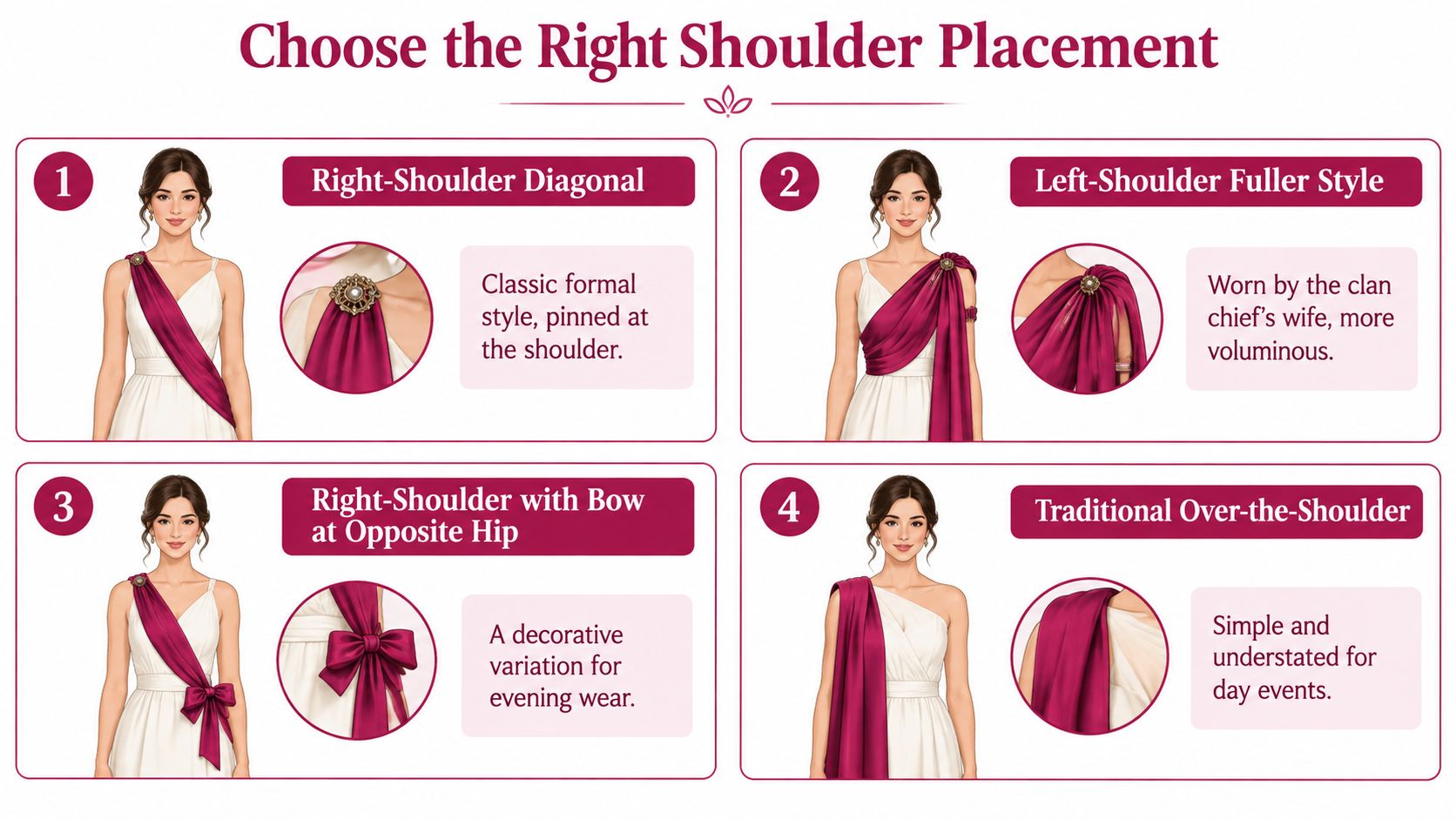
A traditional arrangement still needs to suit the activity. For dancing, assess clearance behind the arm; for a seated ceremony, assess the waist and chair contact. In a warm venue, consider whether you need the same amount of fabric throughout the reception.
Authenticity comes from choosing a convention connected to the wearer and occasion, then fitting it thoughtfully. It doesn't require treating every informal photograph as an etiquette test.
Choose the fastening for the fabric it must support, not for its appearance. Before inserting a pin, inspect the dress at the proposed location. Avoid forcing a thick pin through a fine weave or relying on an unsupported neckline to carry a substantial brooch.
Where the dress needs reinforcement, ask a dressmaker to assess a discreet backing or supported fastening point. Test any proposed solution somewhere inconspicuous and don't assume that an adhesive or clip will be harmless on delicate fabric. If the garment can't safely support the arrangement, change the arrangement.
| Event need | Arrangement to consider | What to check | Comfort or movement concern |
|---|---|---|---|
| Heated reception | A lighter or narrower sash compatible with the occasion | Drape against the bodice | Unnecessary bulk and warmth |
| Long outdoor ceremony | Full-length wool, where appropriate | Fit with the intended outer layer | Comfort over the event's duration |
| Country dance | A dance-oriented, back-secured arrangement | Clearance around the arms and waist | Loose fabric catching during movement |
| Seated formal occasion | A controlled diagonal with a tidy lower finish | Chair contact and waist position | Pressure or bunching while seated |
| Delicate evening dress | A supported fastening assessed with the garment | Pin suitability and neckline stability | Snags, holes or pulling |
Full-length wool and lighter alternatives solve different problems. Choose according to warmth, bulk and drape rather than assuming that more fabric always looks more formal. Lochcarron's sash-wearing guidance provides useful background on draped styling and the practical, smaller arrangement associated with Scottish country dancing.
Check the brooch against the jacket lapel, necklace and corsage before leaving home. Where these sit close together, simplify the grouping or move a non-prescribed accessory rather than crowding everything onto the same shoulder.
For coordinated wedding-party clothing, a tartan pocket square is another accessory to consider alongside the sash. Assess the colours together in the actual outfits, without assuming every person needs the same amount of visible tartan.
Keep medals and decorations unobstructed. The final balance should make each element readable without requiring repeated adjustment.
Rehearse in the same dress, outer layer and fastening pieces you'll use at the event. Stand naturally, sit, walk and lift each arm in turn. Check the front in a mirror and ask someone to inspect the back.
Use a short final checklist:
Wear the outfit briefly, then check it again. If the sash shifts, adjust the cause rather than repeatedly pulling it back into place.
Choose the convention that fits your circumstances, adapt it to the clothing and test it against the activity. A deliberate, comfortable finish is more useful than a perfect mirror pose you can't maintain.
Kilts4Less offers ladies' tartan clothing, brooches and Highlandwear accessories for wedding and ceremonial outfits. Visit Kilts4Less to explore the options, then choose your sash and fastening with your dress, intended convention and event activities in mind.

Kilts4Less is Scotland’s best bespoke, handmade kilt and highlandwear company since 1983.
Specialists in made-to-order handmade kilts, kilt jackets, sporrans & also Scottish, Irish / American Tartan Hybrids. Don’t settle for cheap alternatives – Buy Online at Kilts4Less – sale is now on!
Easy 30 days returns
30 days money back guarantee
100% Secure Checkout
PayPal / MasterCard / Visa