
Choose your usual dress size. That popular advice fails for a Ladies Tartan Kilt, because a kilt has no stretch and no darts to forgive a bad guess. A kilt is a fixed, pleated panel with a structured waistband, so waist, hip and rise measurements decide the fit. Measure first and choose your tartan second: it is the best way to avoid returns caused by poor fit.
Many buyers assume a women's kilt is just a smaller men's kilt. It isn't. The tartan can be identical, but the cut, rise and fit reference differ. A man's kilt is built straighter from waist to seat. A woman's version has to sit over a narrower waist and a more curved hip without pulling the pleats open.
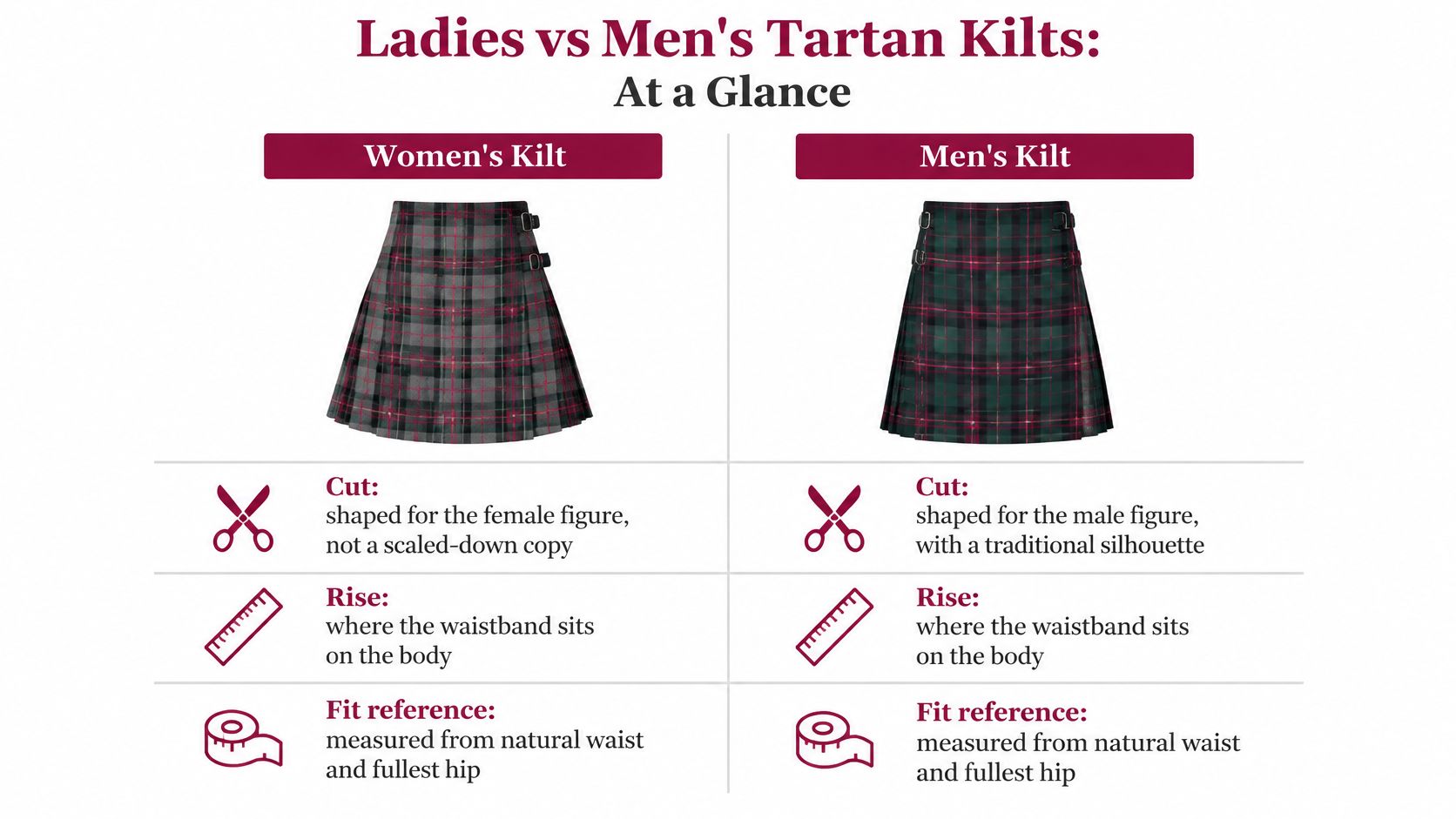
| Feature | Ladies tartan kilt | Men's tartan kilt |
|---|---|---|
| Cut | Narrower through waist and hip, often a curved panel | Straight, broader cut built for waist and seat |
| Typical length | Knee length or just below; above-knee in modern styles | Knee length, traditionally just below the knee |
| Fabric | Wool (8-yard or 5-yard) or washable polyviscose | Traditional 8-yard wool most common |
| Rise and waistband | Natural waist or lower hip, chosen by the wearer | Usually worn at the natural waist |
| Main fit reference | Hip, seat and rise matter most | Waist and seat dominate |
| Typical accessories | Hose and flashes, ghillie brogues, sporran, fitted jacket | Full dress: sporran, sgian dubh, jacket and waistcoat |
| Size labelling | Dress size labels, which vary widely | Waist in inches, more consistent across makers |
Take two things from that table. First, rise is a choice for women, and it changes which measurement matters. Second, dress-size labelling is the weakest guide on the page, which is why our advice is to work from centimetres and compare them with published garment measurements before you commit.
If you don't want a traditional kilt shape at all, a tartan pleated skirt gives you pleats and tartan in a more familiar skirt cut, which suits some wearers better for everyday wear.
Work through your decision in the order that prevents mistakes. Understand why the cut is built as it is, take your measurements, confirm the tartan, pick the route to buy, then think about dressing and care.
A kilt works like an accordion made of tartan. The folds are the pleats, and once sewn they are fixed. A skirt cut to fit the body gets its shape from darts and shaped seams. A kilt gets its shape from how much cloth goes into each fold and how wide the panel is at waist and hip.
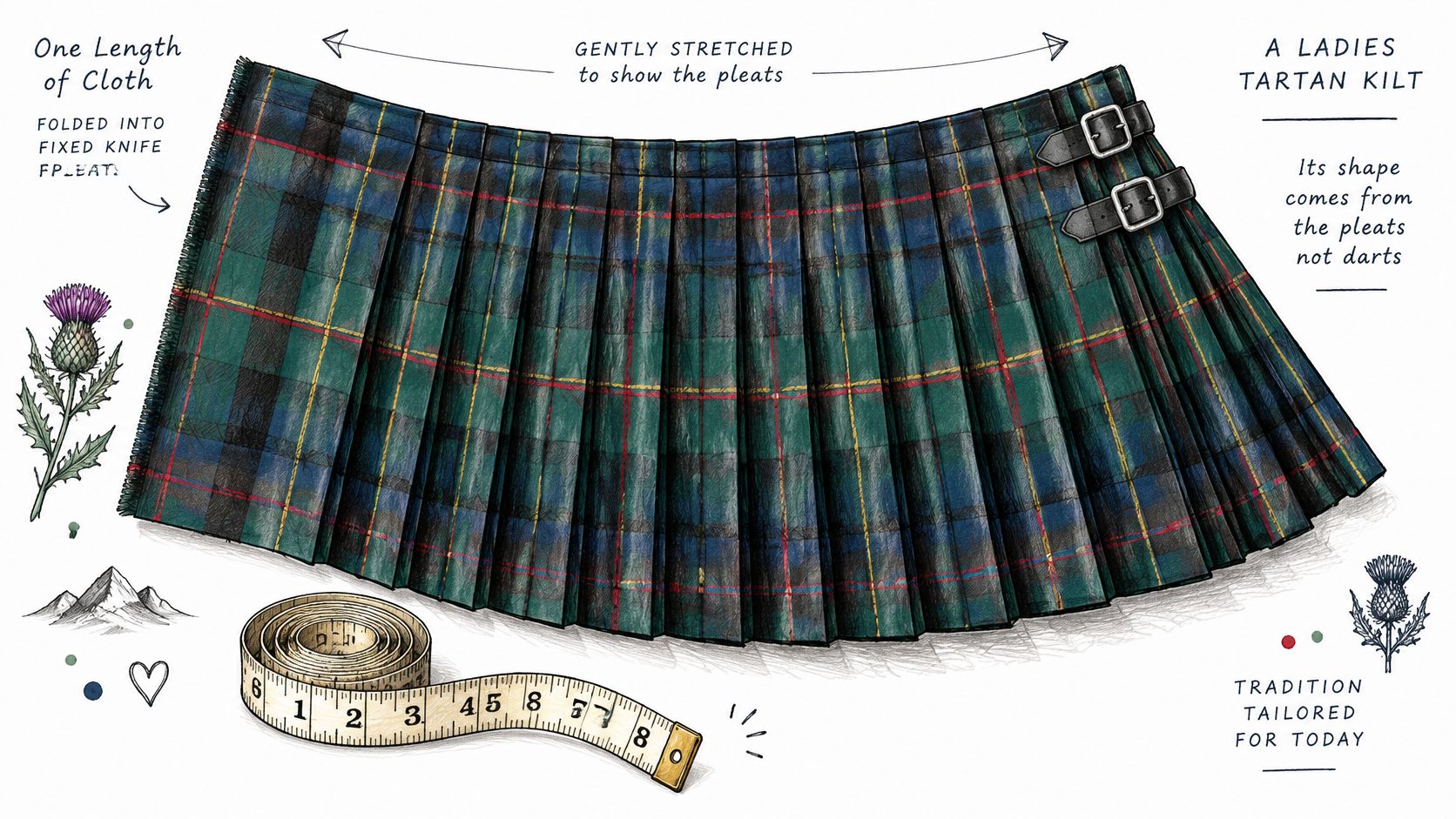
That fitted form developed primarily as menswear. Women's contemporary kilts adapt it rather than starting from a women's pattern, while women's use of tartan itself is much older. The National Records of Scotland notes the Falkirk sett, from approximately the 3rd century AD, and records that both men and women made and wore tartan, as its history of tartan as the fabric of a nation sets out. Women historically wore it as plaids, arisaids, skirts or dresses rather than the modern short kilt.
Because the pleat set is fixed once sewn, makers don't add or remove pleats to change the shape. They adjust four things instead.
Remember this: panel width and rise do the shaping work. If those two are wrong, no amount of pulling at the straps will fix the fit.
Those four points, waist, hip, rise and drop, are exactly what you measure next.
A kilt's pleats use far more fabric than your waist circumference, and the pleat layout decides how much tartan stays visible and whether stripes line up. That's why the seat and rise decide comfort more than the waist does. It's also why a label can't help you. British women's sizing was based on mid-20th-century data and later British Standard ISO 3635 sizing wasn't compulsory for manufacturers, so two garments with the same nominal size can differ in waist, hip and length, as this account of how UK dress sizes drifted explains.
Our step-by-step guide to measuring yourself for a kilt walks through tape position if you're measuring alone at home.
When your hip is more than a few centimetres larger than your waist, let the seat measurement set the size, not the waist. A waist-led choice will feel fine standing up and pull across the hips the moment you sit, because the pleats have nowhere to go. Rise then decides where that hip room sits on your body.
If you're short with a longer torso, a higher waistband usually works better, with the hem placed by proportion rather than by a standard length. If you're tall, check the length measurement twice, since a standard drop can land higher than you intended.
Write everything down in centimetres and add one line stating whether the kilt should sit at your natural waist or lower on your hips. That single note prevents most misunderstandings with a maker.
A tartan isn't just a colour choice. It's a thread count, the precise sequence and number of coloured warp and weft threads that reproduce the sett. The Scottish Register of Tartans calls this the design's DNA, where each colour is a letter and each number gives the exact thread quantity for the loom, as the Register's guidance on thread counts and setts describes. Because the warp sequence repeats in the weft, a wrong count changes stripe widths, overchecks and colour balance.
That matters more on a woman's kilt than a man's. A smaller, more curved panel makes pattern placement around the hips and pleats much more visible, so a stripe that's slightly out of place shows quickly.
The official Register, launched on 5 February 2009 under the Scottish Register of Tartans Act 2008, records historic and contemporary tartans, so you can rely on a documented pattern rather than an informal commercial label. Registration also requires a tartan to be capable of being woven, with its colours, thread count and sett recorded.
You don't need a family link to wear a tartan. A clan tartan carries personal meaning if you have one. Designer, district and Irish or American hybrid patterns are equally valid choices if you just love the colours. Finally, check that stripes line up at the front apron edge and across the pleat folds. Misalignment there is the part you'll notice in every photograph.
Poor fit is the leading reason UK online fashion orders come back. A 2025 survey reported 30% of online fashion purchases were returned, with women returning items for poor fit at 12.9% against 7.1% for men, and 62.7% of women had used bracketing, ordering several sizes to find one that fits, according to reporting on UK online fashion returns and bracketing. Bracketing is a poor plan for a kilt, because each size is a different fixed pleat set that may need alteration.
| Route | Fit control | Relative cost | Returns or alterations | Best for |
|---|---|---|---|---|
| Made-to-measure wool | Highest, built from your centimetre measurements | Highest upfront | Built to order; fewer alterations needed | Repeated wear and important occasions |
| Off-the-peg wool | Medium; check the garment's published measurements | Mid-range | Check returns policy before buying | Frequent wear when measurements match |
| Off-the-peg polyviscose | Medium; same size checks as wool | Lower | Check returns policy; machine washable | Frequent wear with easy upkeep |
| Ex-hire | Limited to stock available in your size | Lower | Often limited alteration options | Budget purchase with a tight fit range |
| Hire | Fit set by hire stock and fitting | Pay per event | Returned after the event | One-off event with no ownership |
Use this rule of thumb. Choose made-to-measure for repeated wear, an important occasion, or a waist-to-hip difference that standard sizes handle badly. Choose off-the-peg only when your written measurements genuinely match the supplier's published garment measurements, not when they're close.
Ex-hire suits a tight budget if your measurements fall inside the available stock. Hire suits a single event where you don't want ownership, storage or cleaning afterwards.
A kilt that fits your seat and rise can usually be eased at the waist. A kilt that's too small across the seat can't be let out, because the pleats hold the cloth.
Keep your chosen route in mind, because the final checklist turns it into specific questions for the seller.
The kilt sets the outfit. Everything else should match its formality, not compete with it. Women have more room here than men, so a fitted tweed jacket, a waistcoat or a blouse can each be right depending on the event.
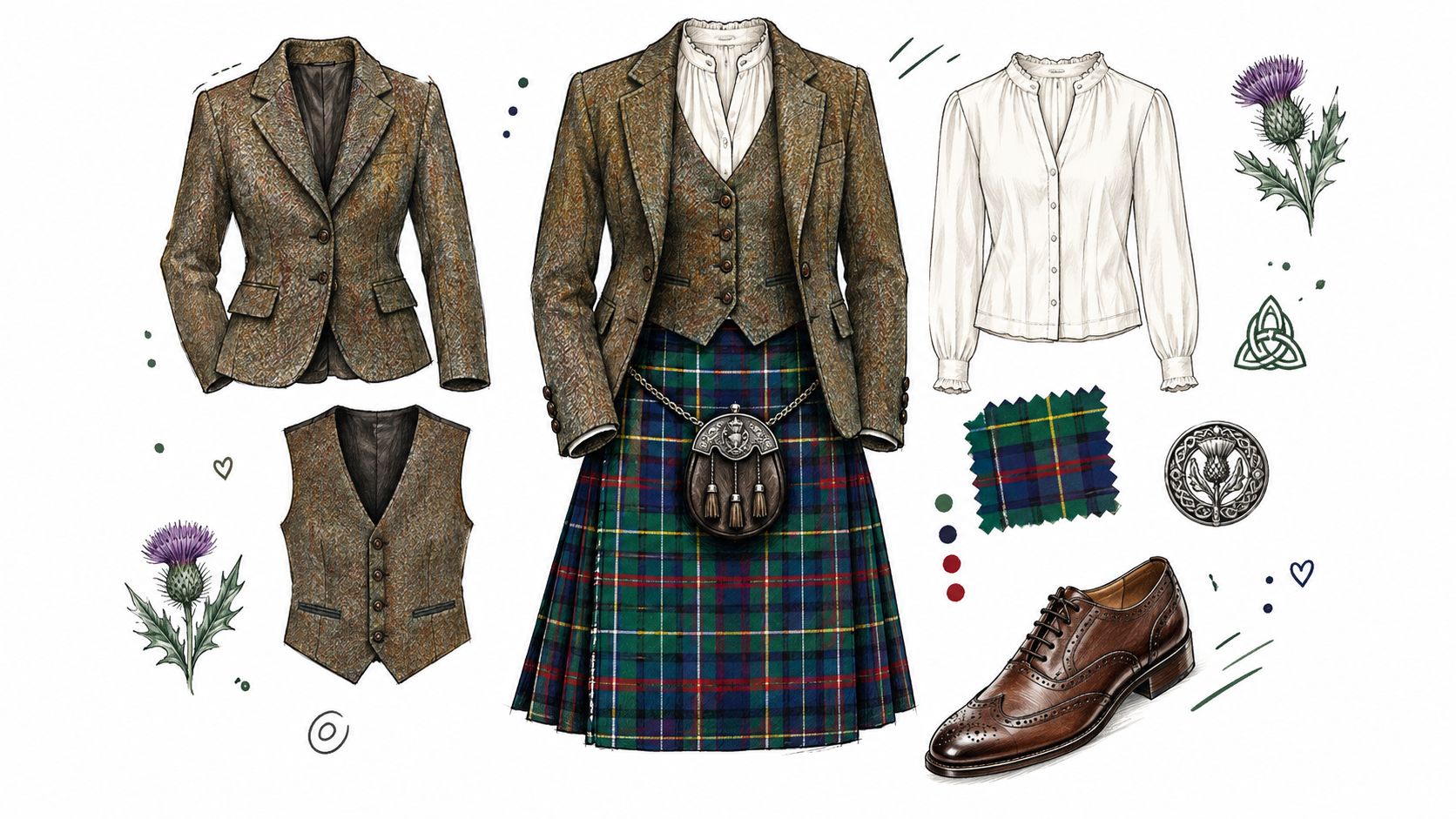
| Component | Traditional option | Modern alternative | Placement note |
|---|---|---|---|
| Jacket | Tweed kilt jacket or Prince Charlie style | Fitted tailored jacket or waistcoat | Match formality to the event |
| Shirt or blouse | White shirt with jabot or bow tie | Fitted blouse | Collar choice follows jacket style |
| Sporran | Dress sporran on chain | Small day sporran | Sits just below the belt line |
| Hose and flashes | Knee-high wool hose with flashes | Plain hose | Flash sits on the outer side of the hose |
| Footwear | Ghillie brogues laced to the calf | Plain black brogues or flat shoes | Lacing follows the traditional pattern |
| Belt | Leather belt with buckle or belt set | Plain leather belt | Holds the kilt at the chosen rise |
If a full kilt outfit feels like too much tartan for the occasion, a ladies tartan sash over a plain dress is the traditional lighter option and still shows your colours.
Watching someone dress in the right order is clearer than reading about it, so use this demonstration alongside the steps below.
Finish with a side view in a mirror. The pleats should lie flat, the front apron should hang straight, and the hem should look level. If the hem tips up at the back, the kilt is probably sitting too low at the front.
The UK generated 1.4 million tonnes of post-consumer textiles in 2022, of which 44% was incinerated with energy recovery, 29% sent overseas, 18% resold and only 2% recycled domestically, while 2025 research found 32% of UK adults had thrown away brand-new clothes in the previous year, as this report on UK textile waste and disposal sets out. The most sustainable kilt is the one you wear repeatedly and keep in good order.
| Garment | Cleaning | Storage | When to repair, alter or pass on |
|---|---|---|---|
| Wool kilt | Air after each wear; dry clean only when soiled | Hang or lay flat in breathable bag; use moth protection | Repair hem or pleat stitching; pass on when it no longer fits |
| Polyviscose kilt | Machine wash on a gentle cycle, following the label | Hang or fold along pleat lines | Replace when the pleat set no longer holds |
| Ex-hire kilt | Check cleaning history before first wear | Same as wool, or as the label directs | Alter where possible; resale extends its life |
| Tweed jacket | Brush after wear; spot clean; dry clean when needed | Hang on a wide hanger | Repair lining or buttons; donate when outgrown |
| Sporran and accessories | Wipe leather; keep metal dry | Store in a dry box | Replace worn straps or chains |
Four habits prevent most damage. Air or brush the kilt after each wear instead of cleaning it. Wear it for several occasions before it needs a clean. Store it hung or flat with the pleats held in shape, in breathable storage. Protect wool from moths, which do more harm in a wardrobe than wear does.
Is durable wool better than hiring or a washable blend? It depends on how often you'll wear it, how long you'll own it, how it's cleaned, whether it can be altered, and whether it can be resold. Fibre content alone doesn't answer the question. Worn twice and discarded, wool is the worse choice. Worn for years, it's the better one.
When a kilt no longer fits, work in this order. Alter first, then resell or donate, and only then discard.
Run this checklist before you order anything. Each step prevents a specific, common return.
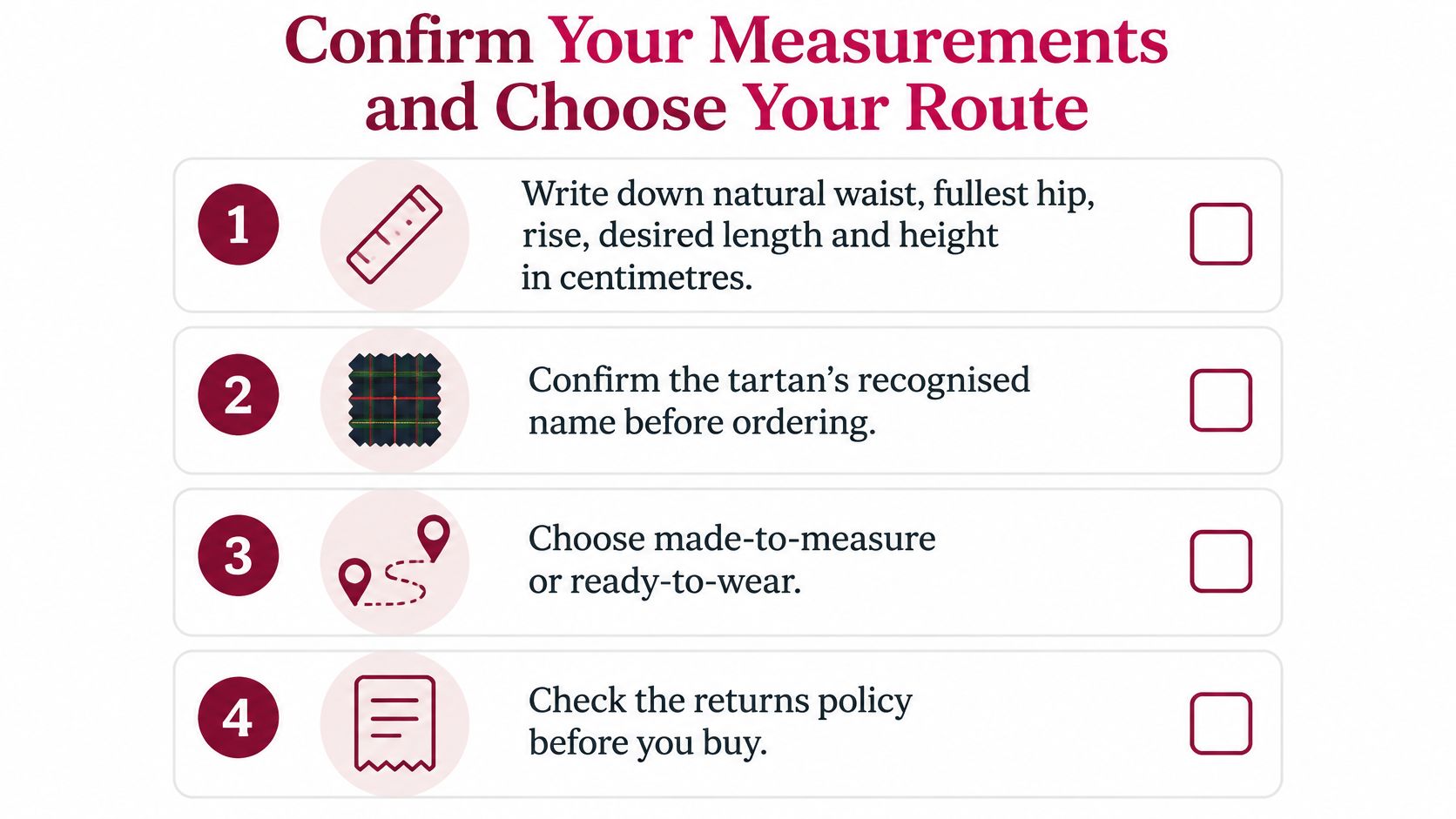
Unwritten measurements lead straight to bracketing, and an unconfirmed tartan name can produce a colour that doesn't match the swatch you were shown. Both are avoidable in about ten minutes.
We offer made-to-order bespoke 8-yard wool kilts chosen from hundreds of tartans, which suits the made-to-measure route when fit control matters most. We also offer kilt hire, jacket hire and full outfit hire for a single occasion. Our personal service guides you through the buying journey, so if your hip and waist point to different sizes, talk to us before ordering rather than guessing.
Before you pay: if you can't read your five measurements and your tartan's name off a piece of paper, you're not ready to order yet.
Order only once both are written down and confirmed. That's the whole discipline behind a kilt that fits first time and earns its place in your wardrobe.
Bring your five centimetre measurements and your chosen tartan name to Kilts4Less and we'll help you match them to a made-to-order kilt, an off-the-peg option or a hire outfit that suits your event. Tell us where you want the kilt to sit and how often you'll wear it, and we'll guide you to the route that fits first time.

Kilts4Less is Scotland’s best bespoke, handmade kilt and highlandwear company since 1983.
Specialists in made-to-order handmade kilts, kilt jackets, sporrans & also Scottish, Irish / American Tartan Hybrids. Don’t settle for cheap alternatives – Buy Online at Kilts4Less – sale is now on!
Easy 30 days returns
30 days money back guarantee
100% Secure Checkout
PayPal / MasterCard / Visa