
You're standing in front of the mirror on the wedding morning, jacket on, shirt fastened, with a bow tie and cummerbund still in their packaging. The outfit looked straightforward at the fitting, but now the bow seems too wide and the waistband feels awkward. Before you tighten anything or add another accessory, check what the outfit needs.
The wedding car is on its way, someone's looking for the cufflinks, and you're trying to work out whether the pleated band belongs above or below the waist. This is when a little preparation pays off. Treat the accessories as part of the outfit's fit, rather than decorations you attach at the last moment.
The bow tie finishes the shirt collar and draws attention towards your face. The cummerbund handles a different job, tidying the transition at the waist. Getting them right means considering the jacket, shirt and lower half together, not choosing a matching set from a box.
For a dinner-jacket outfit, work from the stated dress code. For Highlandwear, begin with the jacket and any accompanying waistcoat, then decide which accessories belong with that combination. Don't assume every formal kilt outfit needs everything you'd wear with evening trousers.
If you're dressing for a Scottish ceremony, the guide to Scottish wedding traditions provides useful context alongside the couple's instructions. For a destination celebration, Princess Apulia®’s Puglia wedding attire for men is a relevant planning resource to consult before settling the groom's outfit.
A wedding colour scheme shouldn't overrule the invitation. Nor should a traditional-looking accessory justify a poor fit.
Practical rule: Judge the outfit fully dressed, not the accessories separately on a hanger.
That means checking the bow against the actual collar and the waist covering beneath the actual jacket. A coordinated set isn't automatically a successful outfit if either piece fights the clothes around it.
British evening dress didn't emerge as a complete, fixed uniform. Its accessories developed through changing fashions, tailoring decisions and the adaptation of garments from elsewhere. That history helps explain why some details remain useful while others deserve a more flexible approach.
The bow tie's predecessor was the European cravat, connected to neck scarves worn by Croatian mercenaries during the seventeenth-century Prussian wars and subsequently adopted by French upper-class society; the later transition into the bow tie and necktie is historically uncertain, while the British dinner-jacket milestone associated with the Prince of Wales and Henry Poole & Co. in 1885 helped establish the evening outfit now worn with a formal bow tie, as outlined in Eton's black-tie dress-code guide. The useful distinction is between the accessory's broader European ancestry and its place in British evening tailoring.
The timeline gives a visual overview of those developments.
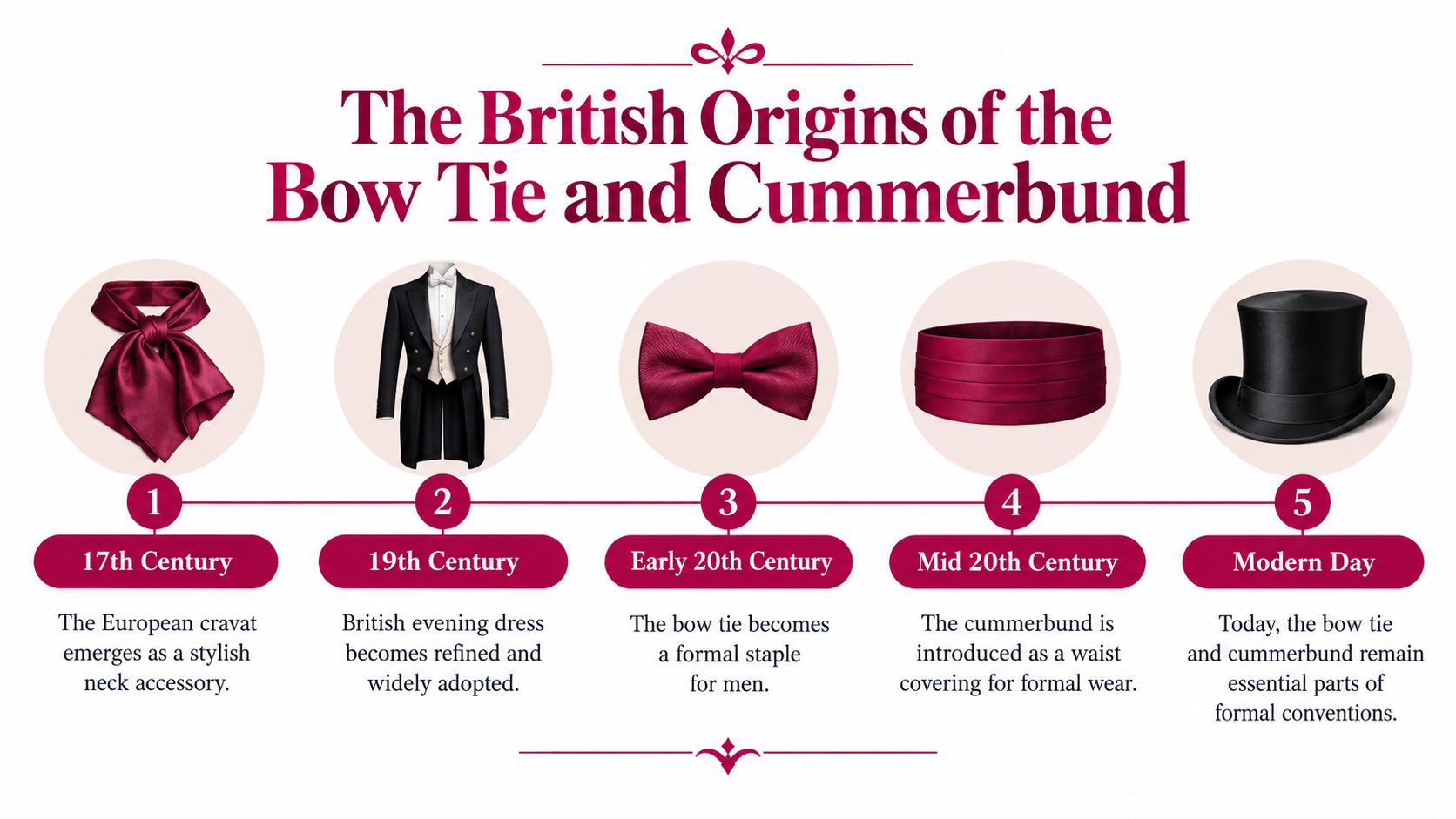
The cummerbund entered British formalwear through officers in India during the 1850s, who adopted the local kamarband-style sash as an alternative to a warmer waistcoat; its later evening-dress role was to conceal the waistband, with traditional guidance specifying silk satin, grosgrain or barathea and upward-facing pleats, as documented in the history and conventions of black tie. Its roots therefore lie in colonial India, not an exclusively British invention.
That practical beginning is worth remembering when choosing an outfit today. There's little sense in using a garment associated with comfort as an excuse to endure an uncomfortable evening.
The strongest modern interpretation preserves the intention behind the clothes. Start with an appropriate jacket, keep the shirt and neckwear coherent, and choose details that serve the wearer. You don't need to reproduce a historical outfit to dress respectfully for a formal occasion.
Practise with the shirt you'll wear, rather than learning around an open collar and hoping the result transfers. Fasten the collar first and check that you can swallow comfortably. If the shirt is already restrictive, adjusting the bow tie won't solve the underlying problem.
Use the illustration to recognise the front bow and the loop that forms behind it.
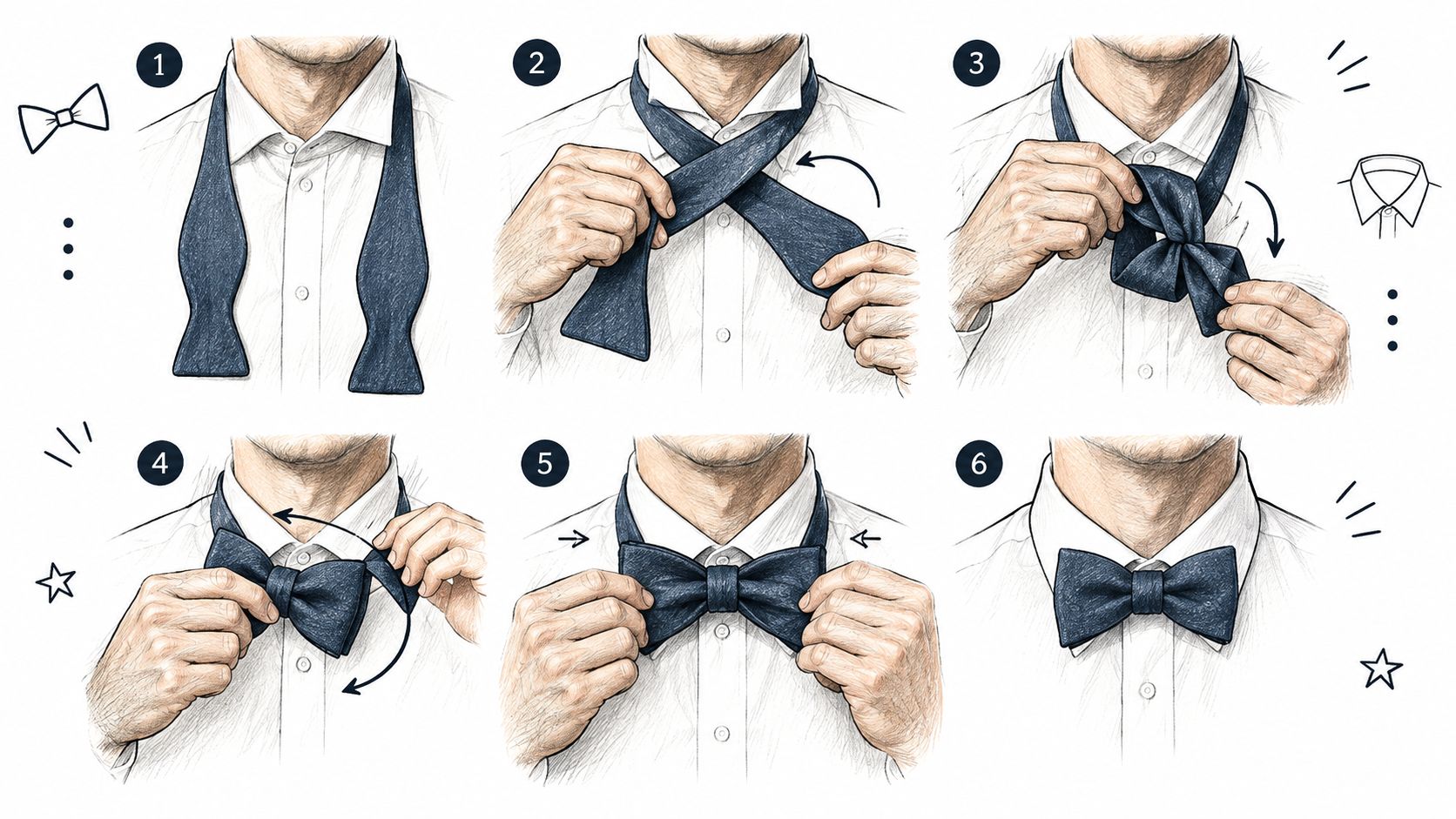
Drape the tie around your neck with an end hanging slightly lower than the other. Cross the longer end over the shorter one, bring it underneath and up through the neck loop, then rest it over your shoulder. Keep this starting knot secure but loose enough to work with.
Fold the shorter end across its broadest part to make the front bow, holding it horizontally against your collar. Bring the longer end down over its centre. Pinch the front bow's wings together to reveal the small opening behind the centre wrap.
Fold the hanging end back on itself and push the folded edge through that opening. Don't feed the loose tip through, which produces the wrong shape. You should now have a folded loop and a loose end on each side.
Pull gently on the folded loops to settle the knot, then use the opposite loose ends to adjust the shape. Alternate between them instead of yanking at everything together. If the bow sits off-centre, ease the knot and reposition it against the shirt fastening before tightening again.
Watch the hand movements if you're struggling to find the opening behind the front bow.
With a wing collar, inspect the exposed neckband and collar tips from the side as well as the front. With a cutaway collar, check that the spread doesn't leave the bow looking isolated. Choose a different bow shape or shirt if the pairing still looks awkward after adjustment.
A self-tie bow needn't be perfectly symmetrical. Aim for a recognisable bow with a settled centre, not matching wings at any cost. If tying is impractical because of limited dexterity or genuine time pressure, a well-fitted pre-tied or clip-on option is a sensible alternative.
Choose the waist covering by wearing it, not by assuming the more traditional-looking option will suit you. A cummerbund and a low-cut waistcoat can produce different results beneath the same dinner jacket. The useful comparison is how each behaves standing, seated and with the jacket open.
Modern guidance connects the cummerbund's declining popularity partly with comfort concerns and recommends a secure rather than tight fit, with bow-tie proportions considered against the face and collar, in Paul Smith's black-tie dressing guide. That makes comfort a legitimate selection criterion, not a concession after everything else has been decided.
| Feature | Cummerbund | Low-Cut Waistcoat |
|---|---|---|
| Visual effect | A concentrated band across the waist | A longer area of coverage through the torso |
| Fitting priority | Secure position without abdominal pressure | Comfortable fastening without pulling |
| Seated check | Watch for rolling or bunching | Watch for strain across the front |
| Shorter torso | Check the band doesn't crowd the jacket opening | Check the length doesn't interfere with the lower garment |
| Larger waist | Confirm usable adjustment rather than maximum stretch | Assess room across both chest and abdomen |
| Jacket removed | Leaves the shirt more exposed | Retains more coverage |
For a shorter torso, try the cummerbund with the jacket on before deciding whether its depth works. If it occupies most of the visible shirt area, try another fit or compare it with a waistcoat. Don't fold the band over to make it narrower.
For a fuller abdomen, sit naturally during the fitting. A band that feels acceptable while you're standing tall may become irritating at the wedding breakfast. A waistcoat may feel more stable, but reject one that pulls at its fastening or lifts when you sit.
Choose the option you can wear comfortably without repeatedly adjusting it.
Check the waistband is covered without trapped folds of shirt. For classic cummerbund styling, use the upward-facing pleat arrangement described earlier. Never combine the cummerbund and waistcoat; contemporary British black-tie guidance treats them as alternatives, not layers.
For practical help assessing length and fastening, consult the guide to how to wear a waistcoat. Remember that a dinner waistcoat and a Highlandwear waistcoat shouldn't be treated as interchangeable because both cover the waist.
A Prince Charlie outfit, a black Argyll outfit and a tweed wedding outfit shouldn't be accessorised by copying the same dinner-jacket photograph. Start with the Highlandwear combination you've chosen. Where the jacket has an accompanying waistcoat, assess that outfit as a whole before considering any alternative waist treatment.
For a Prince Charlie combination supplied with a waistcoat, keep the front uncluttered and let the neckwear finish the look. Don't add a cummerbund over the waistcoat. For an Argyll outfit, agree the intended level of formality with the couple or hire provider rather than assuming the jacket name settles every detail.
Use the visual guide as a starting point for comparing textures, then test the actual garments together.
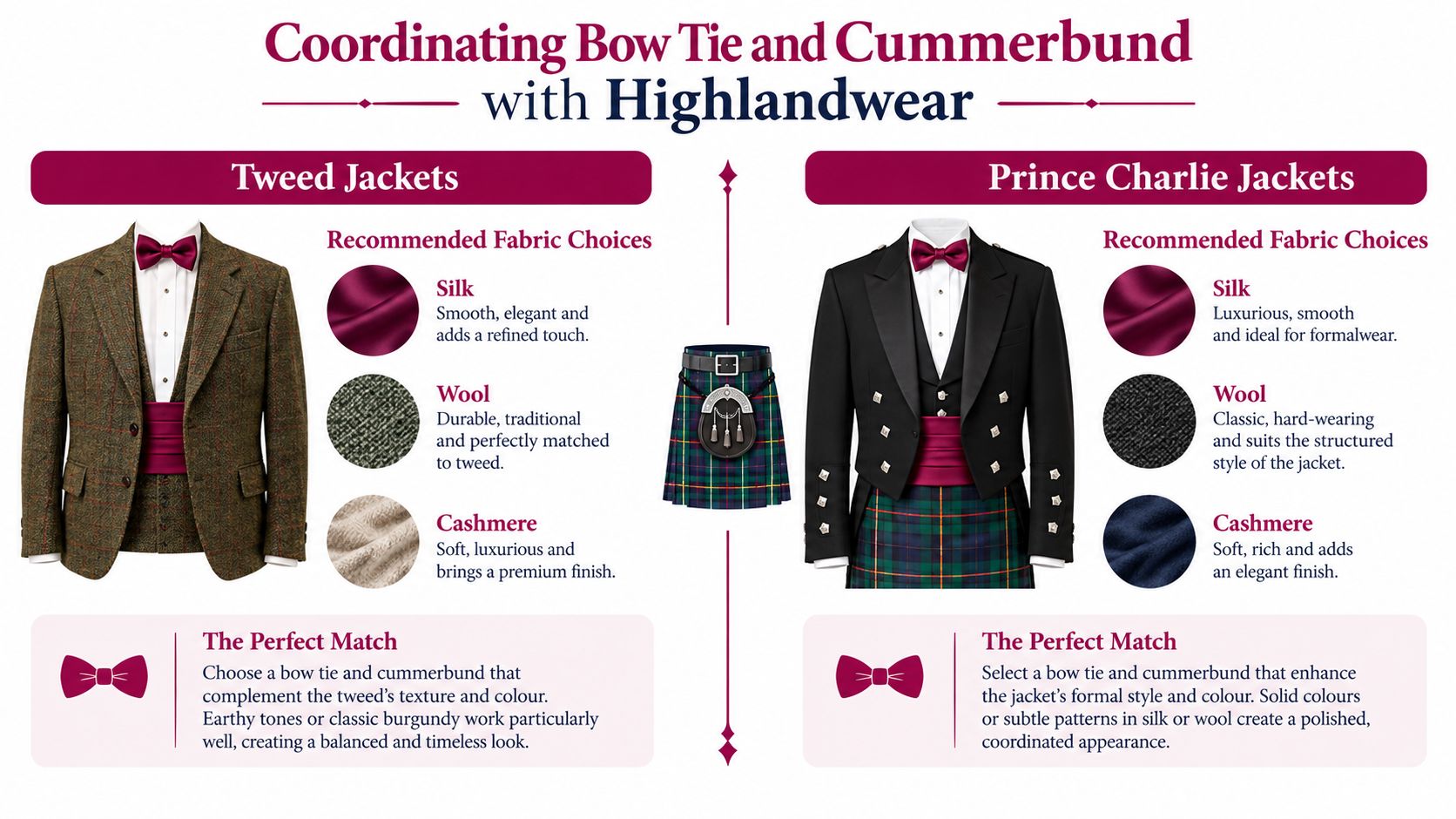
For an evening outfit, compare the bow tie's surface with the jacket's visible finish. Silk satin offers a different visual effect from ribbed grosgrain or quieter barathea. As a styling recommendation, choose related finishes rather than mixing conspicuous shine at the neck with an unrelated shiny band at the waist.
With tweed, try a restrained, textured bow before choosing a glossy matching set. A wool bow can be considered for a wedding that allows that interpretation, but it shouldn't be used to sidestep a strict dress code. View the fabric in daylight and under indoor lighting before committing.
Choose flashes with the tartan in view, then step back and assess the full outfit. Treat the sporran as another prominent feature rather than a reason to repeat every colour elsewhere. A tartan bow, tartan pocket square and strongly contrasting flashes can compete for attention.
If you want pattern at the breast pocket, the tartan pocket square guide offers a focused place to consider that choice. Keep the shirt decision equally deliberate: compare a wing collar and standard collar with the finished outfit, rather than choosing the more elaborate option automatically.
The last check should reveal problems while you still have time to change something. Wear the complete outfit, including footwear, and use a full-length mirror. Looking down at your waist gives a distorted view and can conceal the very bunching you're trying to find.
For hired clothing, locate the bow tie's adjustment and the cummerbund fastening before the event. Confirm that each holds securely within its usable range. If an accessory only fits at the limit of its adjustment, raise that with the hire provider instead of relying on an improvised fix.
Use this checklist as a reminder, then judge your own outfit rather than treating the illustration as a rigid sizing formula.
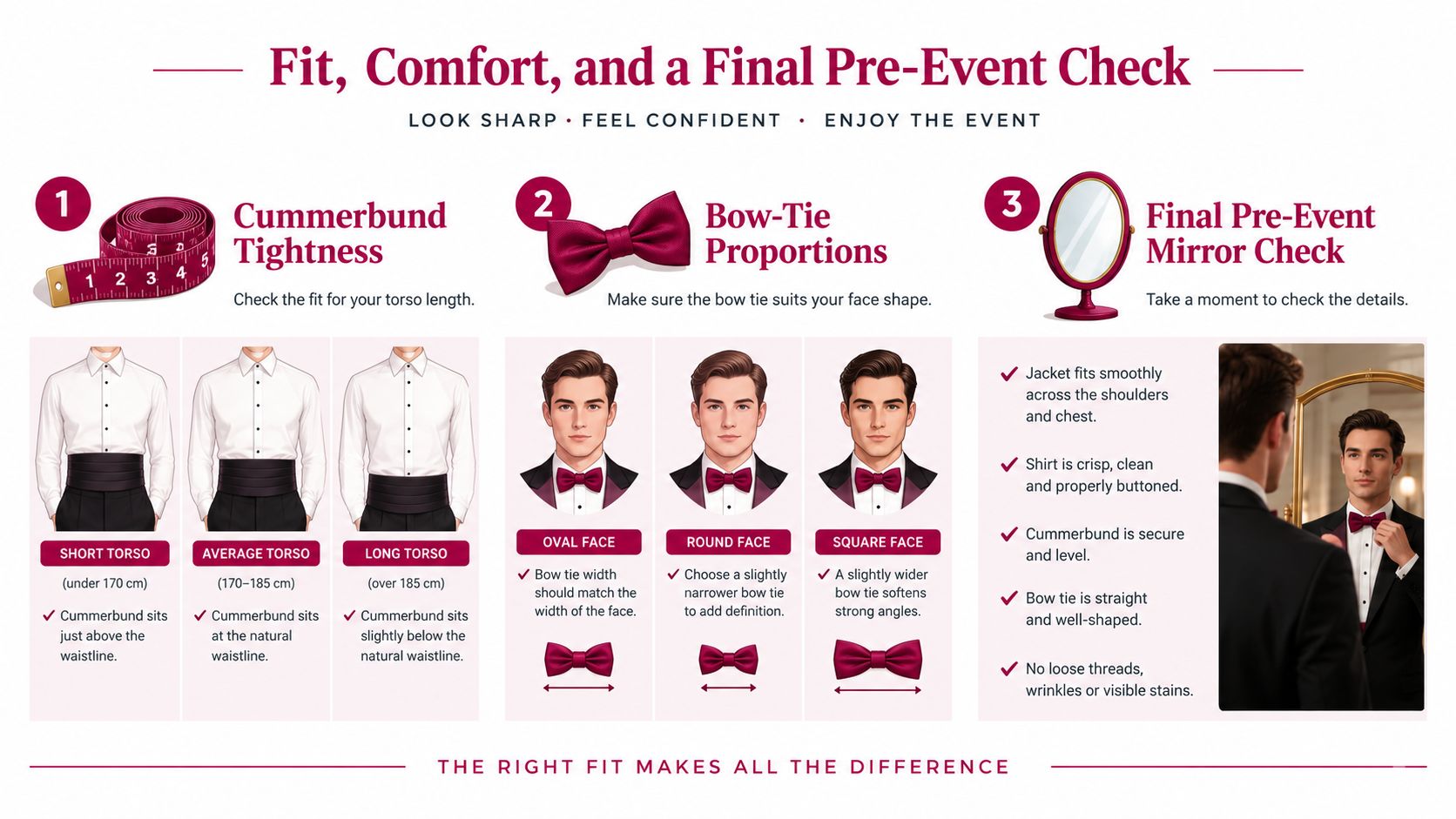
Don't apply a rigid face-width rule to the bow. Compare its proportions with your face, collar and jacket together, using the fit guidance discussed earlier.
If the bow slips, inspect the neckband adjustment before tightening the knot further. If the cummerbund shifts, check its fastening and the lower garment's position. Smooth displaced shirt fabric before readjusting the band, rather than trapping the folds beneath it.
For an overseas wedding, discuss the venue and clothing requirements before packing. Wedding Vendors In Mauritius' Wedding Vendors In Mauritius groom wear is a relevant resource when organising attire for a celebration there.
Before leaving: Ask someone else to check the back fastening and neckband. Those are difficult to inspect properly yourself.
A successful formal outfit shouldn't require constant supervision. You should be able to greet guests, sit through the meal and join the dancing without repeatedly checking your neck or waist. The final decision is about the outfit in use, not just how it looks while you stand still.
Think of the bow tie and cummerbund as tools for a composed appearance, not a compulsory pair that belongs with every jacket. British evening-dress history explains their purpose, while the actual wedding, Highlandwear combination and fit determine how you should use them.
There's no advantage in changing a comfortable, appropriate outfit because another guest has chosen different accessories. Equally, don't ignore a collar that pinches or a band that rolls merely because the matching set looked smart in its packaging.
For wedding parties, agree the visible finish but allow the fitting process to account for different builds. The groom and groomsmen can look coordinated without sharing identical accessory adjustments or forcing the same proportions onto everyone.
Once you've completed the movement and photograph checks, stop making cosmetic changes unless something needs attention. A little natural asymmetry in a self-tie bow is preferable to a knot repeatedly pulled out of shape. Leave with an outfit you can enjoy wearing.
Kilts4Less offers Highlandwear hire, complete kilt outfits, jackets, waistcoats and accessories including bow ties. Visit to compare outfit options for your wedding or formal event, and ask about the shirt, neckwear and waistcoat combination before arranging your fitting.

Kilts4Less is Scotland’s best bespoke, handmade kilt and highlandwear company since 1983.
Specialists in made-to-order handmade kilts, kilt jackets, sporrans & also Scottish, Irish / American Tartan Hybrids. Don’t settle for cheap alternatives – Buy Online at Kilts4Less – sale is now on!
Easy 30 days returns
30 days money back guarantee
100% Secure Checkout
PayPal / MasterCard / Visa