
You're in the fitting room with two jackets on the rail: a structured tartan jacket that looks right for a wedding, and a softer plaid overshirt you could wear most weekends. The choice isn't just about which colour suits you. It's about what the jacket is built for, how it fits over the clothes you'll wear, and whether it makes sense for the weather and occasion.
For men choosing plaid jackets in the UK, start with style, fabric, fit, occasion and care, in that order. A handsome check can't rescue a jacket that pulls across the shoulders or leaves you cold on a wet journey. I'd choose the jacket's job first, then judge the pattern.
Tartan has a particular place in British menswear. After the Jacobite rising of 1745, the 1747 Act of Proscription restricted civilian men and boys in Scotland from wearing specified Highland garments, including tartan outer coats and cloaks. The restrictions were lifted in 1782. National Museums Scotland describes how tartan later entered mainstream Georgian fashion, while George IV's 1822 visit to Edinburgh helped revive public interest in Highland dress. A tartan jacket can therefore be both a practical garment and a visible connection to Scottish dress history. (National Museums Scotland's account of tartan in Georgian Britain)
That heritage doesn't mean every plaid jacket belongs at a formal event. A wool kilt jacket is cut for Highlandwear; a tartan blazer can bridge smart and casual; an unlined overshirt is an everyday layer. Treating them as interchangeable is how buyers end up with a jacket that looks too formal for the pub or too relaxed for a ceremony.
The pattern itself can be traditional, modern, subtle or bold. The Scottish Tartans Authority describes a change from approximately 500 patterns before 1900 to more than 10,000 today, with named civilian tartans expanding in the late eighteenth century. That breadth gives you room to choose a check for its colours and character, not only its association. (The Scottish Tartans Authority's history of tartan)
Start with the occasion, not the colour. Once you know where the jacket has to work, the right construction becomes much easier to spot.
“Plaid jacket” describes a pattern, not a single cut. On the rail, sort the options into three style families before you look closely at the tartan. The collar, lining, buttons and intended outfit tell you more than the check alone.
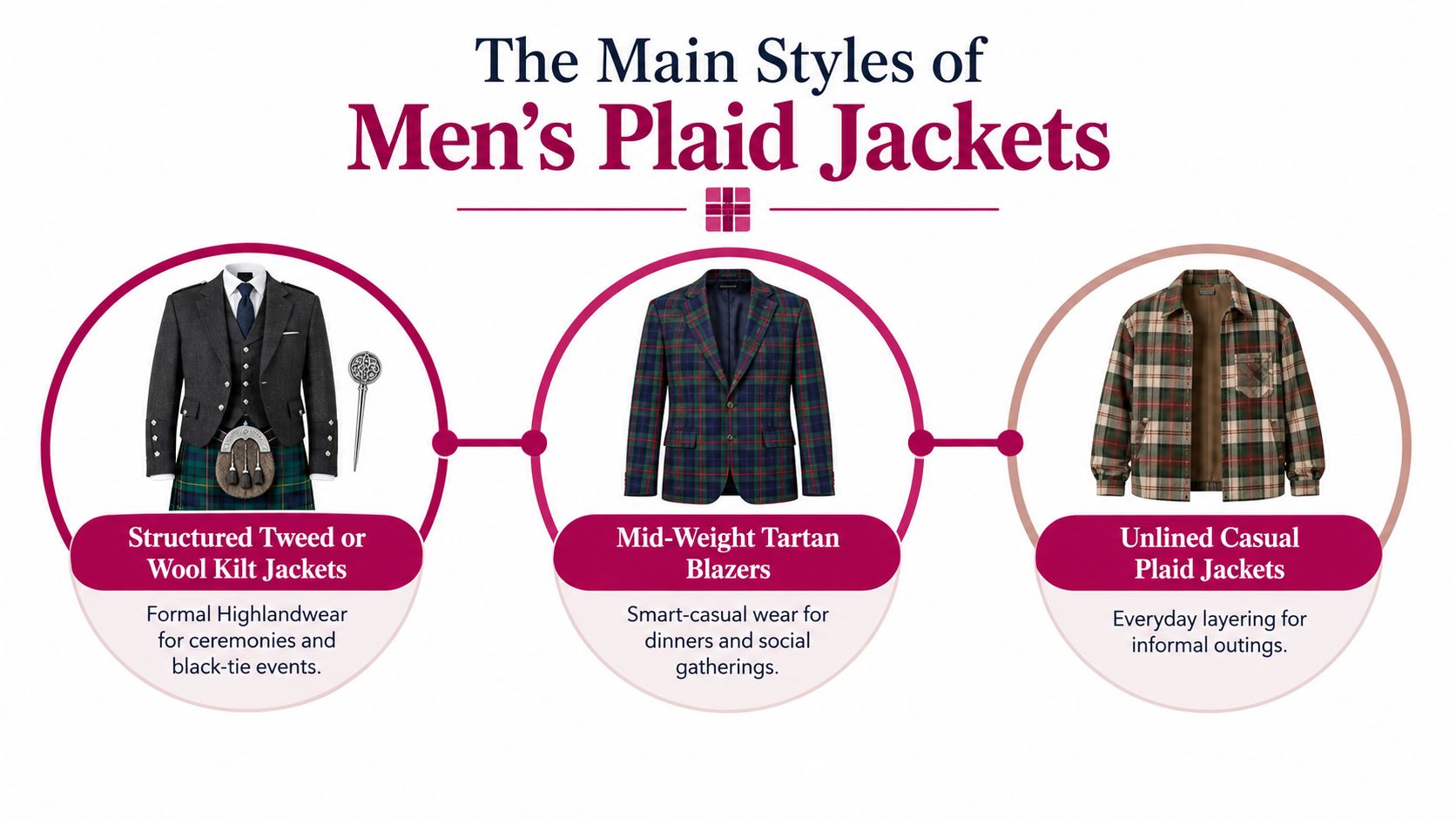
This is the formal Highlandwear choice. Argyll and Crail jackets are designed to sit with a kilt and the accessories that complete the outfit, rather than behave like ordinary office blazers. An Argyll commonly has traditional lapels and a more formal appearance; a Crail is recognisable by its distinctive buttons and shorter, close-fitting shape. Both are structured, usually lined, and made to look balanced with a kilt and waistcoat.
Pick this family for a wedding, ceremony or event where full Highland dress is expected. It can be worn with other fitted pieces, but don't assume its proportions will work as a standard suit jacket. The shorter cut is deliberate.
A tartan blazer is the bridge between Highland tradition and conventional smart-casual dressing. It tends to have a familiar blazer shape, with lapels, a more complete lining and a body length that works with trousers. Choose one for dinners, social events or an office that welcomes character in its dress code.
Look at how the tartan sits across the lapels and pockets. A busy check can feel loud when the jacket is paired with patterned shirts or trousers, so keep the rest of the outfit quiet.
An overshirt is the relaxed option. It's softer, less structured and easier to layer over a shirt or light knit. It suits casual outings and travel, but it won't replace a proper jacket for formal Highlandwear.
The quick test: if it's built around kilt proportions, treat it as a kilt jacket. If it looks like a blazer, style it with trousers. If it feels like a shirt with more weight, wear it as a layer.
Choose fabric for the conditions you'll wear the jacket in, not for an abstract idea of “autumn weather”. A heavy jacket can be excellent for a cold ceremony and cumbersome on a mild, damp day. For UK use, judge warmth, breathability, water resistance, drying and care together.
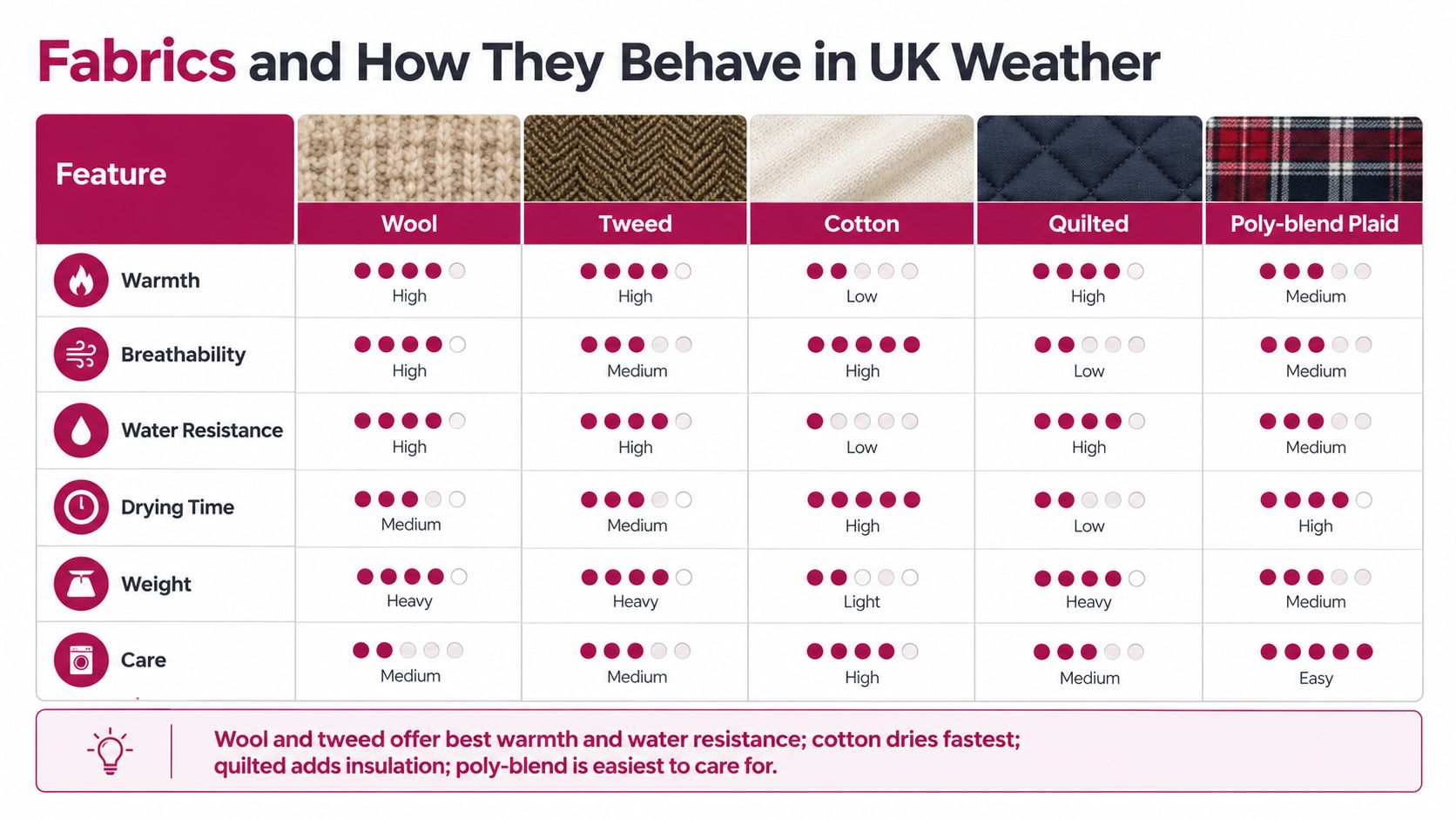
Wool and tweed are the strongest default for structured jackets and repeated cool-weather wear. They offer useful warmth and a substantial feel, but they aren't a substitute for a waterproof coat in prolonged rain. The UK Wool Innovation Action Plan reports that wool garments are typically washed at a lower average temperature than cotton garments, about 30.3°C compared with 41.1°C, and notes that wool textiles often last longer partly because they need less frequent washing. It also says wool is easier to reuse or recycle when it isn't blended with synthetic fibres. (UK Wool Innovation Action Plan)
Cotton plaid overshirts feel lighter and make sense on dry, mild days. They're not as warm as a lined wool jacket, and after getting wet they may take longer to dry than you'd like. Quilted jackets add insulation without the same structured feel, while poly-blends can be practical and easy to care for, though synthetic blends may complicate fibre-to-fibre recycling.
For anyone preparing a custom jacket, artwork prep for custom jackets offers a useful reference for thinking through design details before a garment is made. A tartan accessory can also add colour without another heavy layer; consider a cashmere scarf when you want warmth around the neck rather than a thicker jacket.
Forget “take your usual size” as a complete fitting plan. UK SizeUK research scanned approximately 5,500 men and recorded 140 body measurements across 50 anatomical landmarks, illustrating why one nominal size can't describe every build. Its sizing work also used consistent 5 cm grading intervals, with a central measurement and a ±2.5 cm tolerance for each size. (UK body-measurement research)
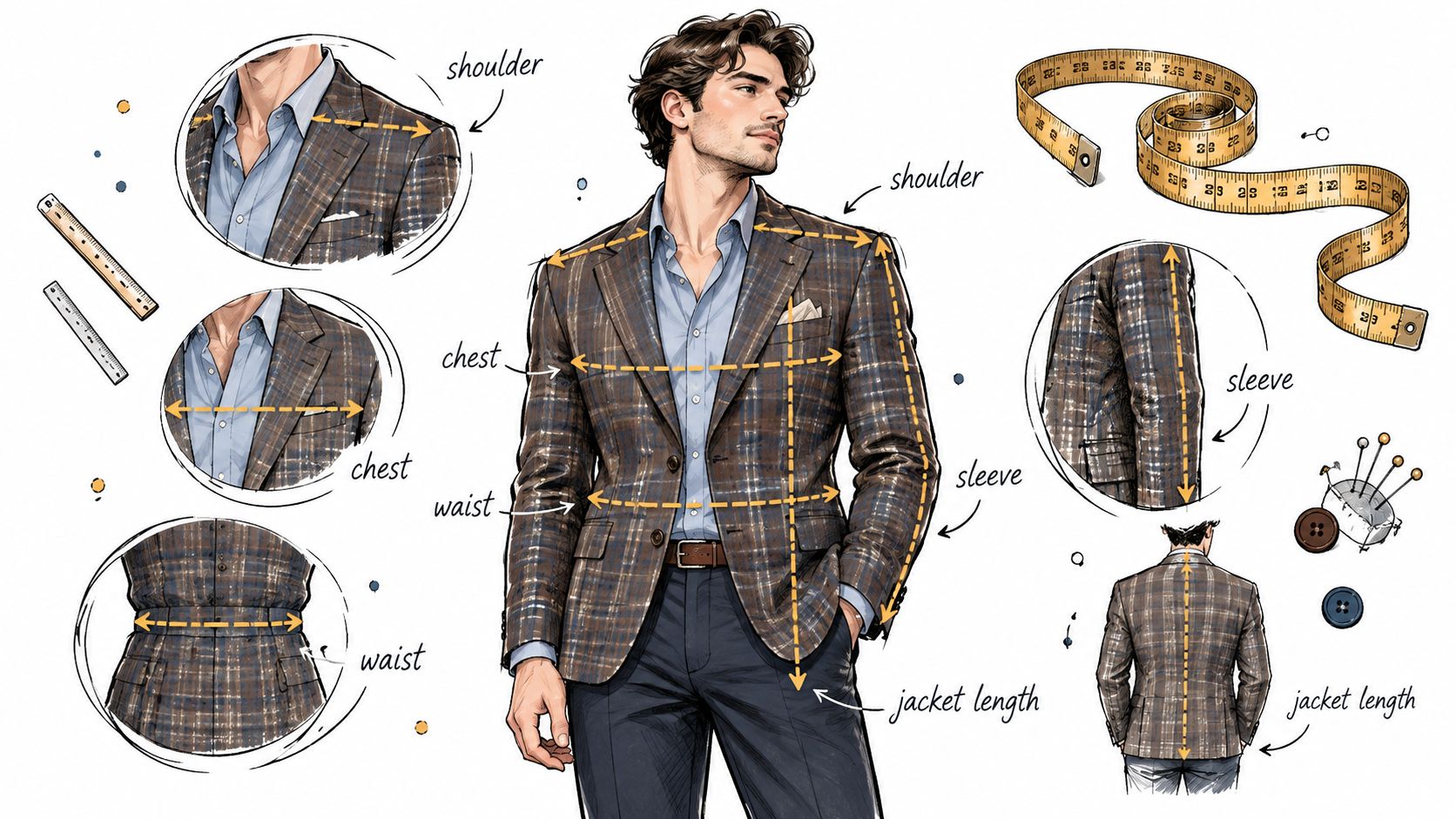
Measure in the shirt you'll wear with the jacket. If a waistcoat or jumper is part of the intended outfit, put it on too. Then compare your body measurements with the supplier's garment measurements, allowing enough ease for movement rather than expecting the jacket to match your body exactly.
The shoulder is the hard line. A tailor can often tidy sleeves and waist suppression, but a poor shoulder fit and tight upper arms are difficult to correct cleanly.
Here's a short demonstration of measuring a jacket accurately. Use it alongside the supplier's own guide, since measurement points can differ between brands.
For structured tweed, take movement seriously. Reach forward, sit down and fasten the jacket over the layers you intend to wear. If the arms bind or the chest strains, don't trust the label to make it right. Made-to-measure or alteration-friendly construction is worth considering when standard proportions repeatedly miss your shoulders, sleeves or torso.
The right choice depends on the event and the journey to it. A wedding guest may need a formal jacket that sits correctly with a kilt, while someone travelling to work may value a lighter layer they can take off easily. In the UK, don't make a purchase based on temperature alone: the Met Office recorded 403.4 mm of UK rainfall in autumn 2025, 120% of the 1991–2020 average, while the season was 0.43°C warmer than average. (Met Office seasonal assessment for autumn 2025)
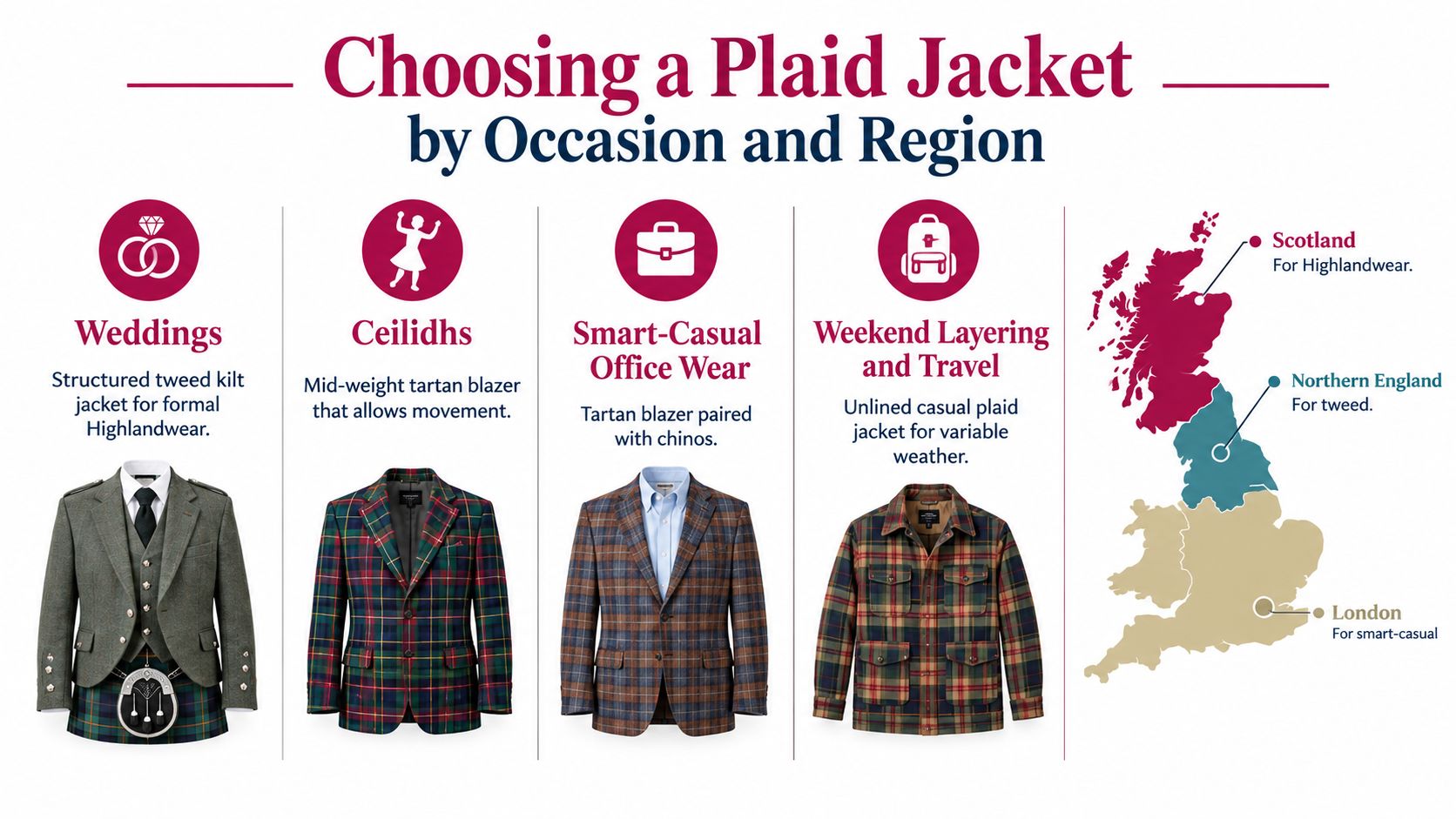
Weddings and ceremonies: choose a structured tweed or wool kilt jacket if you're wearing Highland dress. Fit it over the shirt and waistcoat you'll use, then check that you can sit and move comfortably.
Ceilidhs: a mid-weight tartan blazer is a sensible choice when you want a smart look with more freedom of movement. Avoid a tight upper arm; dancing will expose a poor fit faster than standing for photographs.
Smart-casual office wear: a tartan blazer with plain chinos gives the jacket room to be the focal point. Keep the shirt and accessories restrained if the check is strong.
Weekend layering and travel: an unlined plaid overshirt is the most useful option for dry, mild conditions. It's easy to remove, but take a weatherproof outer layer when rain is likely.
The regional overlay is practical, not rigid. In Scotland, Highlandwear can suit the occasion, but pack a waterproof layer for the journey. In Wales and Northern Ireland, prepare for wet conditions with a shell over the jacket rather than relying on wool or cotton to repel sustained rain. Across England, choose by use: a tweed jacket works for a formal or country setting, while a lighter tartan blazer or overshirt is easier for everyday wear.
For a formal outfit, coordinate accessories with restraint. A tartan pocket square can echo the jacket's colours, but it doesn't need to match every part of the tartan exactly.
Fit matters more than following a slim-fit template. The scale of the check, button position and jacket length all change how a plaid jacket reads on your frame. Large, high-contrast checks can make the torso look broader; smaller checks and tonal plaids are usually easier to wear when you want a quieter effect.
If you're broad through the chest, choose a jacket that closes cleanly without pulling and avoid a check that adds more visual width than you want. If you're slimmer, a textured wool or a clearer pattern can give the outfit presence, but don't let the shoulders extend beyond your natural line.
For a shorter build, check the jacket length carefully. A body that runs too long can overwhelm your proportions; a kilt jacket's shorter cut is designed for Highlandwear, not as a shortcut to a shorter blazer. Taller men should look for enough body and sleeve length so the jacket doesn't appear undersized.
The sleeve should finish at the wrist in a way that lets the shirt cuff show naturally, without leaving the arm looking bare. If you want to wear a jumper underneath, fit the jacket over that jumper rather than buying a larger size by guesswork. Sizing up can create excess width at the shoulders and waist without solving the underlying problem.
Pattern mixing needs discipline. With tartan trews or other patterned Highlandwear, choose one dominant pattern and let the rest support it. (Plaid trousers for men can work as part of a considered outfit, but matching checks too closely often looks accidental.) If you're exploring a relaxed, oversized silhouette, tips from maxijournal.com can help you think through proportions; keep the shoulder fit intentional rather than buying too large.
A 2024 study cited by British GQ found that 43% of British men consider clothes shopping highly stressful. (British GQ on the fit challenges facing men) That's a good reason to judge the actual jacket on your body, not the size on its label. A confident fit will outlast a trend.
Buy a jacket you'll wear repeatedly. Hire one if the event calls for a specific formal style you're unlikely to use again, or if you need a complete Highland outfit for a single occasion. Buying makes more sense when the jacket suits your wardrobe beyond one wedding.
Made-to-measure is useful when standard jackets consistently miss your shoulders, arms or body length. If that isn't practical, compare off-the-peg and ex-hire options, then check the shoulders, lining, buttons and sleeve condition in person. For a family event, confirm children's sizing early so their jacket and accessories can be prepared alongside the adults' outfits.
Air the jacket after wearing it, brush off surface dust and store it on a shaped hanger. Spot-treat spills promptly, and dry-clean a wool or tweed jacket only when necessary. Frequent washing can distort the structure or affect the lining and interfacings.
Check the care label before buying. If you want easier garment care, Kilts4Less offers polyviscose kilts with machine-washable care characteristics, though that doesn't mean every jacket or component in an outfit can be washed the same way.
Before your next event, use this checklist:
For a wedding, ceremony or Highlandwear outfit, visit Kilts4Less to explore tartan and tweed jackets, made-to-measure and off-the-peg garments, and jacket hire. Choose the construction that suits your event, then check the measurements and care requirements before you order.

Kilts4Less is Scotland’s best bespoke, handmade kilt and highlandwear company since 1983.
Specialists in made-to-order handmade kilts, kilt jackets, sporrans & also Scottish, Irish / American Tartan Hybrids. Don’t settle for cheap alternatives – Buy Online at Kilts4Less – sale is now on!
Easy 30 days returns
30 days money back guarantee
100% Secure Checkout
PayPal / MasterCard / Visa