
You're standing in a hotel room or a kitchen, jacket on a chair, kilt already pressed, and the last thing to decide is the pocket square. That's the moment a lot of outfits go wrong, because the tartan pocket square is small but never neutral. In a Highlandwear look, it can sharpen the whole outfit, or it can turn the chest into a second tartan panel if you overdo it.
The trick is hierarchy. If tartan is already present in the kilt, trews, waistcoat, or tie, the pocket square should usually support the outfit rather than compete with it. That's why a carefully chosen square can make a tweed jacket look finished, while an identical repeat of the same bold sett can make even an expensive outfit look busy.
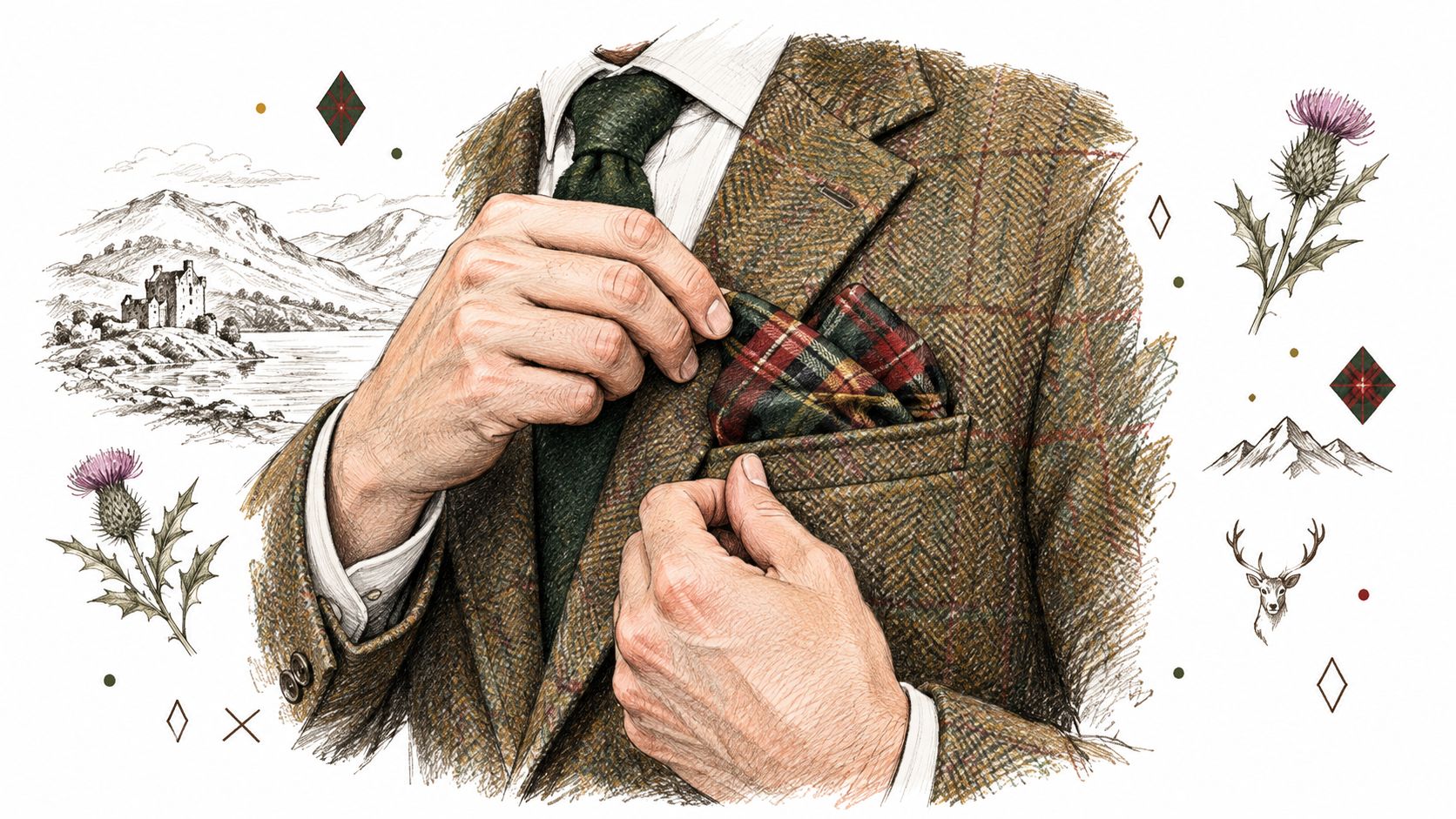
The Scottish Register of Tartans shows why this matters. It was created by the Scottish Parliament in 2008 and managed by National Records of Scotland, and by April 2025 it had reached its 10,000th design, the 131 Argyle tartan created for Diocesan Boys' School in Hong Kong, with records spanning families, cultural organisations, sporting clubs, companies, films and television productions as reported by National Records of Scotland. In practice, that means a tartan pocket square can signal a specific association, not just a decorative pattern. If you want a broader accessory guide to layering rather than clashing, how to accessorize an outfit is a useful companion read. For wedding context, Scottish wedding traditions also helps frame where tartan belongs and where it should stay quiet.
Practical rule: when tartan is already carrying the story, the pocket square should edit that story, not rewrite it.
For a tweed jacket, that edit can be subtle and still effective. For a Prince Charlie outfit, it needs to be even more controlled because the jacket already brings structure and formality to the chest. In both cases, a plain linen square can be the cleaner answer if the rest of the outfit is already doing enough work.
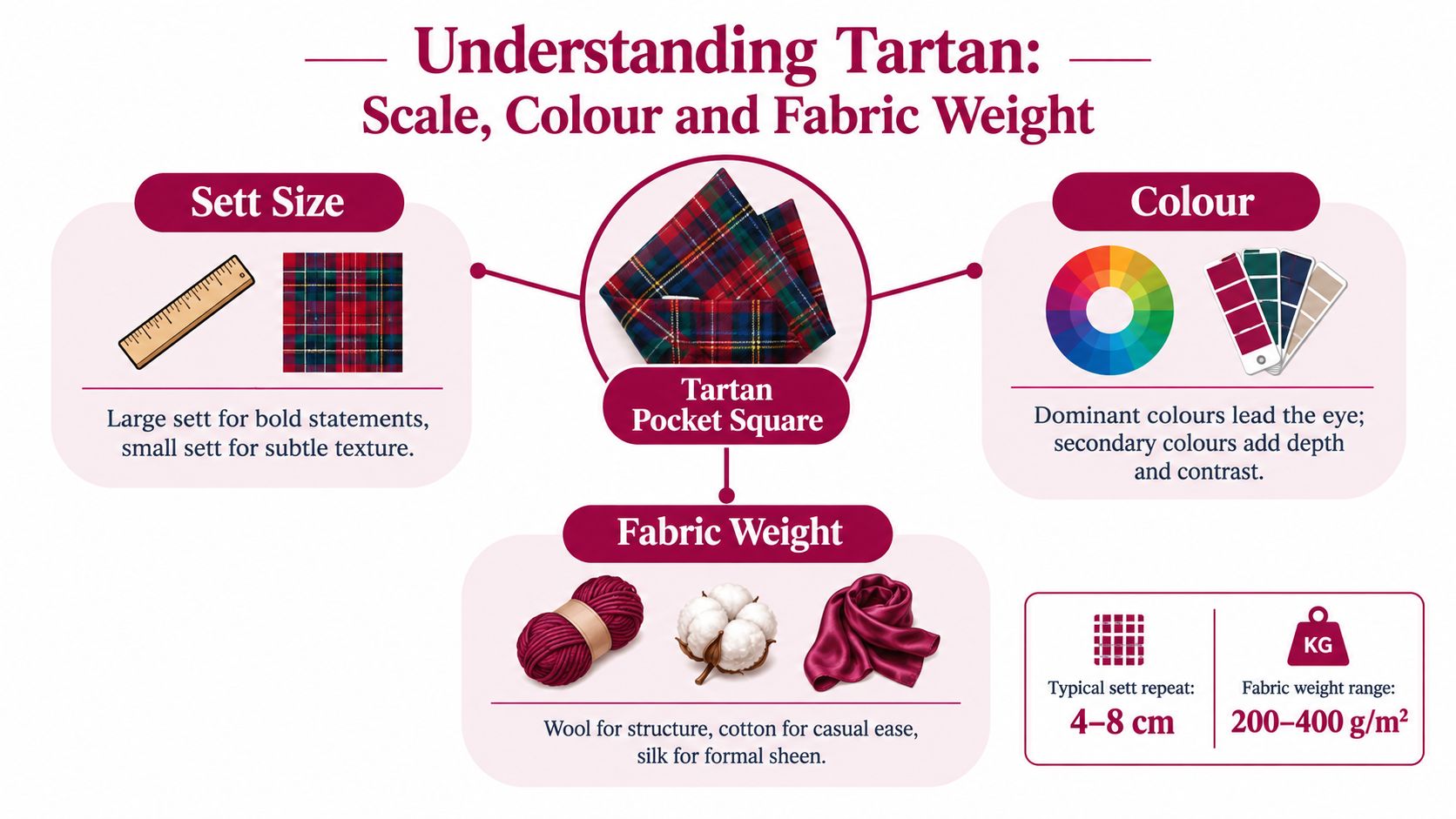
A tartan pocket square reads differently from a tartan tie because the square sits in a tighter visual field. The eye only catches a fragment of the sett, so scale matters more than it does on a kilt. A large check that looks elegant on cloth can feel loud in a breast pocket, while a tighter sett often gives you the same identity with less visual noise.
Think in terms of what the pocket can show. A large sett gives you bold blocks of colour, so it works best when the outfit around it is calm. A smaller sett gives texture first and pattern second, which is usually safer with tweed, a patterned waistcoat, or a checked shirt.
The Scottish Register of Tartans also shows that tartan is both heritage and living design. Scotland's parliamentary evidence in 2008 described tartan-related activity as supporting more than 7,000 jobs, around 0.5% of employment, with a direct contribution of £350 million to Scottish GDP and a broader valuation of about £500 million as recorded in the parliamentary debate summary. That scale is useful context because a small accessory is part of a much larger textile ecosystem, not a novelty item. If you're weighing cloth options, a traditional weave such as Lochcarron 13oz medium weight Braeriach tartan cloth shows how structure changes the finished look.
Dominant colours lead the eye, secondary colours do the quieter work. If your tartan includes a strong red or green, let one of those tones echo the tie or waistcoat, then leave the rest of the outfit plain. If the square is high-contrast, simplify the rest of the chest area so the pattern doesn't fight for attention.
A tartan square should feel like a detail that belongs to the outfit, not a miniature banner pinned to it.
Fabric weight decides how that detail sits. Wool keeps edges crisp and is useful when you want a defined fold. Cotton is easier-going and suits informal daywear. Silk brings sheen and movement, which is why it looks best when you want soft volume rather than a hard edge. In a narrow breast pocket, heavier cloth can create visible bulk, so a fabric that holds shape without swelling is usually the better choice.
At the fitting table, the mistake is usually obvious. The square is either doing too much, or it has vanished into the jacket.
The cleaner approach is a simple decision framework. Match the kilt tartan exactly only when the event is formal, the rest of the outfit is quiet, and the pattern scale is strong enough to carry that repetition. Coordinate one colour when you want the tartan to read as part of the outfit without repeating the sett. Switch to plain linen when the jacket is patterned, the tartan is bold, or the dress code asks for restraint.
| Outfit scenario | Square choice | Tie and waistcoat rule |
|---|---|---|
| Highland wedding with kilt and waistcoat | Exact match can work if the rest is plain | Keep tie simple and avoid another busy pattern |
| Tweed daywear | Coordinate one colour from the tartan | Plain tie, ideally in a secondary colour |
| Charcoal suit with trews | Match the kilt tartan only if the chest is otherwise quiet | Repeat one colour, change shade or texture |
| Black-tie or evening formalwear | Plain linen often wins | Keep the tie and pocket square from competing |
| Burns supper or rugby social event | Colour borrow or partial match | Allow a little more pattern, but not a full repeat |
| Funeral or memorial | Plain, restrained square is safer | Keep everything subdued and avoid contrast |
Exact matching can work for groomsmen, family groups, or any wedding party that needs a clear visual line. It also suits a plain jacket, where the tartan is meant to carry the identity of the outfit. The problem starts when the same sett shows up on the kilt, waistcoat, tie, and square together. That reads multiplied, not polished.
A good test is to ask whether the square adds a detail or repeats what is already visible. If the kilt already sets the tartan, the square usually works better when it borrows one of the quieter colours from the sett. That keeps the chest area calm and gives the eye one clear focus.
If you want to see how a bold sett such as the Gordon tartan kilt reads at full scale, compare it against the fragment a pocket square shows. With a strong tartan, the square often needs to step back. A tweed jacket or dark suit can handle a borrowed colour, but it rarely needs another full repeat.
For men who want a visual reference for restrained, polished event styling, the Image Studio wedding aesthetic guide makes the point clearly. Restraint often reads as more expensive than repetition, and borrowing a colour from the sett feels more considered than copying it everywhere.
The rule I use most often is simple. The more tartan already present below the waist or across the chest, the less the pocket square should insist on being seen.
The fold changes the message as much as the cloth. A structured tartan square in a flat fold says formal and controlled. A softer fold says social and relaxed. If the fold fights the fabric, the result usually looks amateur, even when the tartan itself is excellent.
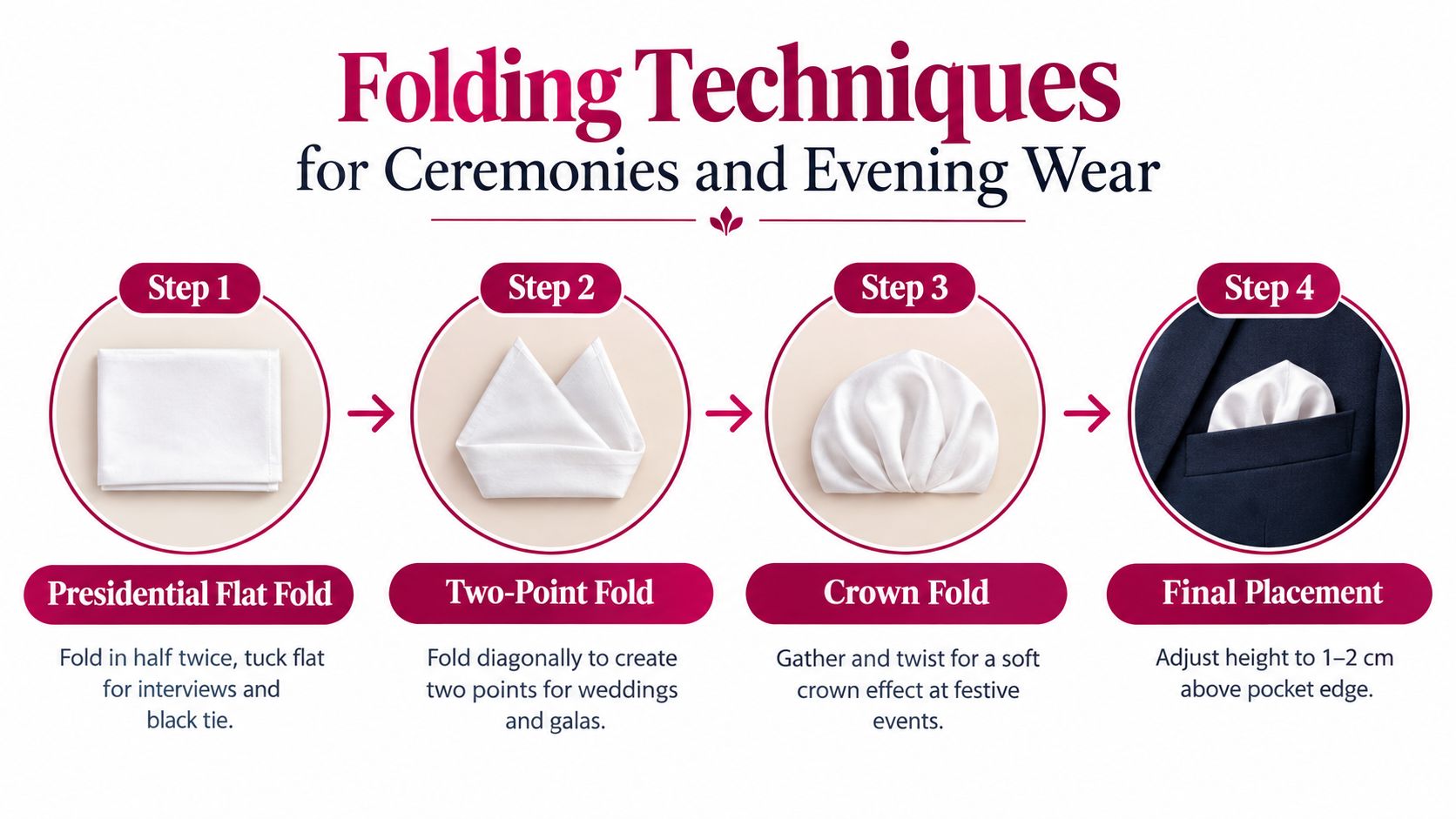
The presidential flat fold is the safest choice for interviews, black-tie dinners, and the more restrained end of wedding dressing. It keeps the top edge straight and gives the pocket square the look of a deliberate accent rather than a flourish. Wool and cotton are especially good here because they hold the edge without collapsing.
That same restraint helps when the tartan itself is bold. A high-contrast square in a tidy flat fold feels controlled, while the same cloth in a loose, high fold can turn the jacket front into a crowded focal point. If the pocket is narrow, keep the exposed height modest so the square doesn't bulge the jacket.
A one-corner fold gives a bit more personality without becoming fussy. It suits daytime ceremonies, receptions, and dinners where you want the outfit to feel dressed but not severe. It also works well when the square is coordinating with a tie in one of the tartan's secondary colours.
A soft puff fold is better for silk, especially when the setting is more relaxed and you want movement rather than shape. Silk drapes well, but that same drape means it needs anchoring inside the pocket. For that reason, silk reads best when the fold is allowed to be rounded and the rest of the outfit stays calm.
If the jacket is formal, make the fold formal. If the jacket is soft, the fold can breathe a little.
The movement of the jacket matters as much as the static look. Button the jacket, look in the mirror, and check that the square still sits where you want it. Sit down, walk a few steps, raise your arms, and see whether the square drops, twists, or swells.
A useful visual target is a visible edge that sits just above the pocket opening without dominating it. Too low, and the square disappears. Too high, and the breast pocket starts to look stuffed. This is one of those places where a careful fold beats a clever one every time.
If you're unsure which fold suits a particular tartan, the answer usually sits in the cloth itself. Crisp cloth wants a straight line. Fluid cloth wants a softer edge. The wrong fold rarely fixes a difficult tartan, but the right fold can make an ordinary one look excellent.
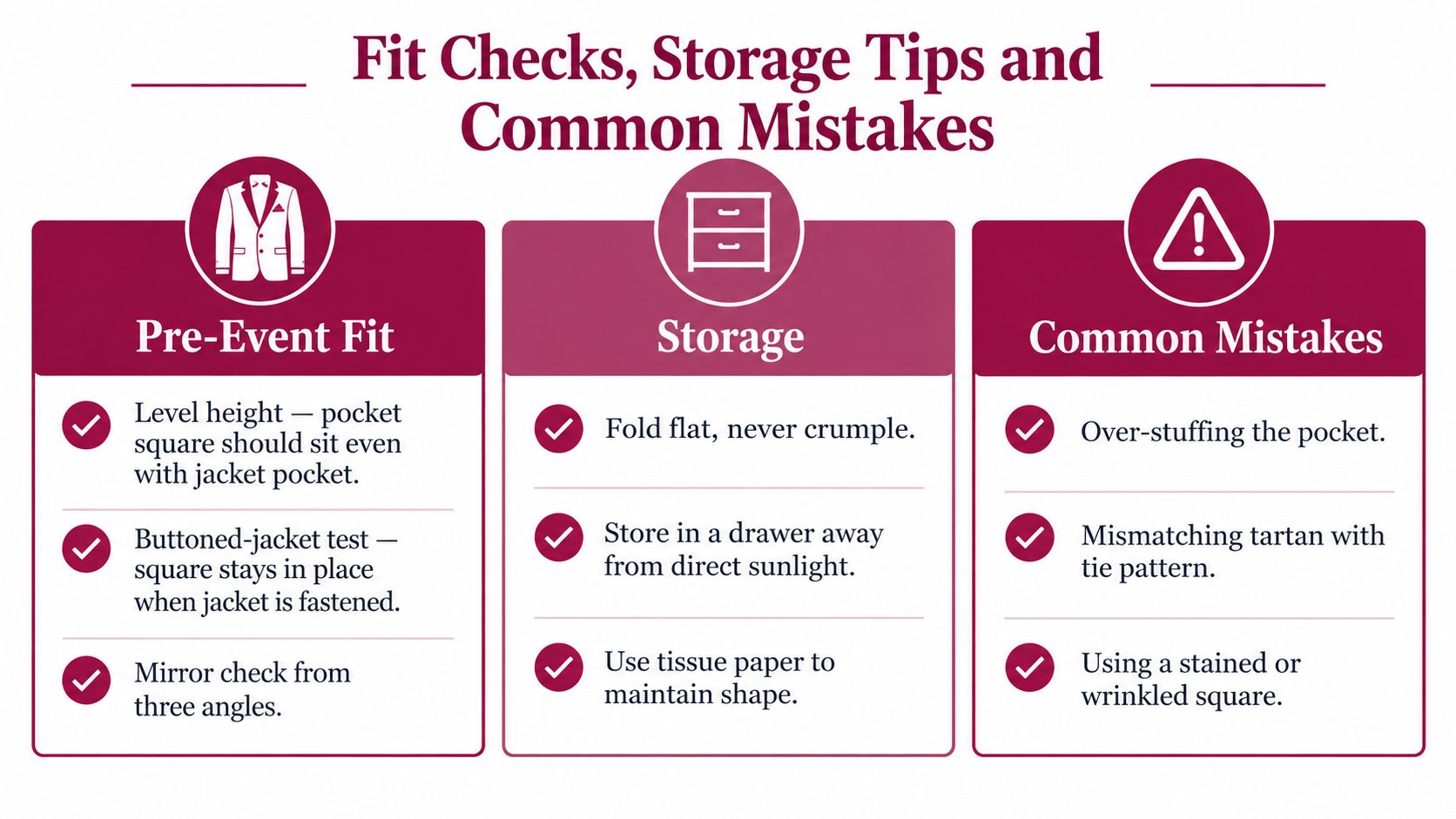
A pocket square should survive a wedding breakfast, a drinks reception, and a proper amount of movement without needing constant rescue. That's why fit checks matter before you leave the house. They're quick, but they tell you more than a mirror does on its own.
Start with the pocket square in the jacket you're wearing, not on a table. Check that the visible edge sits level and only modestly above the breast pocket opening. Then button the jacket and make sure the square still looks balanced rather than skewed to one side.
The movement test matters because a square can look fine while standing still and fail as soon as you sit or walk. Raise your arms, sit down, then stand again. If it collapses, adjust the exposed height, switch to a more anchored fold, or move to a more stable cloth such as wool, cotton, or linen.
For silk, size matters as well as fold. A silk tartan pocket square should generally be at least 40 cm by 40 cm because smaller silk squares are more likely to slide down in the pocket; if the square collapses during movement, reduce the exposed height, use a fuller anchored fold, or choose a steadier cloth as noted in this pocket-square guide. That's the practical difference between a neat finishing touch and a square you keep fishing out mid-evening.
Flat storage is the safest option. Don't crumple the square into a drawer. Fold it lightly, keep it away from direct sunlight, and use tissue paper if you want to preserve the shape between wears. That's especially helpful if the square is made from a cloth that shows creases easily.
Common mistakes are usually mechanical, not aesthetic. Over-stuffing the pocket creates a swollen front. Using a stained or wrinkled square makes the outfit look unfinished. Pairing a tartan square with another busy pattern on the tie or shirt usually creates visual friction rather than coordination.
The square should still look intentional after an afternoon of moving around. If it doesn't, the fold or the cloth is the problem, not the outfit.
For families and wedding parties, that durability matters because the same square may be worn again with a different jacket, handed on, or kept as a memory after the event. That's better value than a piece that only looks right once.
A good tartan pocket square doesn't shout for attention. It confirms the outfit. If the event is formal, a plain linen square often gives the cleanest result. If the outfit is already structured and the tartan below is strong, borrowing one colour is usually smarter than repeating the whole pattern.
Exact matching still has its place. It works best when the rest of the outfit is quiet, the wedding party is coordinated, or the square is part of a carefully controlled Highland look. Beyond that, restraint tends to age better. It also rewears better, because a square that coordinates instead of copies can move between jackets, season to season, without looking tied to one outfit.
The best Highlandwear is the kind that feels deliberate on the day and still useful after it. That means choosing a square you can wear with confidence, clean storage after the event, and a pattern that supports the rest of the kit rather than fighting it.
Keep the tartan recognisable, keep the chest calm, and let the outfit do its job without trying too hard.
If you want help putting that into practice, Kilts4Less has Highlandwear, tartan accessories, hire options, and made-to-measure choices that make it easier to build a look around the right square rather than forcing the square to do everything. Visit Kilts4Less to explore tartans, jackets, and complete outfits that suit weddings, formal events, and repeat wear.

Kilts4Less is Scotland’s best bespoke, handmade kilt and highlandwear company since 1983.
Specialists in made-to-order handmade kilts, kilt jackets, sporrans & also Scottish, Irish / American Tartan Hybrids. Don’t settle for cheap alternatives – Buy Online at Kilts4Less – sale is now on!
Easy 30 days returns
30 days money back guarantee
100% Secure Checkout
PayPal / MasterCard / Visa