
You've spent months organising a wedding, ceremony, or formal celebration. The outfit is pressed, the kilt sits correctly, and the photographs are planned. Then the tartan bow starts slipping from the bride's hair, or a rigid headband gives the groom a headache before the first dance.
That's why choosing tartan hair accessories on appearance alone is a mistake. A well-made bow, clip, scrunchie, or headband should complement Highlandwear while staying secure, comfortable, and presentable throughout the event. The right accessory adds heritage without requiring a full tartan outfit, but the wrong one becomes a distraction.
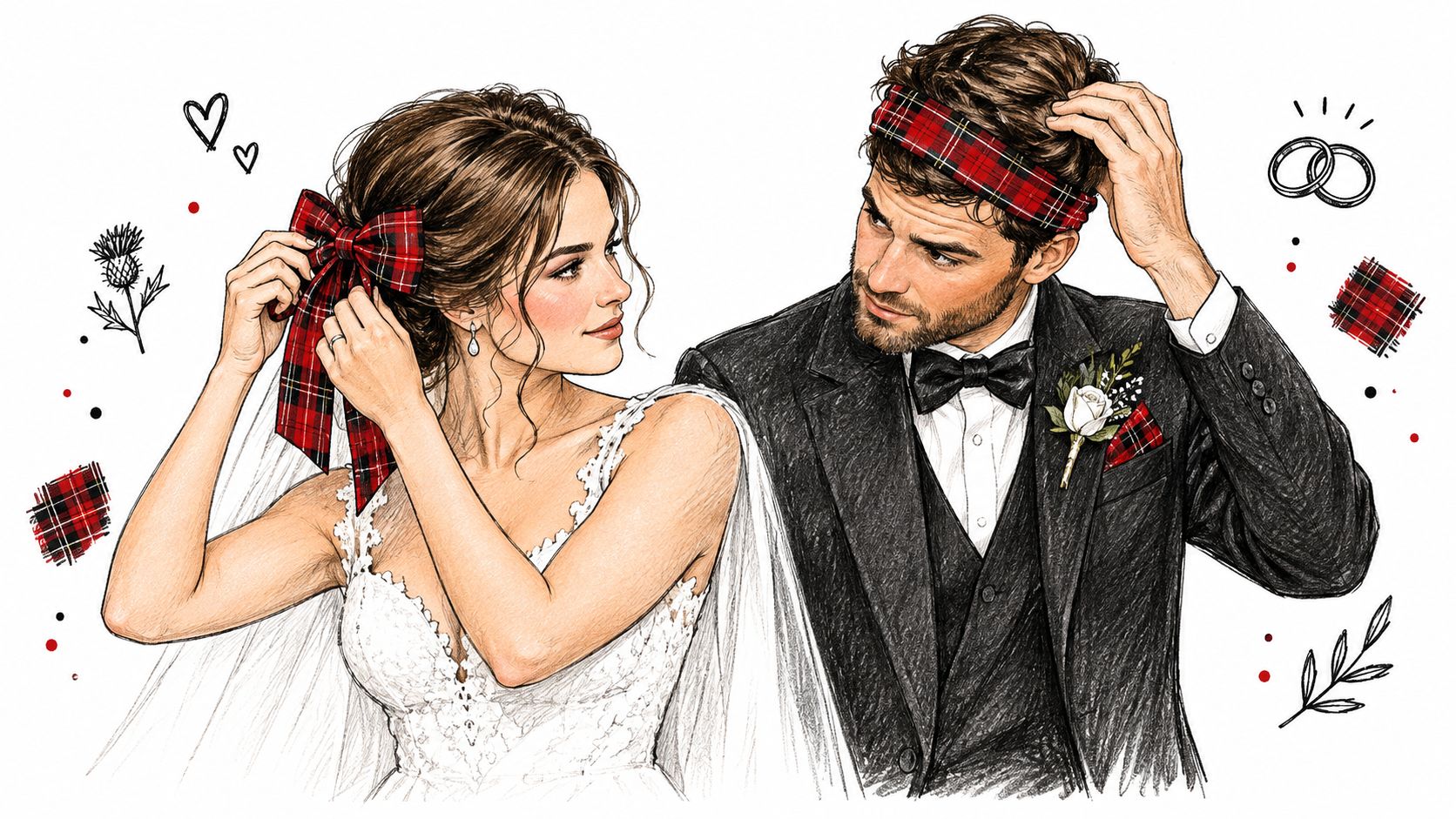
Tartan hair accessories have become a practical way to bring Scottish character into modern formalwear. A bride might wear a small tartan bow with a low chignon, while a guest chooses a discreet barrette that echoes a kilt without competing with it. Children can wear matching ribbons, and members of a wedding party can coordinate through the same tartan while choosing different shapes.
The best choice depends on more than colour. Hair texture, density, length, grip, tension, fabric weight, and weather all affect whether an accessory works. Fine hair may need a lined clip or a lighter bow, while thick or coily hair may need a stronger fastening that distributes pressure rather than pinching one section. A long outdoor ceremony also demands more from an accessory than a short indoor reception.
Practical rule: Choose the fastening first, then choose the tartan shape and colour.
Tartan accessories also deserve a more accurate cultural description. They're modern decorative applications of tartan, not evidence that bows, scrunchies, or headbands were standard ancient Highland hairwear. Their significance comes from tartan's documented movement from regional Highland clothing into wider British fashion, making these small pieces a natural fit for contemporary Scottish styling.
Treat your hair accessory as part of the outfit's construction, not as an afterthought. It should stay in place, feel comfortable after hours of wear, and survive careful reuse. If it meets those requirements, the tartan becomes more than decoration. It becomes a controlled, elegant detail that supports the whole look.
Tartan's place in hairwear makes more sense when you understand how the textile entered mainstream fashion. During the Georgian period, tartan moved beyond regional Highland tailoring into women's cloaks, gowns, and children's clothing. By the end of the eighteenth century, it was regarded as a desirable Scottish textile rather than only a practical Highland cloth, as recorded by the National Records of Scotland's history of tartan.
The transition wasn't politically neutral. Following the Jacobite defeat, Parliament's Act of Proscription restricted Highland dress, including tartan, from 1747 to 1782, a prohibition period of approximately 35 years according to National Records of Scotland. During the seventeenth century, Highland communities used tartans as signs of unity, while Jacobite supporters could be identified through Highland dress and white cockades.
The repeal of the restriction in 1782 allowed tartan to re-enter public life, but the nineteenth century gave it much wider visibility. The 1822 visit of King George IV to Scotland, together with Sir Walter Scott's influence, helped make tartan and Highland dress fashionable and widely recognisable. The royal spectacle turned a politically charged identity marker into a commercially desirable national symbol.
That sequence matters when you're choosing a tartan accessory for a formal event. A bow or headband doesn't claim to be a surviving piece of ancient Highland hairwear. Instead, it belongs to the later history of tartan as a decorative material used across clothing and dress accessories.
A tartan hair accessory can therefore sit comfortably beside a kilt, jacket, dress, or modern suit. If you're selecting a full outfit, compare the accessory with the tartan used in your Gordon tartan kilt rather than assuming that any red, green, or navy check will coordinate. Heritage works best when the pattern is intentional.
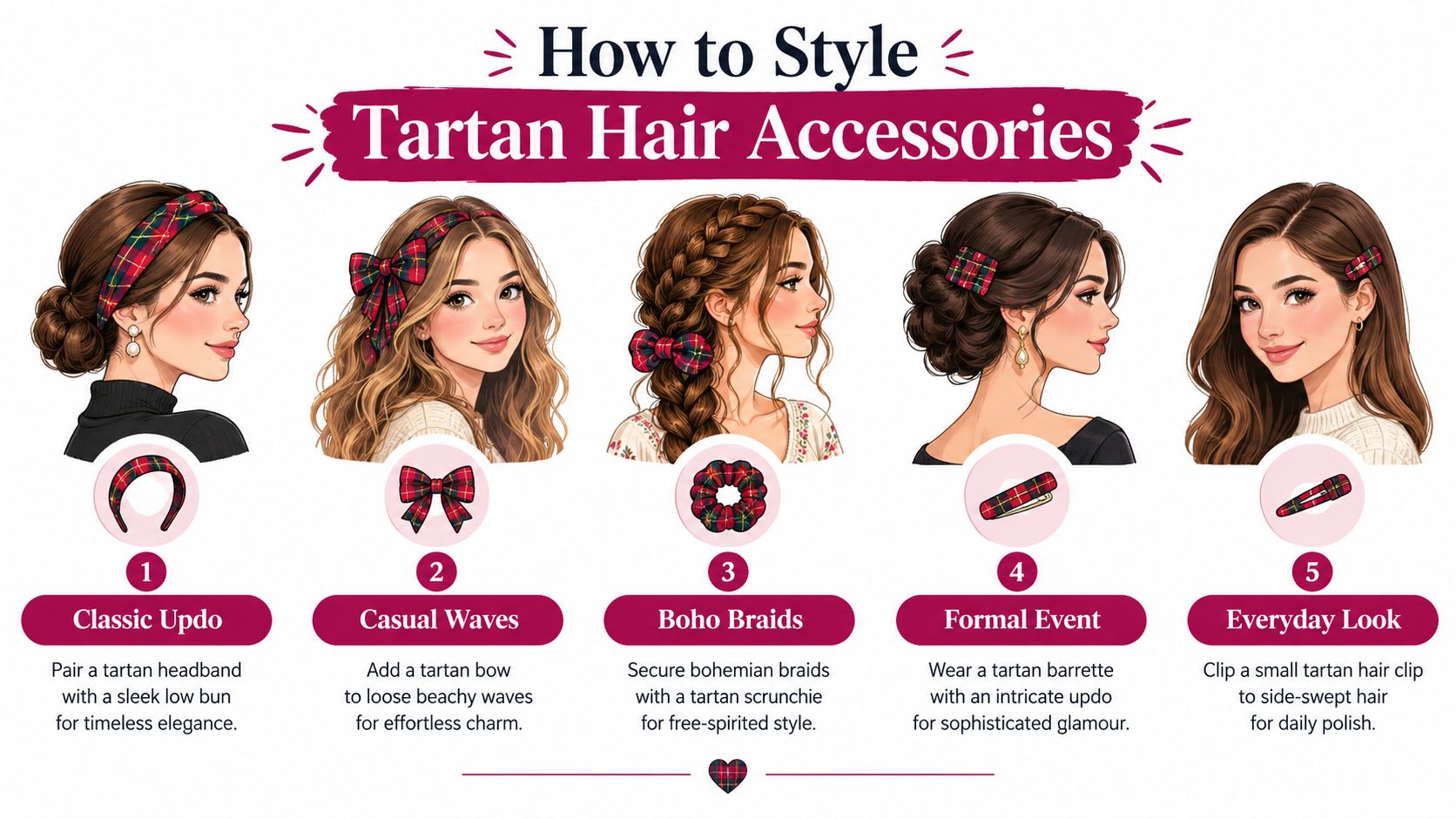
Different accessory types solve different problems. Start with the hairstyle, then consider how much control you need.
Tartan is defined by its sett geometry, not merely by a colour name. Woven warp and weft stripes intersect at right angles, and the sett records the sequence, width, and thread arrangement. A narrow strip cut from one part of the cloth can look noticeably different from another strip because the cut intersects the pivot and stripe sequence differently.
For a matched pair, specify the tartan design name or registration, fabric width, cut direction, finished dimensions, and whether the centre pivot should align. The textile research on tartan sett construction explains why repeat-aware cutting matters. It's particularly important for paired bows or a headband-and-scrunchie set.
Before buying specialist hair additions, consider whether your hairstyle needs extra volume, length, or anchoring. A resource on best hair extensions Sydney can help if you're comparing extension options, but don't use extensions to compensate for an accessory that is badly balanced. The fastening still has to suit your natural hair and the finished weight.
A stable seam allowance and reinforcement at attachment points also matter. Cutting through the balanced structure of woven fabric can leave edges vulnerable, so inspect stitching before an event. Attractive tartan is only half the job. The construction determines whether it remains attractive after repeated handling.
Formal styling should look deliberate, but it shouldn't force everyone into one hairstyle. The V&A Dundee's discussion of tartan presents the pattern as something adopted by diverse communities and identities, not only through conventional Highland dress. That makes a flexible approach more appropriate than insisting on one “correct” tartan look.
For a bride, a modest bow can sit at the base of a bun or secure the end of a braid. For a groom or guest, a headband may be suitable with longer hair, but it must be comfortable enough for extended wear. A barrette can give a similar visual accent with less contact around the head.
The most attractive accessory is the wrong choice if it causes pulling, slippage, or a headache.
Test the complete hairstyle before the event. Wear it while walking, sitting, turning your head, and moving your shoulders. For an outdoor wedding, test it in wind and light rain conditions where possible. For dancing, secure the accessory to the hairstyle instead of just placing it on top.
If the outfit already includes a strong tartan focal point, keep the hair piece restrained. A small matching detail usually looks more refined than several competing tartan accessories. Those coordinating with Highland headwear can also review practical options such as a plain Glengarry classic headwear choice, but the headwear and hair accessory should support one another rather than create visual clutter.
A tartan accessory lasts when you treat it as a textile item with attached hardware, not as disposable event decoration. Start by checking the fibre content and care instructions. Wool tartan, polyester, polyviscose, metal clips, elastic, adhesive, and packaging all respond differently to moisture, heat, and cleaning.
Avoid perfumes, hairspray, oils, and heated styling tools coming into direct contact with the tartan. Apply styling products first, let them settle, and attach the accessory afterwards. Heat can deform synthetic components, weaken adhesives, and alter the finish of some fabrics.
Maintenance rule: Repair a loose attachment before it becomes a lost accessory.
Sustainability also depends on use, not just fibre labels. A durable item worn repeatedly can be more sensible for your wardrobe than a fragile “natural” accessory discarded after one occasion. Mixed-material construction can be difficult to recycle, so consider whether the fabric can be reused, the clip can be replaced, or an undamaged piece can be donated.
For broader tartan coordination, the same care mindset applies to a men's tartan scarf. Keep accessories clean, dry, and stored properly, and they'll remain ready for future ceremonies instead of becoming single-use purchases.
Tartan hair accessories work best when they're selected with the same care as a kilt pin, sporran, or pair of brogues. The tartan should be intentional, the fastening should suit the wearer, and the construction should withstand the event. A beautiful bow that slips after the ceremony is a poor purchase, while a well-balanced clip that remains comfortable can become part of your formal wardrobe.
Their cultural value also deserves precision. Tartan hairwear belongs to tartan's later development as a fashionable and decorative textile, following its movement from Highland clothing into wider British dress. That history gives a modern accessory genuine context without requiring exaggerated claims about ancient hair traditions.
For weddings and ceremonies, choose quality over novelty. Match the sett where coordination matters, test the fastening with the actual hairstyle, and consider whether the wearer will be outdoors, dancing, travelling, or wearing the accessory for several hours. Don't make comfort an afterthought, especially for children, people with sensory sensitivities, or anyone with hair that doesn't behave like a standard salon model.
The strongest tartan styling is inclusive and practical. A bride can wear a restrained bow, a groom can choose a comfortable headband, and guests can use clips or ribbons that reflect Scottish heritage without copying a formal Highland outfit. The pattern provides the connection, while the fit and maintenance determine whether the result feels polished.
Invest in an accessory that can be worn again, repaired when necessary, and stored without losing its shape. That approach respects both the textile and the occasion. Tartan should add confidence to your outfit, not give you another problem to solve halfway through the day.
Kilts4Less offers tartan accessories and complete Highlandwear for weddings, ceremonies, and cultural events, with made-to-measure, off-the-peg, hire, and practical purchasing options. Visit Kilts4Less to coordinate your tartan details with a properly fitted kilt outfit and choose pieces designed for real events, not just photographs.

Kilts4Less is Scotland’s best bespoke, handmade kilt and highlandwear company since 1983.
Specialists in made-to-order handmade kilts, kilt jackets, sporrans & also Scottish, Irish / American Tartan Hybrids. Don’t settle for cheap alternatives – Buy Online at Kilts4Less – sale is now on!
Easy 30 days returns
30 days money back guarantee
100% Secure Checkout
PayPal / MasterCard / Visa